Author Archives: helldriver

I Heart Goatwhore


Photograph by Stephanie Cabral (www.stephaniecabral.com)

Photograph by Stephanie Cabral (www.stephaniecabral.com)

Dear Goatwhore,

I love you.

I’ve loved you since I first clapped eyes and ears on you more than a year ago, at St. Vitus. Remember? Of course you do. You followed Three Inches of Blood. I was at the back of the club, watching Louis B., waist-length hair matted to his back and shoulders, harvest the unfortunate souls lined up in front of the stage. The venom, oh God! the absolute fucking venom that came out of that man’s mouth. Sammy’s, too, when it was his turn, holding his axe like the reaper his scythe.

I could have written you then. Or after that trip across Jersey a few months later, when I popped Carving Out the Eyes of God into the disc-changer, and my Toyota Corolla became a chariot of bones drawn by War-Death-Famine-Pestilence, razor hoofs all aflame, hurtling the bodies of the dead, and me behind the wheel screaming, “Eat your heart out, Judah Ben-Hur!”

But it was only after seeing you again this spring, on Easter, that I worked up the nerve to write you. I love that you came north for Easter, like a plague. (Never mind that you didn’t know it from Christmas, birth from resurrection, the nativity from the zombie-Christ.) And who was I to go a-courtin’ Satan, on Easter, of all days? But there I was, at St. Vitus, writing my St. Valentine’s to you in my head. I have made a habit of such trysts on the days of saints and martyrs, call me perverse! There wasn’t a spot of white in the whole club but that which made a word, a skull, an inverted cross, yes, St. Vitus himself was attired in black, and I just another spot—so how could you have noticed me? I was sick as a dog, too, of body, mind you, not of heart. But there I was, listening, watching.

Writing. Hence this missive, this confession.

Are you as promiscuous as your name, Goatwhore? I hope I’m not being too forward. I think you are. Just listen to that guitar! Rutting away, utterly abandoned to the flesh. I can’t think of a raunchier guitar sound in metal. (And that gatefold-cum-centerfold of you on A Haunting Curse: pin-up goat-girl, exquisite corpse!)

But raunchy’s not the half of it. No, you open it up, too—and not just those minor thirds in strummed tremolo, no, I’m talking about the way you let minor seconds in your riffs yang against each other (e.g., “Alchemy of the Black Sun Cult”), and even more, the way you’re not afraid to arpeggiate with heavy distortion, sometimes against a double-bass kick (yes, I’m thinking of “Carving,” and also “In Legions, I Am Wars of Wrath”). So many of your brothers and sisters forget what distortion imperfect can do. When you let those neighboring notes grate, those unhappy intervals sing, those filthy colors show—when you open up your blacken’d heart in this way—you impose upon me an eerie seduction.

But then you tease me, Goatwhore, and most mercilessly at that, one moment hissing in my ear, the next butting me with those proud horns. I’m an Ares—not quite a Capricorn, but I do know horns. From blast beats quick as a cook’s knife on a hibachi grill (sorry, but have you ever looked into the eyes of the children of the family gathered at the other end of the hibachi, watching the knife, the flames?), to incantatory triplets, to motoring four-square, to galloping warhorse, all with nary an “ugh” between—albeit a deep, bleeding “ugh” when it appears, as if to cast off all that had come before, like the residue of the unholy syllables you let fester on your tongue  … The words, yes, above all, the words! I knew from the moment I read your titles, many five or six words apiece, some as long as eight, songs that blast by sometimes in three minutes, stuffed full of words … at last, I thought, here is one who suffers possession like I do. We are possessed, you and I, by language, the rush when the words take control, overmaster us, pour out of us like from a cut vein. Even DCLXVI is a word, and unpronounceable as the name of God. Is not language the true father of lies? It is language that controls us, and this god admits of no repentance.

Oh, I know you build your motor out of parts from old Slayer, and Vio-lence, &c.—really, what is “Apocalyptic Havoc” but a slowed-down, re-tooled “Silent Scream”—but I wouldn’t dream of holding it against you. The way you polish it, and tune it, the love you clearly put into it, it hums like new. It is new. You’re traditional, but never holier-than-thou. I don’t hear irony, or a penchant for putting riffs in quotes; you’re the furthest thing from a revival band, and hallelujah for that. You play metal because you play metal, because you &c., period.

And yet, you play American black metal, or “blackened death metal,” as the internet has it. That has a fine Cajun ring to it. I hear elements of the great Scandinavians in your sound, of course, but none of that “in my kingdom cold” shit, no, the devil’s alive and well in rank, inscrutable, pestilential Louisana. Adders and alligators and who knows what crypto-beasties; squat, atavistic trees with branches like tentacles, draped in sacerdotal vines; the sucking death of the swamps themselves; the play of masks and travesty of our only American carnival; the voodoo and bloody crosses and sacked tombs, their gates creaking in the wind … and all this not even to mention (at least directly) the tortured, howling revenants of slavery … there’s dark, dark magic down there, all of us up here are sure of it, legacy and ambience enough to provision an army of ghouls.

Dear Goatwhore: come north again. Soon. We’ll go carving out the eyes of God together. And perhaps afterwards, in the wee hours, I’ll even try curing you of that medieval hangover called religion, but without any hair of the dog this time, even as we bathe together in the charnel waters of oblivion.

Smitten,

Helldriver

Rails

IMG_0054Look at these beauts. Their fine metal livery polished, a bevy of butlers awaiting your handful of change to connect you with anywhere in the world for four solid minutes.

The nuclear family: junior on the far left, his mostly-grown sister beside him. Mother has to wear heels just to look her in the eye.

The urinals in the men’s room: all but one at standard hip height, the last at the level of your knees. (Ah, Democracy! Who says that Capital has throttled thee?)

Here is the most remarkable thing: they work. Not just hung on the wall to be admired. No sir.

Why? Why? Why the working phones, the gleaming metal?

Because you are in Grand Central Station, and Grand Central is supposed to evoke the New York of another time. Saved by landmark status, Grand Central is at once impressively functional and a museum of itself. Although the design dates from the early part of last century, to most visitors the station probably evokes a slightly later New York: the fast-talking, highball-downing, fedora-and-trenchcoat-wearing ‘40s. The classic photo, where light streams in through cathedral-tall windows, and the little people with long shadows make their halting, hunched way toward the gates. The eternal soundtrack of the City, bebop.

When you step inside Grand Central, you partake of the myth of Grand Central, and the myth of New York, and everything around you needs to be interpreted with this in mind. Tourists will stare at you like you are part of the diorama. But everyone in Grand Central is both inside and outside the diorama, at once exhibit and patron.

Like the rest of the station, the payphones serve the two masters on whose marriage Grand Central prides itself: function and ornament. But the payphones are unique in that their functionality fulfills their status as ornaments. If they were not required as ornaments—part of the Grand Central museum, the myth-projection of another New York—they would be allowed to perish, as everywhere else in the City. For what would Grand Central, the culmination and glory and celebration of the golden age of rail travel, be, without payphones?

Commuter rail may be alive and well, but trains—like payphones—are objects of nostalgia. Behemoths are always pitiable in their defeat: Kong swaying from the cupola of the Empire State Building, Godzilla’s denuded skeleton sinking in the ocean.

Go ahead and leave that nickel for the homeless man shuffling by, sticking his well-practiced finger in each coin-return slot. Like the bit of crop the Bible says you’re supposed to leave the beggar. Or the traveler.

As long as Grand Central is here—that is, as long as there is any value in trussing up the past and decorating it with a FOR SALE sign—I know I can depend on these phones. And they will always be polished, because they are the mirrors into which we look in order to see the New York of our dreams.

Of Plagues and Antibodies

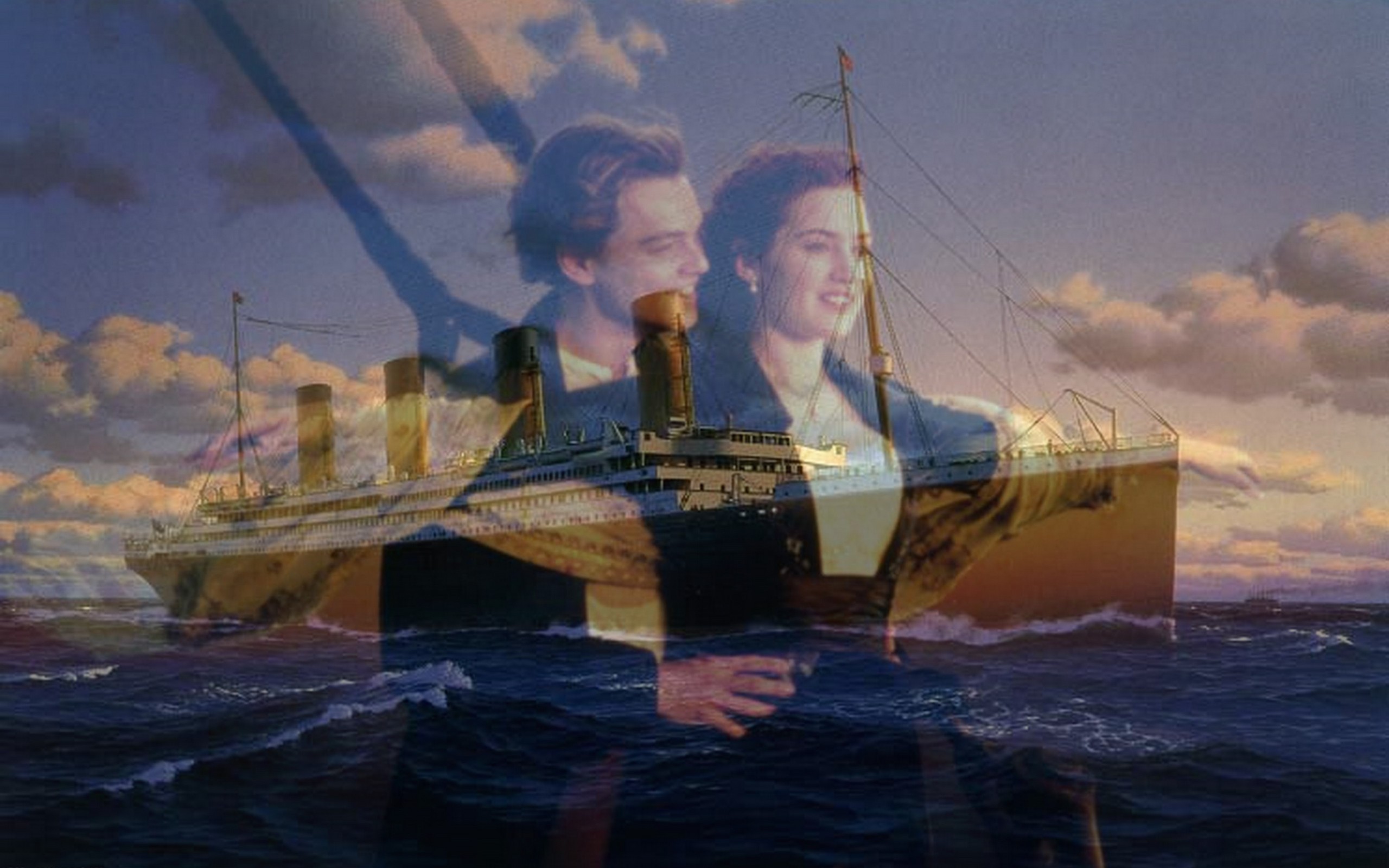
titanicIf someone were to ask me, “Helldriver, what is the most maudlin sound in the world?” the Conan sitting Indian-style in my brain would answer, in the thick Austro-Bavarian accent of a future governor of California, “The most maudlin sound in the world is that of a Chinese immigrant playing ‘My Heart Will Go On (Love Theme from Titanic)’ on an amplified tremolo harmonica against a karaoke backbeat, on a subway platform in Harlem.”

And lo, there he sits, feet crossed at the ankles, PA on a dolly, wringing out chorus after chorus with Dion-like fervor. If you live in New York, or maybe any major city, you’ve no doubt heard this song played on a host of different “world” instruments, all vying to out-schmaltz that dreadful penny whistle on the original. As melodies are memes, and memes are viruses, so this one is the plague among plagues of melodies. No cultural mountain is high enough, no lost tribe lost enough, to be safe.

God help us, is there a vaccine?

Waiting for the 4 train, I open my copy of Angela Carter’s The Bloody Chamber to the page where I have stopped, and read the following: “The Countess wants fresh meat. When she was a little girl she was like a fox and contented herself entirely with baby rabbits that squeaked piteously as she bit into their necks with a nauseated voluptuousness, with voles and field mice that palpitated for a bare moment between her embroideress’s fingers. But now she is a woman, she must have men. If you stop too long beside the giggling fountain, you will be led by the hand to the Countess’s larder.”

Carter! Hear how she bites the throbbing vein of sentiment, nourishing herself on its blood while Celine Dion squeaks piteously. She is the proverbial iceberg in that hyperinflated dinghy’s path. If My Heart Will Go On is music at the service of a children’s story, The Bloody Chamber is a collection of children’s stories at the service of—at the mercy of—Carter’s grotesquely seductive voice.

In Carter’s version, I imagine Winslet hacking off DiCaprio’s hands with a hatchet as he tries to climb from the icy waters into her lifeboat. She takes the one that still clings to the gunwale and hides it under her dress. Back in New York, she masturbates relentlessly with the severed hand of her dead lover.

The 4 arrives. I am boarding the train, giggling to myself—the image of Kate Winslet masturbating with Leonardo DiCaprio’s severed hand is irresistible—when the song modulates up one step in that de rigeur pop apotheosis … just when I thought he had wrung every last drop of sentiment out of the melody. Oh, Angela! Quick! The hatchet!

On the train, a Guatemalan man begs money for his sick daughter in Guatemala City. He has a picture of his daughter in one hand and his hospital ID in the other. He tells his sad story first in English, then in Spanish. While he is talking, I dip into Carter again, read: “She loathes the food she eats; she would have liked to take the rabbits home with her, feed them on lettuce, pet them and make them a nest in her red-and-black chinoiserie escritoire, but hunger always ovecomes her. She sinks her teeth into the neck where an artery throbs with fear; she will drop the deflated skin from which she has extracted all nourishment with a small cry of both pain and disgust. And it is the same with the shepherd boys and gypsy lads.”

Perhaps he has no daughter. Perhaps he does, and she is not ill, but hungry. Who knows what parts of his well-practiced story are true? I read Carter. The Countess does not want to kill; she feels compelled to. She is as pitiful as the rabbits whose blood she sucks. Ill, hungry, she waits for that rational, virginal shepherd boy to arrive on his bicycle and break the spell. Like many of Carter’s stories, this one mobilizes the fairy-tale romance against itself, yet still maintains something of its original sentimental power. Carter, then, is the Countess, at once relishing and regretting the violence she must do.

I can sympathize with the Countess—the monster, the outsider—better than I can with the Guatemalan man’s daughter, an unknown figure suffering an unknown malady in a faraway hospital. Her father’s presence, the bits of evidence he holds in his hands, are less persuasive than Carter’s voice, before which I am as powerless as the Countess’s voles and rabbits. It is his story, most of all, that I guiltily resent. So overwrought, so manipulative. So Titanic.

Do they enable me to withdraw from a world of suffering, these lurid fantasies of incandescent beauty? Probably, but no more than Titanic would. In fact, far less. After all, The Bloody Chamber is a self-conscious antidote to the tawdry Titanic fantasies that undergird our society, where peasant boys die for love and the virtuous poor valiantly panhandle their way to health.

And yet, I don’t give a dime, and the ones who do, why, they were the very ones bathing happily in the melliflous stream of “My Heart Will Go On” on the subway platform.

*

Carter may be an antidote, but it is only temporary, and when I stop reading, the Titanic virus begins its insidious replication inside my brain cells. A couple of hours later, I find that I am manifestly ill, humming the melody to “My Heart Will Go On” around the office and between classes. Thankfully, there is another little antibody floating around inside me, waiting to be mobilized: through incessant repetition, I find that “My Heart Will Go On” resembles “The Great Gate of Kiev” in Mussorgsky’s Pictures at an Exhibition. The same opening interval, tentative or triumphant, evenly spaced across two measures; and then a four-note phrase that touches down again on the supertonic.*

The differences, however, are what make “Kiev” an effective antibody: it mimics Titanic only in order to scuttle it. The stepwise cascade of notes that ends the first part of the Titanic melody has none of the muscularity of “Kiev”’s 3-1-3. Dion has just blown her wad in an effusive leap, a full octave if you include the preparatory dip; now she turns tender, goes in for the snuggle (that 3-4-3 half-step nudge; another stepwise, descrescendo descent). “Kiev” mirrors a bit of the descent, but the effect (3-5-2-1-7-5) is of clanging cathedral bells, prefiguring the chimes at the piece’s end. “Heart” goes on to repeat the whole choral melody, which is really an embellishment of the verse; in pop, you have to come twice or people want their money back. “Kiev” repeats just the second phrase, then—counterintuitively, at least to my ear—jumps back to the opening four bars. (This jaggedness of phrasing is typical; Pictures’ well-known “Promenade” theme, with which “Kiev” is allied, is another example. In “Kiev,” the latter parts of this opening section will be reshuffled as the theme reappears.) But it is the last part of the opening section—the different use of IV, and another near-repetition before a more emphatic restatement of the opening bars—that most happily throws Winslet and DiCaprio overboard. Overall, rather than present us with the sinuous thread of an emotional narrative (boldly declared love followed by self-pitying longing), “Kiev” is static, ekphrastic, a music of sharply-angled phrases that boldly affirm and resonate with each other, as suits its purpose. (This is not to say the piece as a whole feels directionless; it builds through repetition and crescendo, like Bolero. As has been remarked, if it suggests any narrative, it is one of the traveler approaching the titular monument until it looms above him in all its sublime grandeur.) Titanic is confessional, personal; “Kiev” is ritualistic, cultural. It is marriage, not romance. Cuddling with the Gate is strictly verboten.

The similarities shouldn’t surprise us; romantic love and romantic nationalism are twinned emotions, and can be made to speak a similar language. I don’t mean to elide the difference made by instrumentation, or to understate its importance to “Kiev”’s effectiveness as an antibody: the heroic vehicle of the piano, or the brass in Ravel’s dramatic re-creation for orchestra, versus Dion’s heart-choked voice (or the penny whistle, or the tremolo harmonica).** What I find most fascinating, though, is the way the musical brain responds to melodic, rhythmic and structural affinities regardless of instrumentation and mood.

Anyway, thanks to Mussorgsky, before long I am marching around the office to a fanfare, a bloody Russian patriot.

*

With these two pieces I was able figure out why my brain toggled from one to the other. But who knows by what dark logic my inner ear moved between a Bach prelude and Nuclear Assault’s “Stranded in Hell” the other morning as I walked down 145th Street. Oh, the funny looks I have gotten from record-store clerks for bringing, say, Slayer’s Diabolus in Musica and John Coltrane’s Crescent together to the register, as if the latter would burn the former, like Lucas’s lost ark burns that swastika off the Nazi flag draped over the crate in which it is stowed. Or the Anthrax EP Armed and Dangerous with Oliver Nelson’s Blues and the Abstract Truth. But I am not the god of used record bins to say why I should have found these two in the same vinyl vein; nor can I say why bugs for Love Supreme-era Coltrane and ‘90s Slayer should have bitten me at the same moment. Maybe I need Slayer to clean the Jesus out of my system, and Coltrane to clean the Satan out, before either works his nails too deeply in. Or maybe all this is just a symptom of the true plague of the West: an abiding Manichaeism, crippling our aesthetic sense, blinding us from the fact that music is music; that Coltrane and Slayer, in their moments of inspiration, stand shoulder to shoulder, tugging at the same old rope around the heart.


* I am reading the song in E, not C# minor, despite the initial chord. I can’t hear the melody resolving any other way. The chord progression of “Heart” (C#m-B-A-B-C#m) is standard rock/folk fare (e.g., “All Along the Watchtower,” etc.), though there it is often i-VII-VI-VII-i. Here, all vi seems to be doing is substituting for the I in I-V-IV-V-I.

** James Horner, who wrote the eponymously battle-horny score for Aliens as well as the theme for Titanic, cannot be a stranger to Mussorgsky, and this makes it doubly tempting, though perhaps unfair, to hear Titanic as a degraded version of “Kiev.”

Two Quixotes

When I lived in the City, I used to spend my Friday afternoons tooling around the Village, working a well-worn route between used book and music stores, park benches and cafés. Generation Records, on Thompson a little north of Bleecker, was a frequent stop. One of the clerks there, with a badgery sort of face and most of his exposed flesh colorfully desecrated, was—likely still is—their resident metal expert, and now and then I would pick his brains about, say, a representative Wolves in the Throne Room album, or whether the new Deicide was available in an aerosol can.

One day I was in the basement flipping through discs toward the back of the alphabet, grinning at the relentlessly offensive names and cover art of bands and albums I would never hear. Said expert was playing something I thought I should recognize, but didn’t. I approached, inquired; he looked up and, eyes scourging me from under his tight-fitting commie-kitsch military cap, wordlessly stood a CD on the counter. It was Sepultura, Schizophrenia. Old Sepultura, clearly. Really old. And here I had thought Sepultura began with Beneath the Remains (1989). I was staring at a Sepultura album I didn’t know, Max Cavalera-era Sepultura, my Sepultura, proffered to me by someone who probably hadn’t yet been born when it came out.

Upstaged on my own turf by a coffee thug, I immediately wanted to talk about how I had seen Sepultura in their heyday, on the Arise (1991) tour, at a club in Madrid. About the posters I had seen around my Madrid neighborhood advertising the show: death squad on one end, Cavalera and his guitar on the other, facing them down, both cut out against a fire-orange background. About how I had tried to pull the poster down and hang it up in my apartment, but ended up tearing it.

I didn’t say anything.

Some months later I was in Baltimore visiting a friend, who related a somewhat similar experience to me. He works on an urban farm, and on weekends sells the produce in one or another of the city’s farmers’ markets. Who does he meet at one of these markets one weekend but a kid maybe half his age—a little older than his own son—who is enamored of ‘80s hardcore punk? We’re talking Dag Nasty, Minor Threat, 7 Seconds et al. My friend was a skinhead back in the day, was still wearing his burgundy Doc Martens when we met in college. (Keeping the hair short was easy: we were swimmers.) When he told this kid that he had been into all those bands, had been to all those shows, had a milk crate full of old hardcore records in his basement, he immediately became an oracle.

Or should have. As it turned out, the kid was reading a book on the history of hardcore, and knew a hell of a lot about the scene that my friend, who had participated in it half a lifetime ago, was not aware of, or had forgotten.

Result: my friend bought the book. He claims to have learned a great deal.

*

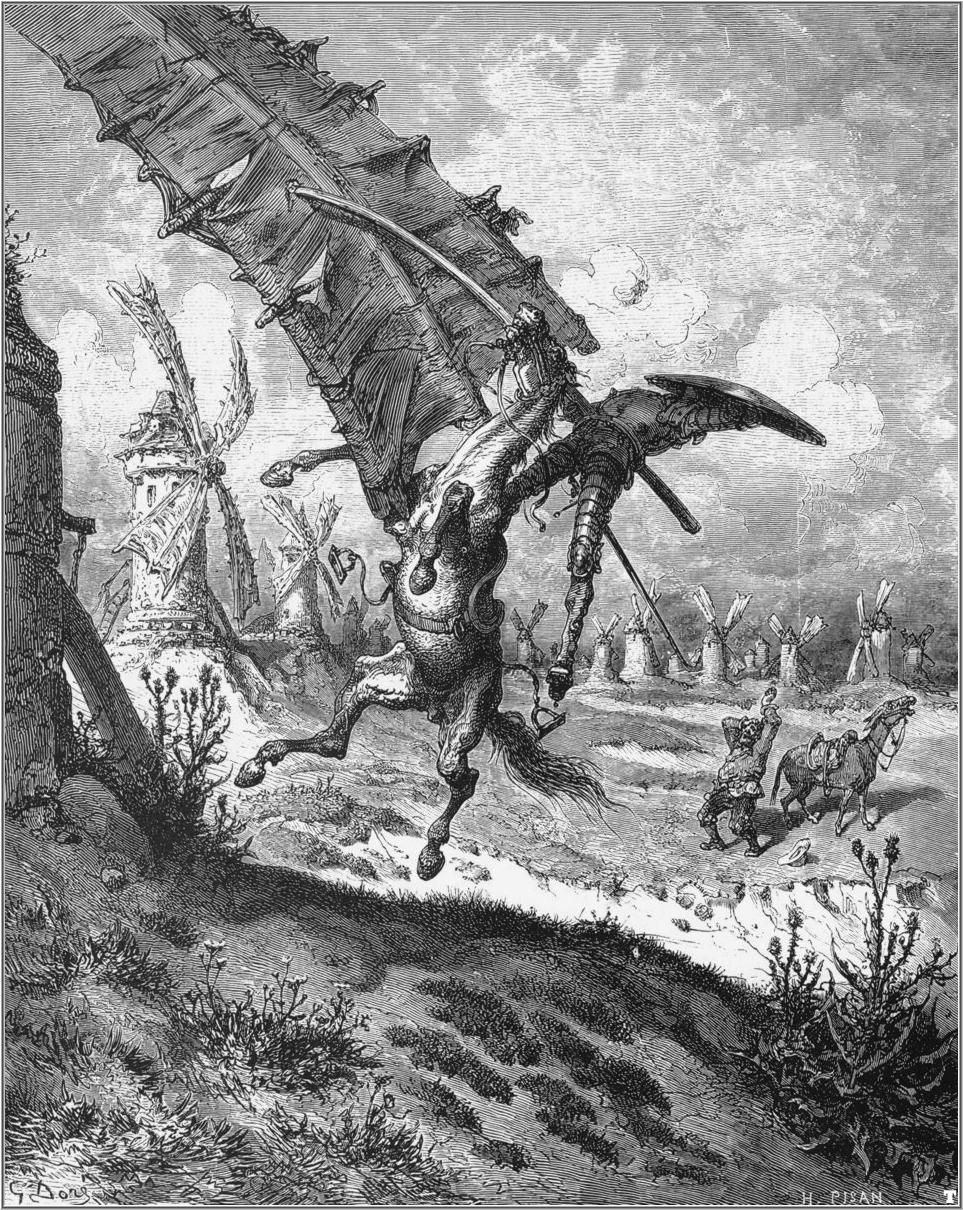
Don_Quixote_6In Book II of Don Quixote, the ingenious knight encounters a duke and dutchess who know of his exploits from having read his “history.” He is famous, and, as is due any knight, becomes the guest of honor at their castle … and the butt of endless jokes, a grand entertainment. He appears as a character walked out of a romance, into the real world of the present (la actualidad). So my friend must have appeared to that temporally-displaced version of himself: as a character from a moment in cultural history. To be viewed as a splinter of a dead scene’s true cross, a living, breathing historical artifact, like a thawed mammoth: it gives one a glow, an aura, for people who value that moment, but whose contact with it is purely textual.

But in that encounter between one-time participant and passionate historian, we—forgive the transition to the plural pronoun—become texts, signs. We are there to be read, not listened to; we do not speak, but are spoken. We are nothing more than that (faint) aura that surrounds us, exhausts us. Disposable saints, transparent as icons, the better for them to project their desire upon, venerated not in ourselves, but for allowing the worshipper to get nearer to God: that fantastic, unrecoverable past. Like Don Quixote, we are at once honored and ironized, empowered and neutered.

Bits of pottery without pattern, we can’t hope to represent our time. So-called living history is always a disappointment; flesh is no match for text. For they finally know more than we do: all our rare butterflies, the ephemera and esoterica, patiently netted and impaled. Suddenly, we are forced to recognize that our knowledge of our time is piecemeal at best, that we are inadequate historians of ourselves, that we are not masters of ourselves—that we are in fact mastered by their agglomerate, abstract vision, that sees us as part of a comprehensible totality, an island from the air, the earth from space. They can click through our whole history in seconds, and file it away on a chip. Our time, our history, our selves, stripped to bits of information, small enough for them to hold in their hands. What is lost to us is weirdly present to them, more present, yet only through the phantom agency of language.

They know much too much about what we were like to ever be us. How can they hope to be us when we knew so little about ourselves?

Conversely, what is present to me—the ambience, the outrage, the trace sensory impressions and other memories, emotions and stories, all knotted together into a sort of umbilical cord—is mine and mine alone. I can’t claim to know more, only differently. My knowledge, such as it is, is more in my muscles and blood than in my brain, is bonded by things non-textual, things that can be expressed only obliquely, when at all. Experience fuddles text, creates gaps, swells seemingly meaningless moments, hazes everything. When I reminisce with friends, we are not sharing information, but performing a ritual.

What can it mean to that clerk at Generation that I tore that Sepultura poster trying to pull it down? Yet the image on the poster, the weatherbeaten paper … I can still feel it, gritty from the dirt blown onto it while it was still wet, stiff and brittle as parchment.

We may listen to the same music, but we hear something entirely different. I don’t hear the Jimi Hendrix that, say, Germaine Greer did, and I wouldn’t recognize E.T.A. Hoffmann’s Beethoven if he pulled up beside me on the street, horn blaring. My Hendrix is out there, like the house seen from the piazza; the albums, the documentaries, the guy in Salt Lake who fixed my guitar and who saw Hendrix in ’68, are as close as I’ll ever get. I’ll never be able to strap myself to his Marshall cabinet, like to the mouth of a cannon, and experience the thrilling Liebestod of that opening chord. The left-handed general lowers his sword, Brrrang. Nor did my mother bring my infant self to Woodstock, like she did to the TV the night men landed on the moon. My love for him may be deep as the ocean, but my Hendrix is facts spinning around an absent center. Or at least, a different one.

Don Quixote is maybe too literary a figure to describe our experience. No one could be more loquacious, and his surprised interlocutors always comment on how his opinions are as judicious as his vision and actions are mad. In the event that I do speak, I feel more like one of those mechanical presidents on Disneyworld’s Main Street, who recite something sententious, patriotic, and very much in character about U.S. history. My mouth moves like a dummy’s, my eyes light up; when I am finished talking, I freeze again. They will get no more from me—everything else my body jealously guards—and no closer to the Thing Itself.

Half the time, the nickel gets stuck in my throat. Better to sit and wave, like an effigy on a parade float, and try to make my halo obvious as I pass by, and perform gestures as though to bless them.

The genius of the second volume of the Quixote—a genius which far surpasses the first—is in its transformation of the world into text: the duke and dutchess participate in writing the second volume, make themselves characters in Don Quixote’s legend. The madness of the knight transforms the world, which is revealed to be just as much fantasy and theater. So forgive us, young lovers of ‘80s metal and hardcore punk, if, in our roles as characters in your drama, we end up textualizing you as well. The book is reading you even as you read it. You are just as much a ghost. Your costume of me is a little baggy; you don’t quite fit my scene’s drama.

And yet, that is the only way I have myself: textually. I can’t resurrect myself as the monster I was, and were I to try, I would be no less baggy than you. And perhaps I’m gratified to see myself refracted in people half my age, listening to the music that that mythical we did. Amused, moved, the way we are by Don Quixote.

We’re not tilting at windmills, my friend and I. We’ve never tried to live in a mythical past, or to re-live our own. They are at least as much Quixotes as we are: driven mad by electronic libraries infinitely vaster than the knight’s, and by a text, music, infinitely more seductive than the epic of Amadis de Gaula. Because it convinces us, somehow, that it is more than text, that it captures an essence, that it bores a hole in time. That through it, and only through it, I, and my friend, and the clerk at Generation, and the young man at the farmers’ market, touch. What can we, the duke and the dutchess, do but play along?

For RJD

Traces

Near the start of his perfect little book about New York, Colson Whitehead writes the following: “You are a New Yorker the first time you say, That used to be Munsey’s, or That used to be the Tic Toc Lounge” (3).* Here, Whitehead captures not only the way one’s sense of place is constructed through feelings of nostalgia and loss, but also the City’s pace of change and its relentless assimilation of newcomers.

*

IMG_0056


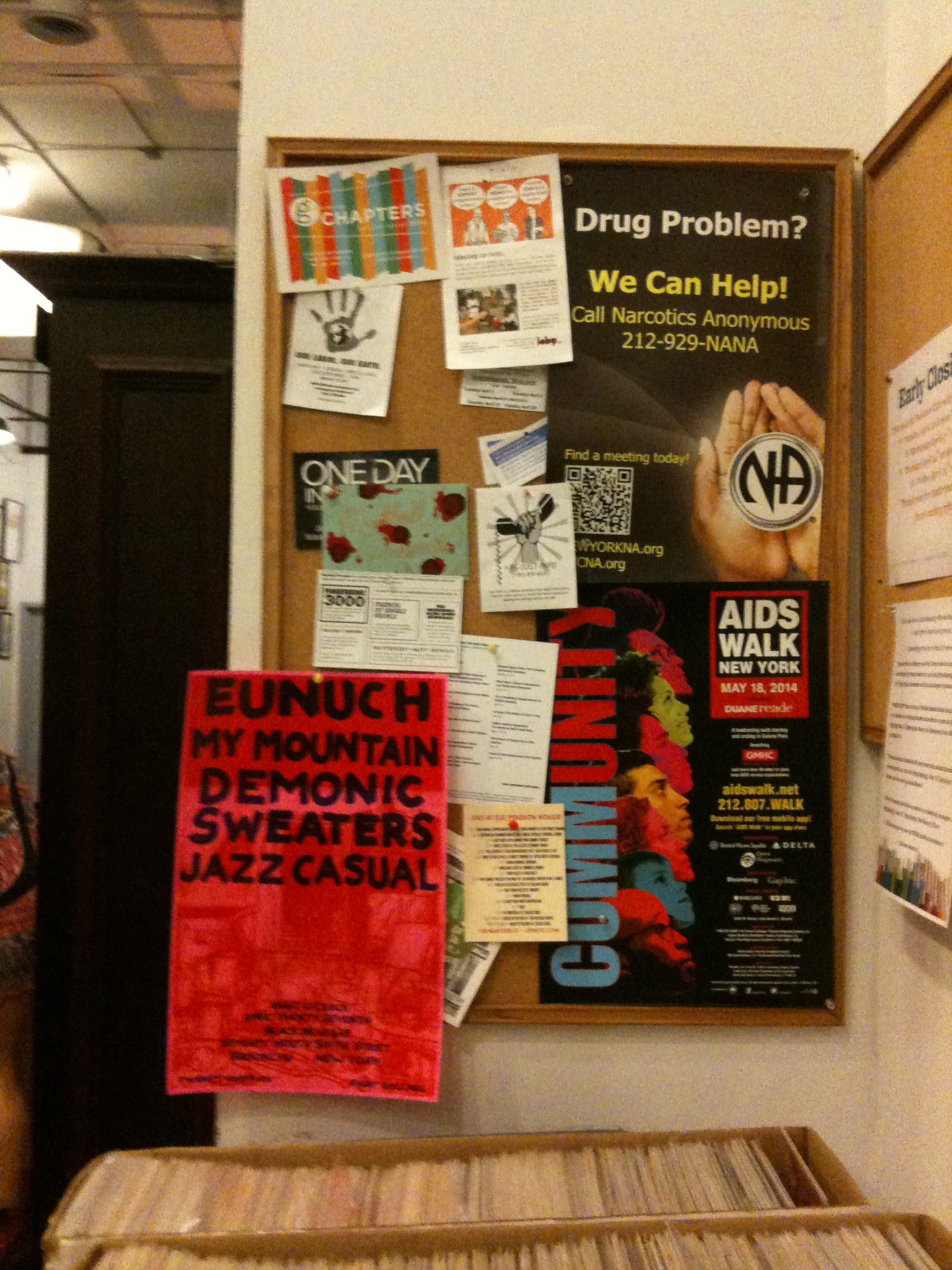
This is the bulletin board inside the Housing Works Used Bookstore Café. It used to be a payphone.

I discovered the UBC in 1997, when I worked in Tribeca. I would get off work and walk up to the Village or to midtown, and then grab a train home to Astoria. I would walk a different way every day, charting the uncharted far east and west sides. Our mental maps of the City tend to be full of blank spaces between subway stops, like those unstudied, unloved swathes of time between the periods we all read about in history classes. Biking and walking force us to account for the what happens in the spaces between the patches of the known. We come to understand much better how the City relates to itself.

I can barely remember what the old UBC looked like, back when my partner used to volunteer there, before they punched out the back wall and created that whole sitting area in the rear.

But I remember that payphone. I’m sure it was there until quite recently. The other day, I asked the volunteer at the cashier, and she claimed not to remember. Why would she? Then she humored me by saying she had a vague recollection. We constructed a whole story together around that absent payphone, like police entrapping some would-be serial killer: And then you cut the body up with a saw, right? And then you buried it in the sandbox in your neighbor’s yard, right? Yes, that’s where it was, sir. Where the bulletin board is now. I’m sure of it. How many kooks does she have to humor in this way every day? But then they are all do-gooders here, and this madness for absent payphones is harmless, mostly.

IMG_0049

IMG_0050


These are the trash and recycling receptacles at the Harlem 125th Street station of Metro North. Isn’t their blue newness ravishing? They used to be payphones, too. A whole bank of ‘em, at least four. Six? Possibly my nostalgia multiplies them. Not a single one of them worked. One day when I missed my train, I tried to use every phone, and every one was defective in its own special way. When I got to the last phone, and it ate my last dearly-collected dollar of quarters, I went apeshit, beat the receiver against the cradle, and left it hanging. Like Robert DeNiro does in Goodfellas when he finds out Joe Pesci got whacked. (Something about phone receivers makes them particularly well-suited to beating: snug grip, concealable-weapon size, hard plastic, all of the above?) I probably shouted “fuck,” too. Good thing there weren’t any cops around. Possibly they wouldn’t have blinked. Probably they see this sort of thing every day. The station is a hive for such mini-meltdowns. A place where high-strung commuters and the indigent mingle. The pathos of 125th Street, epic.

*

In Whitehead’s formulation: I reaffirm being a New Yorker when I say, There used to be a payphone at the Housing Works Used Bookstore Café, or, There used to be payphones at the Harlem 125th Street train station. For it is not just the first time that matters, but all the times thereafter: a ritual through which we construct and renew our sense of place and belonging. As for the payphone, it is more than a particular instance of a broader phenomenon, or an individual marker of identity, or a reference point for a number of individuals. It is representative of that vanishing City; it extends Colson’s idea from an “I” to a “we”: Here was New York, we might say, invoking E. B. White. It is through this collective act of nostalgia that we create and affirm that dream-City against which the present is measured. We might even expand Whitehead’s claim to the City as a whole: that New York became itself the moment it began to consume itself in order to become something newer, and reaffirms itself through its relentless change. Yes, this is true of every place; but it is truer of towns than villages, truer of cities than towns, and truer of New York than any other city. Partly it is a matter of size, partly age, and partly geography (e.g., New York can’t grow out, so it has to grow in, like a nail or hair).**


* The Colossus of New York: A City in Thirteen Parts. New York: Doubleday, 2003. This is a book that deserves to be on your shelf next to E. B. White’s Here Is New York. It is a perfect lyrical evocation of the City.

** Here as elsewhere on this blog, I have capitalized the word “City” to refer to New York. I do this not only to abbreviate New York City (the way we say “America” for “United States of America”), but to affirm that New York is the essence of city-ness, the ideal city, the city all other cities aspire to. If this has the same jingoistic ring that “America” has to, say, a South American (“We are all Americans,” my uncle, Argentinian, incensed, once said to me), it should.

Four Years in the Pit

Ah, work, work, work. Groan, expire, reanimate, groan again. The life of a property owner. Pools of blood to be drained and refilled, iron maidens to scour of clotted flesh, eternal fires to stoke and bellow, darkbulbs to change, visitors to mulch, dung to fling. The man-eating hogs have to be slopped, the man-eating cows milked, the coop of the man-eating chickens swept and aired, the seeds of the man-eating plants sown. The vile trees, each and all ceremoniously hugged.

And in the midst of all this spring cleaning, re-no-va-tion!

You’ve probably noticed the rotten plank I’ve laid across the mouth of my pit. Don’t worry—no gag this plank, the pit still sings. But about your fall: it may be inevitable, yes; but once the renovations are complete, my hope is that you will have a choice as to the barbed spikes on which you land. You may, that is, hurtle into one of two nether regions: the Realm of Noise, which contains all materials categorized under “What I’m Listening To”; or the Realm of Silence, which, inaugurated last month, will contain everything associated with The Payphone Project.

Needless to say, the work is dangerous, passers-by hardly protected, “accidents” common.

But how else to fill the pools?

I know what you’re thinking: “You complain about all the work you’ve been doing, but thus far in 2014 you’ve abandoned the pit. You eked out a March post by one day, and on an entirely new theme. What gives? Why have you forsaken us?” Aye, reader. Guilty as charged. I have been pulled hither and yon by one thing or another. A long project, pit-worthy, even pit-relevant, was sent screaming into the world in early March, though I had intended for it to be done by the beginning of the spring semester. Then there was the matter of promotion materials to prepare—what can I say, I’m tired of the first circle, I find the virtuous pagans dull guests and abysmal hosts, all they talk about is living-in-desire-without-hope. Blah, blah, blah. I think I’ve accomplished enough to get bumped down to the fourth, possibly fifth circle—I’d love to work with the wrathful and sullen, knocking them on the heads with a bean-pole while they gargle and stew. I’ve heard tell that a white whale lives in this circle, swimming round and round its Stygian perimeter, and of a man named Ahab (Ay-hab) staked screaming to it; and of one Ethan Brand, who wanders in a vast ellipse, returning as regularly as a comet, where the road to Dis is cobbled with the kiln-cooked hearts of unpardonable sin …

Meantime, my virtuous pagans can muster nothing better than an unpardonable belch. Then they laugh like donkeys. They pick their teeth, too.

And then there is the matter of my hearing, or not hearing (e.g., “Reflections of Orrin,” 10.6.13). This will become a post in itself, eventually, as there is much to be said about it—not to wallow, of course, lest I be hit with my own bean-pole. This doesn’t mean the Realm of Noise will go quiet, though the last few months might suggest as much; but the content will shift somewhat, as it had already started shifting last summer. Concert and set reviews will become more rare, and will probably focus on musical epiphenomena when they do appear. There will be more commentary on readings about music than about music itself. But that’s for the future future; there are at least a dozen posts at various stages of completion to finish and get up, including that ever-belated magnum opus on Domenico Scarlatti, which, with a little diligent work, may finally see the dark of pit this summer.

I can hear enough old music in my head to keep writing until the end of time.

So, as for the desert of the last few months, take heart: the pit is coming a-dead again. As anyone who has kept a blog knows, this blogging thing is not for the sprinter. I was a miler in college—that’s water, not land—so I get pacing, timing, splitting to within a few tenths of a second. And if I ever start to flag, I scroll through some recent posts on Tony’s Thoughts, admire the vastness of his archives, and put my shoulder to the wheel again. (I don’t know what the man eats, but it clearly has fiber, and vitamins to boot.)

As I have contributed less in the last several months, so I’ve surfed the Commons less as well—much to my regret, as the Commons continues to grow, and its musical offerings have expanded. Doing my year-end review provides an excuse to catch up (and spring break gives me a smidge of time to do so). The GC Music Program Community Portal is a go-to site—and when you do go-to, make sure to have a calendar handy, as you will find lectures and conferences and concerts, oh my, more than enough to addle the brain and sully the ear of the most committed CUNY musicophile. Maybe even more exciting is the nascent spinoff Open Music History Project, now in its prodigious infancy, and seeking contributors. Helldriver, whose corpse putrefies before the collective knowledge of CUNY’s music scholars, can never aspire to be more than a reader. But readers have their demands. Let him down, dear scholars, and it will be your flesh he scours from the iron maiden next spring.

Have you seen Dean Reynolds’s series of posts about winter Jazz Fest? A hearty kudos to Dean for busting his hump to finish out those posts with the semester full-on—trust me, I know how hard it is to juggle—and for the insightful comments about the music, musicians, crowds, and venues. I look forward to catching more as he catches more live music in NYC. Besides Reynolds, there are two other ethnomusicology grad-student bloggers, one a writing fellow at Baruch and a horn-player for the Rude Mechanical Orchestra—yes, the groove that has kept your spirit and mine up at any number of protests—the other interrogating the “ethno” in ethnomusicology, among other things, at the wonderful Mu-sing-ing blog (love the story behind the name). A fourth grad student, in theory (not the student; the subject), has posted a series of papers that fly swallow-high over my head. Rounding it all out is the Sonic Cinema course blog, where enrollees post their pre-presentation thoughts on noise and information. Attali’s Noise beckon from my bookshelf. All in all, music writing of all stripes is flourishing on the Commons, making this reader feel at once warm, fuzzy, humbled, and well-fed.

Ach, Helldriver. The least you could do is provide url’s for the above. You could turn them into links, so that people can click on them and be taken to the blogs you mention, and so really do your bit for the Commons community. Your text is a stony, linkless soil. True, vile reader, true. But then I have an argument about hypertext, a perfectly self-serving, self-justifying argument. It goes like this: I am reading on the internet. The paragraph I am reading contains several underlined words or phrases to signify they will link me to another page by clicking on them. They are like whirlpools; my eye is drawn to them, sucked down into them; my finger automatically wanders to the mouse or link, clicks. What becomes of the surrounding text? A channel, a funnel to draw me toward the hypertext, and no more; when I click again, I will no doubt find more hypertext, and so on, and so on. Results: Death of the materiality of the sign. Destruction of the living texture of language. Conditioning to not see the signifier, to move past it rather than examine it, listen to it, celebrate its materiality. We might not call it reading at all: an eye that glides and pokes without ever really looking, a mind that wanders without ever really thinking. Hence my cri de coeur: no hypertext, never, not in the pit, no.*

Well, okay. Here you are: helldriver. Go ahead, click on it. It didn’t work, did it? Frustrated? Try again. Click harder, like you’re speaking to a foreigner as though he were deaf. C’mon, push your finger into the screen—beat that mouse! Working? No? Ha! Ha! Take that, internet! Take that, virtual world!


* And then the specious argument—which I think is passé at this point, since hypertext fiction died the ignoble death it deserved—that such texts allowed the reader to exercise creative authority. Please. It was never anything more than a more sophisticated form of manipulation. Sophisticated is maybe the wrong word; in hindsight, it appears quite crass and mechanical. My understanding is that these texts died in part because of the rise of actually collaborative, evolving texts, such as on Wikipedia and social media sites. This seems logical, and begs a bit more discussion. In The Pleasure of the Text, Barthes writes about the way a reader’s eye and mind dip in and out of a text, skipping here and there, though never the same bits twice (hence the pleasure of re-reading). Does hypertext create a particular “grain,” to (mis)appropriate Barthes’s term, in internet reading? Or is it rather a break, one that yanks the reader entirely out of the text? It depends, I guess, on how we define and limit the text: by author, or by reader. In a sense, the reader’s text is a newly-collaborative text created via the circuitous routes of his or her desire. This is marginally more creative than the hypertext fantasies of the ‘90s, since, although the reader doesn’t really contribute, his or her maze is still collectively assembled, and the reader-writer line is culturally more fungible. Anyway. When Helldriver feels snubbed, he writes things like the above.

The Ferry & The Bulldozer

The purpose of this project is to ferry the payphone into an afterlife of image and word before it disappears like a tribe without a written language under the bulldozer of modernity.*

What Kerouac said about the sadness of bus-station floors applies equally well to payphones. Their stoicism, their patient, heroic suffering, what we associate with saints, these are the things that make them beautiful. I imagine them as aged Broadway matrons, albums full of clippings clasped to their bosoms, waiting on the corners for someone to remember them. (I am their Billy Wilder; I have come to give them their close-up.) Or as worm-eaten prostitutes, caressed as smooth as driftwood, cast up onto the streets where they used to solicit, petrified there. Or abandoned dogs tied to lampposts, waiting for their master, any master, to come with kind word, let them drink from cupped hands. Or protestors, trapped in a generations-long act of civil disobedience; when the workers come to carry them away, the steel will suddenly turn to rubber. Or the Greeks at Thermopylae, making a last stand against the invincible future. In all these ways, they speak to every New Yorker, whose identity depends on the fantasy of living in that older, greater New York that directly preceded his or her arrival.

Lift the receiver; not even a dial tone. But isn’t the gnawed plastic still warm from the last hand that touched it, a hand just like yours? Why do you stick your finger where a thousand other fingers have been, noodling around in there for some stray nickel like a loose tooth? And what about the beer bottles and take-out containers they wear like uneasy crowns? The smell of urine, the fingerprints of a runaway, the old calling card left by a tourist rearranging the contents of his wallet, the used condom in a mound of soiled snow, the empty baggie, the stickers and graffiti—all the traces of those who have taken advantage of a moment’s shelter underneath that metal wimple …

And the stories, of course. Millions of them. Payphones like open-air confessionals. No acts of contrition required.

Have you never told your stories to the dead silence of a broken payphone? Try it. Go ahead. Lift the receiver, cradle it on your shoulder. Listen to the silence that, unlike the silence around you, assumes the shape of a void. The wire goes nowhere and everywhere, is connected to nothing and everything, as relatively primitive as the cup-and-string you played with as a child. There, you’re a child again. Go ahead. Whisper your deepest secrets. Your most obscure and embarrassing fantasies. The names of your secret loves. Hexes against those who caused you pain. The names of people you believe you could kill … or at least whose absence from the world would help tilt its moral ledger a hair nearer the black. Who knows but that somewhere in that gizzard full of coins, many of which are older than you, some fabulous organ hasn’t captured every word everyone has ever said there? If just one payphone could be coaxed out of its decades-long silence, ah, what sordid marvels …

Beautiful, too, that no one sees them anymore. But then part of the purpose of this project is to make us start seeing payphones, as the sticker on the bumpers of cars driven by motorcycle enthusiasts urges, and to say that, by paying attention to payphones, we are seeing the vestiges of a city that is daily more easy to ignore. The phone is a figure for this superannuated city, for vanishing public/collective space, for the people thrust from consciousness. Forgotten city, diminished city, residue-of-a-city. For a city depends on public space and public personhood in order to be a city; without these, it is something else—call it what you like—but it is not—it is not a city.

The ostensible replacement for the payphone—I mean the cell—is not a city-friendly technology. “Cell” better describes the person than the technology: each his or her own closed entity, milling about in proximity to but divided from every other. Of course, this is not a bad description of the pre-cell city, and one could argue that the cell consummates the city even as it dissolves it, that the cell simply further exacerbates the alienation that has been one consequence of technology, at once joining us and transforming our relationships and interactions. To argue that the cell represents some break with the past is thus to participate in a cell-induced myopia.

But then this is precisely what I am arguing: that the cell doesn’t simply exacerbate, but rather creates a whole new set of conditions for this alienation. For what the payphone could never do was really make us believe that we had “reach[ed] out and touch[ed] someone”—that is, give us a convincing illusion of wholeness. Historically, the city drew people with the fantasy of an achievable wholeness, which began by making them recognize, or imagine, their own lack thereof. What people found when they arrived was never that promised wholeness, but a desire that, in the multiple channels available for its fulfillment, sometimes masqueraded as wholeness … or at least enabled them to forget, for a time, what (or rather that) they lacked. The important thing was the awakening and cultivating of that desire. In the city you could have it all, or die trying; one day mouthing at the ineffable, unable to bite down; the next waking up in an alley, at the bottom of a river, on an out-of-service train. The payphone was never more than a go-between, a pulse on a wire: the tryst, the trick, the shady deal, the drop-off, the fugitive on the lam. If you went to the payphone to call home, it was only to be reminded of what you had lost, what you could never go back to. The payphone spoke the desire to connect, the endless deferral of that connection, and the palpability of loss.

The cell trades on a similar fantasy, but addreses it differently. On our fabulous little pocket phalluses people appear like djinns from lamps. There is no reason to reach out and touch someone; they are all right here, in our pockets, or in our hands. (More often than not in our hands. Pockets have a way of making you feel alone.) We smile and coo at our little screen-mirrors, wandering about holding them before us like divining rods to ourselves, blocking the tops of subway stairs, narrowly avoiding collisions with others just like us in our eagerness to be nowhere.

The payphone could never provide such gratification, not just because the voice was never present—it always somehow evoked its own absence—but because we could never take it with us. If the payphone is tenuous bridge and deferred fulfillment, the cell is unreal fulfillment. The payphone retains the material object but defers it; the cell phone dematerializes the object and presents a fantasy of it. With the payphone, the other is substantial but unknowable; with the cell, insubstantial and knowable, or rather, knowable because insubstantial. With the payphone we reach out and “touch” someone; in cell space, the idea of reaching out (and touching) holds no meaning. With the payphone the City cradles us in its maw; with the cell phone, the city fits in our palms. The cell replaces the city, making it into a single, fantastic un-city. Unlike the public phone, the cell has no inside; it is pure surface; images adhere to it without passing through. Disembodied others drift endlessly over our surface like projections on a bubble.

Objection: people use cell phones for finding other actual people more efficiently and fluidly than payphones allowed—say, at a protest to defend my beloved public space and fetishized “public” phone. Two responses. First, position is no longer defined by the actual, individual physical space—the city—but by the persons traveling through it. All space is alike, because its only function is to provide coordinates for finding the other; it has no value as such. (Ironically, the payphone, an entity which once signified a certain rootlessness, has become the last vestige of place.) Second, this is a subsidiary function of the cell phone, the residue of an earlier age—the payphone age, the city age. Look at Manhattan over the last twenty years, the agribusiness-like pursuit of a profitable monoculture. “Independent” businesses have become identical, because their clientele seem to have identically-constructed expectations and desires. Chains have come to have a nostalgic appeal, a resilient, corporate individuality, while the idea, chain, has penetrated to the level of culture.

*

So, the project. Think of it as an ethnography of sorts, one where the subjects cannot speak or even gesture, and this forces you to observe them more minutely than you might otherwise, had you been able to depend on their words, trying to figure out what they say and what they mean. I accrete them as I write; their edges grow blurry as I do.

A bit about materials and methodology. All pictures of payphones will be taken on a “phone.” By “phone” I refer to an old iPhone my brother-in-law wiped and mailed to me. It is not set up to be used as a phone, but it has this capability. I have received conflicting answers about whether this means I have a phone. Whole schools of philosophy scuttle themselves against such questions. Hence the scare quotes. Anyway, I do hope this amounts to more than a cheap irony, or an act of peurile resistance. I hope to suggest something about the way the technology and culture of the present consumes and represents that of the past.

I think it was somebody in PETA who said something to the effect that they knew chickens who had more personality than most people. As with chickens, so with payphones. Another way of thinking of what follows: as a pageant in honor of the beauty of a disappearing city. A long, slow parade; allow for two to three weeks between marchers. Wave your little flag as they go by. Hoist the nearest child onto your shoulders. Buy a pretzel. Let the dog bark. Emote.

And if you happen to see me go by? Don’t be afraid to wave. I, too, am part of the parade. I AM the parade. I haunt the city, even though I no longer live here, or even feel that I belong here. (Even when I lived here I was something of a ghost.) I walk and walk and walk. I take a table here, a bench there. Wave to me: I refuse to die.


* The payphone is a relic, vestige of an earlier age of communication. Unlike some older technologies, it requires an entire technological, and even more, a cultural infrastructure, to support it. Meanwhile, in the underdeveloped nations of the world, communication leapfrogs directly into the cellular age. What do they make of our quaint, primitive payphones, these children of the new world? They (the payphones) must appear to them (the people) like ornate drums did to the nineteenth-century European traveler in Africa.

Arcless; or, Pure Dirt

Or, How I Learned to Stop Worrying and Really Like High On Fire

Fandom is the stuff of high drama. It demands a certain emotional immaturity, or a short-lived but full-throttle regression. We bond most closely with those bands and artists we discovered in our teens, follow them until the scales fall from our eyes, or they die, or break up, sometimes in the full noon of our love. If they don’t move on, we do. In either case, they become a yardstick for our development, allowing us to think of our lives in clearly-demarcated stages (“I used to be into x, now I like y”) and providing fodder for nostalgia (“Remember how great z was?”). Sometimes we move on because we think they’ve betrayed us, sold out. Growth is supposed to be organic, authentic, and artist-driven; selling out is artificial and market-driven. In fact, a band’s or artist’s growth is often figured as a sort of pilgrimage to authenticity, to the discovery of their “voice”; and this teleology allows us, the loyal fans, to map onto our own lives a similar sense of direction, purpose, and meaning under the aegis of art consumed. That said, the line between these two ostensible opposites can be blurry: one fan’s evolving artist is another’s sellout, and the latter fan may measure his or her own integrity by refusing the change. For those of us who stick with a band through their changes—and who, in that miracle of marketing, feel that a band has “stuck with us,” too—there are the purported rewards of growing old together.

The process of change over the course of a band’s career is often referred to as their arc. Career as fired projectile: trajectory and singularity, purpose and identity. Fractures and cobbles are smoothed into a seamless history. There is an implied normativity, too: the projectile is full of energy as it leaves the cannon’s mouth, reaches a peak—a state of equipoise between its native energy and the pull of the world against which it strives—and then falls. Bands run out of ideas, sell out. That sucking sound you hear is gravity.

But must the falling side of the arc be imagined as decay, as the projectile analogy implies? Let’s consider another career narrative, the traditional evolutionary model; perhaps it will give our projectile a little more life. Artists and bands—at least, first bands—often do begin full of naïve energy and unreflective passion, and follow with a period of expansion and experimentation, an adolescence full of straining and angst. The music becomes more and more complex, convoluted, self-conscious. In time, this reaches a breaking point, and from the break a new, simpler sound emerges: a sound, a voice that declares, finally, who this artist or band is. Simple, but no longer naïve or unreflective; the dynamic of complexity, gained from that period of experimentation, that journey to the self, is folded up inside it, like those extra dimensions in the string-theory universe. What appears simple is, for the careful—loyal, initiated?—listener, profound.

It’s probably no surprise to a habitual reader of this blog (?) that Rush is my template here. Consider the first decade or so of their 40-year career: from their beginning in the early ‘70s as a “Canadian Zeppelin” or Bad Company, to the Genesis/Yes-influenced period of 1975-78, to the British electro-pop/“world” music period between 1979 and the early ‘80s, at which point they (as the band tells it) “found their voice” and “became Rush.” For the purpose of illustration, the period from 1978 to 1981 is key. 1978’s Hemispheres was the most complex and Yes-ish in the band’s oeuvre. The first side is a six-part sci-fi rock-opera that actually continues a story begun on the previous album, A Farewell to Kings. There, the protagonist flew his rocket ship the Rocinante into the black hole Cygnus X-1. Here, he discovers the city of Olympus, and a society divided between mind (represented by the god Apollo) and heart (Dionysus). In the story’s climax, he brings balance to the world, figured in the sphere, and is re-christened Cygnus, god of balance. Now, a lot of people see Rush’s music as a whole as too much Apollo and too little Dionysus; Hemispheres is certainly their most Apollonian record, the peak of their Apollonian phase. It was, in fact, a breaking point, an odyssey of underworldly recording sessions. The Apollo-Dionysus conflict is a nice image for the band’s trajectory, and it might be said that their task post-1978 was to find that “perfect sphere” where the two impulses would be held in balance. Hemispheres is thus a prophetic record, charting a course for Permanent Waves (1980) and “The Spirit of Radio,” as these overly-regenerate Who fans found a way to bring the unregenerate three-chord brilliance of “Baba O’Riley” back into what was, after all, only rock ‘n’ roll.

One difficulty with using Rush as a template is separating pattern from history. Rush have always been a most protean and omnivorous band, and the shrinking and re-packaging of their sound at the turn of the ‘80s has as much to do with a response to the currents of the time as to their own maturing artistry. Other major progressive bands, like Yes and Pink Floyd and Genesis, similarly attempted to re-create themselves. But with the possible exception of Genesis, these bands’ heydays had come and gone—and Genesis did such an about-face by consolidating a poppier sound under the leadership of soon-to-be pop superstar Phil Collins that they seem only nominally equivalent, like Gilmour’s Floyd to Waters’. Yes split in two, one half combining with ELP to create something called Asia, a mildly embarrassing superproject, and very much the embalmed corpse of ‘70s prog rock. Then there was 90215: genial, radio-friendly, and about as much the Yes of Relayer as Asia. Only Waters’ Floyd succeeded in marrying the art-rock concept record to the radio single … then put out one more fraught record and promptly blew themselves to pieces. In sum, voices long-since discovered, these bands were on the falling sides of their arcs, pulled hither and thither by changing lineups, and working out of the crucible of punk reactionism. Rush, hidden away in the Great White North, listening to the signals of distant revolutions over their radios, the younger band by a little under a decade, were still on the restless upper climb when the ‘80s landed.

If we look after 1983 or so, to the parallel progressivism of underground ‘80s metal, for whom the classic and progressive rock bands of the ‘70s were as influential as NWOBHM, I think the evolutionary arc emerges more clearly from its historical circumstances. It is as though, once woven by history, a pattern becomes detachable, and able to be worn as a garment by future artists.* When Metallica moved from their magnum opus … And Justice for All (1988) to the more pared-back metal of the suggestively eponymous Metallica (1991), Lars Ulrich justified the change—which enraged so many loyal fans—with the words, “More than any other band, we are like Rush.” In fact, Ulrich described a breaking point not so different from the one Rush described with Hemispheres, in his case after playing the nine-minute title track live for the umpteenth time, and, if I remember correctly, stabbing his drumstick into one of the “lady justice” props on his way offstage (how symbolic!). This sort of piggybacking has more than a bit of self-promotion about it—we’re talking Ulrich here, after all. But then it wasn’t only Metallica. Many of the prog-metal bands I most admired from the ‘80s (Voivod, Queensryche; to a lesser extent, Iron Maiden) went through a similar evolutionary process, from a straight-ahead sound to a more experimental one, to a distilled, popular form.

This is all well and good for peaks. But the falling projectile still troubles me. The preceding discussion leads me to wonder whether a band’s achieving their voice really leaves them anywhere to go—whether the meridian isn’t also the onset of night, whether there is something vital and sustainable in that achievement, and whether other voices are possible, or at least other registers. Finding one’s voice might simply spell the end of something essential about a band’s life-cycle. This is precisely the case many have made about Rush: after the aesthetic and popular peak of Moving Pictures (1981), the band began a long downward slide, with a big dip at the end of the ‘80s and a spotty record since. Perhaps Floyd, or at least Roger Waters, did well to move on; perhaps Yes was right to continue re-configuring line-ups. Perhaps marriages, at least in rock ‘n’ roll, were never meant to last.

And yet, Rush has kept on changin’, whatever we might think of the quality of their output, and has managed to sustain and even expand their fanbase of 30 years ago. Clearly, a voice is a sound, not a style—Rush keeps dabbling in the latter despite the stability of the former.** If we imagine the peak as full maturity, or the achievement of identity, or self-understanding, is there something approaching wisdom, at least for some bands, when we look later in their careers? Perhaps we should ask a different question, one I suggested earlier: Does the listener have to be a fan, even a lapsed one, to really hear the later work? A year or two ago, a friend of mine who is a big Dylan fan floated me one of the bard’s more recent albums—I don’t remember which one—because he felt it had crystallized elements of Dylan’s art in a way that many weaker recent albums had not. I confess I couldn’t hear it; it sounded like bad Dylan to me. But my knowledge of Dylan ends with the major albums of the mid-‘60s and a few other well-known songs; my favorite of his records is still The Times They Are A-Changin’, for God’s sake. So how could I hope to understand what made this recent Dylan album different, special? In this way, consciousness of evolution—a sense of history—allows certain canons of knowledge to revolve around fan identities: what appears trite to the outsider is, in the context of an ouevre well-studied, profound; fidelity is rewarded by (presumed) insight, as the later works become runes interpretable only by the initiate.

It’s true that the evolutionary arc is a bit like Monty Python’s theory of dinosaurs: thin on both ends, thick at the middle. And from the emotional and intellectual gratification I receive, and from my vaunted academic training, it follows that I want to squeeze anything and everything I can into such a model … and when I can’t, to use the model to explain away anomalies. Even more, as the projectile implied, I want to use the model normatively, so I can judge the success or failure, authenticity or artificiality, completeness or incompleteness of a band’s career. It’s just so neat: the vulgar Hegelianism of it, simple-complex-“simple,” innocence-experience-wisdom, life-death-rebirth. And yet, for me, the neurotic fan, the reluctant follower, it begs the question of whether alternative models of evolution are possible, or desirable, and what it means as a listener to throw the template aside and embrace something completely different. And it begs the question whether it’s possible for a band not to evolve … and still remain vital.

*

HOF       I first read about High on Fire in the Village Voice, of all places. This was back in 2005 or so, shortly after I’d discovered Mastodon, and HOF was listed along with them and Shadows Fall and Lamb of God as bands that were remaking contemporary metal. Now, HOF had long been paired with Mastodon; the bands had some joint early releases and tours, and their big, lumbering sounds had yoked them together in the “stoner rock” or “doom metal” sub-genre.§ In 2006, when Relapse bundled new versions of the songs on Mastodon’s “Lifesblood” (2001) and “Mastodon” (2000) EPs with material from their original demo, they bundled that with a sampler that included two tracks from HOF’s Blessed Black Wings. Based on these tunes, my first impression was of warmed-over Kill ‘Em All-era Metallica, with some reconstituted Sabbath and Motorhead dumped in. And so, for the following several years, I wrote them off.

In hindsight at least, Mastodon and High on Fire make an odd pair. Like Metallica, Mastodon might claim they are “like Rush,” or maybe just “like Metallica”: from the punk-length, solo-less miniatures of the early work, through the crushing Remission, the proggy Leviathan and Blood Mountain and, to a certain extent, Crack the Skye, a title suggestive of that pinnacle/breaking point, and an album on which one can already hear the paring back to a more popular, anthemic, vocal-melodic style of The Hunter. Mastodon have clearly made the arc part of their identity, and, like the progressive rock bands of yore, expend a good part of their artistic energy in the self-reflective mapping of their career.

But High on Fire? They’ve been mired in a sound, the sound of sounds, since Matt Pike was roused from Sleep. They are the Neanderthals to Mastodon’s Homo sapiens. Evolution has never been the point. As with their career, so with their individual albums—two-speed bikes all of them—and songs, which work less through development than bludgeoning repetition. There’s no hiding here, either the band in their music or the listener from it. It has a single dimension, and it demands surrender.

Said surrender was never more apparent than at the Bowery Ballroom last winter, my sadly belated introduction to HOF live. I started out in the back, by the bar, a little skeptical, mildly disappointed. But the longer the show went on, the closer I got, wending my way song by song through the crowd; and the closer I got, the more my critical and rational faculties were beaten out of me, until, by the time the band ended with “Hung, Drawn and Quartered” and encored with “Snakes for the Divine,” I had no resistance left. The “stoner rock” and “doom” labels thus fit nicely, even mesh: music as inescapable as Fate, as the potsmoke-haze of distortion that envelops everything. At the Bowery, you could hear that distortion humming between songs; the amps sounded restless, twitchy, as if the music were a tiger hidden inside them, waiting to pounce.

Like his music, Pike is all of a piece—what you see is most certainly what you get. And what you get is ugly. It’s important, no, it’s essential that Pike be ugly. Pale, sweaty, bloated, tattooed, shirtless, snaggletoothed, strings of hair sticking to his face, guitar strapped to his body: he is metal’s answer to Stevie Ray Vaughan, and that dirty, sweaty, snaggletoothed sound he gets owes as much to his one-time Gibson Les Paul as SRV’s did to his Strat. (The other two, bassist Jeff Matz and drummer Des Kensel, are not bad stand-ins for Double Trouble; Matz even looks a little like a younger Tommy Shannon.) As for his voice, what would you expect it to sound like, coming out of that jagged hole of a mouth? It has that heart of a heart of a Gibson crunch, too, as if, by following each other so often, guitar and voice had come to be parts of a single instrument.

Pike. Even his name is a weapon.

The Bowery stage didn’t transform Matt Pike, or anyone in High On Fire. Or anyone in the crowd. At the Bowery, no one, nothing becomes beautiful. But then this is a music, a band, that tries with might and main to make a virtue of an aggressive ugliness. What’s amazing is how often it succeeds.

*

It was Snakes for the Divine (2010) that turned my ear to High on Fire, that made me want to turn back to the earlier records. There’s some sense in this. With the opening riff of the opening and title track, the album announces itself as more riff-oriented, more traditionally power-metal, than what I had heard previously. The songs as a whole are less chorus-averse, and sometimes even downright chorus-friendly, more invested in structure than droning repetition. The production on Snakes (and 2012’s De Vermis Mysteriis) is a little cleaner, too; the chord progressions are a tad less jagged and time-screwy than those on, say, Surrounded by Thieves (2002). These differences are probably what enabled Snakes to serve as a way “in” to the bands oeuvre. And yet, the idea that Snakes marks some new stage of growth, some new incarnation of High on Fire that more closely mirrors my taste, is impossible to sustain, since these differences are overwhelmed by the general sameness of a decade’s music. The pummeling, bludgeoning feel is as much in evidence on Vermis as on the debut Art of Self-Defense (2000) … to the point that any music critic who would grapple with writing about HOF has to dig deep into the Thesaurus to find new words meaning “to be hit with a blunt instrument.” The sound is still hugely oversaturated, with a humming layer of hyperdistorted bass, although, as noted, it has pulled back a little from the edges. Songs still regularly wander into the six-to-eight minute range, trading on a certain amount of droning monotony to get there, if (again) a little less relentlessly than a decade ago. Nor did the heavy riffing really start or stop at any particular moment; I can point to Snakes as having more of them, and “Snakes” as having the sort of über-riff that is worthy of video-game immortality; but Self-Defense is hardly riffless (cf. “Blood from Zion”). Even Death Is This Communion (2007), the band’s most “experimental” album (according to Pike), keeps experimentation firmly on the margins, as preludes, postludes, and interludes, hardly troubling either the typical bent of the songs or the overall sound. Thus, small differences of degree submerge occasional, tantalizing differences of kind.

I mentioned before that HOF is a two-speed band, either full ramming mode or smoke-clearing-after-the-battle rumination, menace, and self-regard. Of the two, I go for the lower gear, and a cross-section of such songs demonstrates both the essentally static nature of the band’s career and the subtle, and sometimes not-so-subtle, changes between records. “Thraft of Caanan” (2002) could be “Death is This Communion” (2007) could be “Through All Dark We Pray” (2010) could be “King of Days” (2012). All exhibit the doom sound in full regalia: the heaviness of Fate; the certainty of Death in the slow, tidelike motion of Time; or some other such statement ending with a capitalized, abstract Noun. It’s music that sounds smelted; you can hear iron and sweat, smoke and blood. Fuck, you can almost taste it. But within this essential continuity, differences: the jaggedness of “Thraft,” pared back to a near-hypnotic groove on “Communion”; the latter’s minimal riff extended on “Through All Dark” into something more Sabbath-flavored; while “King of Days” has the vibe of a heroin anthem from an old Alice in Chains record. Differences, yes; but never any sense that the band is building toward anything, that this series forms part of a growing edifice, where each album is a stone lain atop the last. With HOF, the edifice was there from the start; the band have just been exploring chambers within it, some a little more classical, some more modern.

Again, the contrast with Mastodon is illuminating. Mastodon build songs out of smaller parts, adding them together, and then trying to create bridges between parts, or just letting them jangle against each other, in either case hoping that they add up to something greater. This is seldom the case with High on Fire. They don’t build up and out; they dig down, mining the guts out of a single riff, burying themselves and us in their groove. With Mastodon, at least as late as Crack the Skye, you’re just getting a taste of a riff when they change it on you. HOF cram it down your throat until you choke on it. There are no sudden shifts, and sometimes no feeling that a chorus or bridge (insofar as they exist) is climaxing a song. Instead, what you feel is a vein exhausting itself: walls collapsing, oxygen giving out, tissue beginning to die. You can’t really like or dislike part of a HOF song—you either take it whole or don’t take it at all. It’s carved out of a single stone; its success or failure is integral, not additive.

That stone isn’t only the monotony of a single power-chord progression, or riff disguised as such, but of a sound: one that depends on voice and instruments all saturated and downbeat-pounding on that riff together. Listening in particular to the earlier albums, you sometimes get the feeling that the musicians have all found the same frequency, and that the recording is in the process of shaking itself to pieces. (Remember that movie we all had to watch in science class, of the suspension bridge coming apart, the roadway twisting like a sheet of cardboard, the cables snapping, the towers crumbling? Like that.) These are unfinished, half-emerged carvings in noise—noise feeding on itself, muddling everything into a hivelike, motoric drone.§§ Pike’s endearingly sloppy guitar playing only multiplies that overall noisiness: double-tracked solos a la Tony Iommi, big bends with a wavering semitone to grate against, speedy runs that feature a wildly-picking right hand.

Maybe one’s whole listening life isn’t about coming to terms with noise. Hell, maybe music is a way back to noise, and not the reverse …

Mastodon, then, are building a cathedral, crafting a legacy with a self-consciousness about and worshipfulness toward rock tradition befitting a prog-metal band. The idea of the quest, which has been with them through all their albums since 2004’s Leviathan, folds into the broader quest for a sound, a voice, and nicely into the Rushian arc. With Mastodon, one can’t really predict the next record from the last. Nothing could be less true for HOF. I’d as soon ask a record store clerk what the new High on Fire sounds like as ask a druggist how their latest shipment of aspirin is. Their career is a flat line, slope 0, with bumps and divots, hillocks and gullies. If we want to imagine anything like directional change—and I’m always looking for it, and making it up when I don’t find it—I would think not arc, but straight line with a negative slope. Let’s borrow a word from the band, redefined for our purposes: devilution. Here, perhaps, is the Cartesian equivalent of that mining I described earlier: a distilling, a purifying, an attempt to become yet more themselves, to dig down to the essence of something that has been present from the beginning, only in mixed form.*** That they seek this purity in dirt, in noise, is, I think, what makes them so interesting, and what keeps me listening.


* I don’t mean to imply that this template begins with Rush, or progressive rock more generally; it is clearly part of the way an artist’s career is measured against his or her life. But since a rather interesting idea has emerged, I’m going to let the discussion stand.

** It’s different for a band that reach their meridian and then stall, or for the band that achieve something toward the beginning of their career and then find they have nowhere else to go, no way to really build on that sound. In such cases, after a few iterations, we start to get the feeling that the band are performing themselves. Rage Against the Machine, Tool, maybe Living Color. Consider Tool: after they had fully achieved their sound with the brilliant Aenima, less by transformation than by organic expansion, the few subsequent albums—each longer-awaited and more elaborately packaged—added nothing to what they had done before. A few great tracks on Lateralus, and a couple of quite good ones on 10,000 Days. But those albums sound a little forced; the psychedelic, faux-Eastern, fractally-multiplying minimalist sound had already been perfectly realized; all they could do now was lard it. Of course, such an assessment is much influenced by the first album one hears by a particular band, as well as by the listening background that brings one to them. (By the way, that Rush were considering what it meant to be a band on the other side of a megahit like Moving Pictures (and their resilience in the face of this) is suggested by the chorus (and title) of “Marathon,” from Power Windows (1986): “From first to last/ The peak is never passed/ Something always fires the light that gets in your eyes/ One moment’s high/ And glory rolls on by/ Like a streak of lightning that flashes and fades in the summer sky.”)

§ For me, the pairing goes deeper. The Bowery Ballroom, the first place I saw High on Fire, is the same venue where I first saw Mastodon back in 2005, after waiting a very good hour in front of the sold-out club for the bouncer to grace me with a point and curl of the index finger.

§§ I may have parodied the idea of metal being a drug in “Vermis Odium” (02.11.13), but only because I am intrigued by metal’s (like all music’s) potentially therapeutic use; I’m actually still waiting to receive a scientific paper to this effect from a presenter at April’s Heavy Metal and Pop Culture conference. Seriously, there’s a reason I listen to Miles Davis on the way into work and Napalm Death on the way home. Distortion, noise itself, has to be therapy. Writing this post called to mind an experience my partner and I had while working in Spain as WWOOFers back in 2002. At one of the fincas, the proprietors informed us of a technique where one person lay relaxing belly up on the ground while another blows into a didgeridoo, moving the end of the instrument all around the person on the floor, about a foot away from their body. I don’t remember what the outcome was supposed to be, or whether I felt anything when it was done to me; but it was clearly intended to be therapeutic (relaxing? exciting?), and it strikes me that the sort of all-consuming distortion HOF trades in might have a similar effect on the listener. A vibrational purging, like those tractors with a vise on the front, that shake the ripe olives out of a tree at harvest.

*** Or perhaps I have stopped writing about High on Fire here, and started writing about Meshuggah?

Attacking the Big Screens

At the Tokyo String Quartet’s farewell performance last May, I picked up the Winter 2012 issue of the classical music magazine Listen, which I had just begun to receive gratis for my occasional concert attendance at the 92nd Street Y. It would be mid-summer before I cracked it, and found a short article about the rise of multimedia presentations in classical music venues. Reading it convinced me that I should clarify my own position on the matter by posting an addendum to “The Last Waltzes” (07.01.13), which ended with a kvetch about screens at the Van Cliburn competition. Then, after seeing Lamb of God the other night at the soon-to-be-defunct Roseland Ballroom, it occurred to me that these thoughts might warrant a separate post.

Called “Attack of the Big Screens,” the article (by Colin Eatock) describes the different ways video has been employed in symphony halls around the country—from the naturally spectacular (e.g., NASA images of the solar system to accompany Holst’s The Planets) to more interactive and involved productions, such as those by the CSO’s Gerard McBurney. Reception has been largely positive, at least according to the promoters quoted, while producers and critics alike herald a bright new age. McBurney, for example, sees the screen as a way to help free the symphony hall from the shackles of convention, and audiences of their ossified expectations, “wean[ing them] off one of the great destructive influences of our culture—which is to treat art like something you consume, like a burger and a plate of fries”; and Alex Ross’s claim that the New World Symphony’s production of Thomas Ades’ Polaris convinced him that he was “witnessing the birth of a new artistic genre” suggests the potential of multimedia to transform the contemporary concert experience.

Let me begin by saying that I do privilege “abstract” music, music that is “only about itself” (!?), that eschews visual and narrative programs, and the concert hall as a space to experience music qua music. We don’t need the image of Napoleon on his horse or Obama at his podium to feel our hearts swell, particularly after Waterloo or the ACA. We don’t need NASA images of Jupiter, either, though I’m sure they’re lovely. (No, I’m not going to rehearse the arguments or rebuttals about music deriving its greater power from the absence of such programmatic fixity.)

That said, I have no intention of presenting myself here as another version of the “angry man screaming from the balcony” cited in Eaton’s article—although, it must be said, balconies are fine places to scream from. Marx’s aside, I’ve never been one for manifestos. I can think of nothing more pernicious than an artistic manifesto. Visual media present wonderful possibilities for creating other dimensions in our appreciation of music, and vice-versa, and new aesthetic experiences when combined; the concert hall is a perfect venue for exploring these possibilities; and the music-going public should welcome such productions as they would the opportunity to hear any new work, or new take on a classic work. I would argue that the visual should strive to be an equal partner with the music, as in Ross’s “new genre”: to be more than an embellishment, or a literalizing of the program, if one exists.

Now, the Holst-NASA production may simply make obvious the thinness of the score, and there are certainly pieces like it that beg to be aided by some sort of visual prosthetic.* But the Holst example, unthreatening and dollars-and-cents savvy as it may be, is troubling when considered in the context of a broader, creeping visual parasitism—is troubling precisely because it is unthreatening and easily rationalizable. For such “enhancements” suggest that the musical concert experience is no longer adequate for an audience raised on and mired in visual media; and that this is particularly the case when the music is from another time.

What I object to (as I did at the Cliburn, and might, apparently, in places elsewhere, as smaller, nimbler cities race ahead of my own beloved grey dinosaur) is the injection of the TV aesthetic, its flattening/narrowing of the world, of perception and understanding, into every possible place of assembly. In the ostensibly public spaces of the city, it is obnoxious enough; in concert halls, where people go to physically interact with art and with each other, it is even more disheartening. Lap-space, phone space, iSpace, your space, my space: all are one and equal. Or perhaps not: as every place is re-imagined to accommodate the latest iShit, physical space seems increasingly an adjunct of virtual-cellular space. At a time when I can barely get my students to go hear live music—and who are by and large thankful for the experience when they finally do—articulating the concert hall as another version of the phone/home theater seems like an enormous loss.

I understand that the concert hall is not eternal and immutable, that it is a product of historical forces, that it may soon be another quaint object of nostalgia, like the classroom with the chalkboard and my vaunted public square. And I understand, and don’t regret, that the art-entertainment binary has been paradox’d out of existence over the last half-century. But none of this is an excuse to suspend reflection or judgment. Poetry is still different from advertising; corporations still aren’t people. The composer or visual artist who is inspired to think about how nineteeth- and twentieth-century music or painting responds to and intersects with contemporary culture, and to produce work that, pleasantly or unpleasantly, troubles an audience’s relationship to its culture and its canons, whether by transforming the space of the concert hall or by seeking out some alternative, genre-blending arrangement, is not the same as the bean-counter trying to get more twentysomethings’ butts into seats at Carnegie Hall. Go ahead, tell me about how it was always a business, how Beethoven was a “scheming careerist,” as Virgil Thomson wrote, or how the beboppers wanted not to create a new art form, but get their due as professional musicians, as Scott DeVeaux argued. It’s not purity I want, or its loss I mourn. I’d welcome a bit of dirt in a world where everything is distilled to profit.

Music is one way, maybe the best way, to get outside that. Not to escape it necessarily, but to have a space to reflect, to stand back for a long moment from the hive and the chattering tide, to meet the stranger on the other side of you. And so either there is a sad irony in McBurney’s comment about the screen being a way to wean the public off the idea of art as something to be consumed, or that comment was made in bad faith. Rather than defying expectations, the screen, at least from what I’ve seen, seems like the latest way of giving the people what they want—it’s just different people, with different expectations … the ones who have grown up in the culture of art-as-consumption, and consumption-as-art, and who could most use to have their burgers and fries spilled on them.

*

I don’t have a huge soft spot for the Roseland; it’s always felt more like a wannabe stadium than a big club. That stadium-ness was never more apparent than during the recent Lamb of God show, and it was the screens, the screens, that made it so.

One on either side of the stage, they served two purposes. The first was to give those in the back close-ups of the musicians—just the band’s highly-regarded drummer, Chris Adler, and the occasional shot of guitarist Mark Morton shredding. They were stationary cams with a bit of fisheye distortion, and were not, as a whole, all that intrusive. Yet, I couldn’t help but feel that there was something even more dispiriting about this kind of video at a “club” show, Roseland-size or no. Metal shows are—should be?—about an ethic of participation and a total absence of personal space. The sort of contact you loathe on the subway is the reason you go to a metal show. Unless the sweaty, shirtless guy pushes past you and leaves a slug-trail across your arm-hairs; unless someone comes flying out of the pit and topples the people around them, so that you at least feel the ripple; unless somebody trying to get closer to the stage shoulders you out of the way, dragging his girlfriend behind him like a harrow; unless you push back; unless you yourself are touching the people around you and constantly being touched, can you really claim to have attended a metal show? And unless you enter the circle, or push past its madly spiraling currents to that dangerous reef between circle and stage, where the surfers roll over you in the waves of noise, and you feel the soles of their boots or sneakers against your scalp; unless you dare such a Hellespont, can you claim to have gained contact with the music?

It’s difficult to express the difference in power between the back and the front of a club like the Roseland. Each step toward the stage is like a step up the trail toward an erupting volcano. The sound rattles your ribs and pummels your heart; the angle of vision tilts up, so that the band crests over you like a wave. But then this was the precise angle of vision granted of Morton, the cameras hidden somewhere in the monitors. And so the video lulls, says, Don’t bother coming any closer. Don’t move. I am your limbs as well as your senses. Don’t desire; I have prepared a far more interesting spectacle for you that you can achieve for yourself. Why touch, or feel, when you can SEE so well? When I looked out on this sea of Lamb of Godders, they didn’t need the screens; there must have been forty or fifty watching the concert through their phones, martyring themselves, I suppose, so that everyone else in the world could bear witness on YouTube.

So many fans in the cave, taking the shadows for reality, and every wild-eyed, sweaty, bleeding S.O.B. who stumbles past him, a philosopher. But fuck Socrates, I’m talking about the orgies of Dionysus here. Hell, I’ve gone full-frontal Nietzsche …

I did say that LOG used the screens for two purposes, and before closing I should say something about the second. In fact, the first might have been more palatable if the second—which occupied the majority of the video-time—hadn’t been a textbook case in how NOT to use vids. Trite, context-less images of world chaos—you know, Vietnam carpetbombings, Saddam Hussein being arrested, darkskinned people weeping, etc. For other songs, creepy-looking Catholic icons, carpetbombings. For the chest-thumping patriotic song, U.S. soldiers giving the peace sign, carpetbombings. Every cliché of “political” turmoil, every cheapjack religious symbol, every fig of sentimental patriotism, all thrown together into the hopper. It was the sort of bad that revealed the danger of vids per se: that flattening and homogenizing of history until it becomes a reflection of the present, yours. Seriously, if I’d wanted to channel surf between cable news stations, I could have stayed home.

I’m not a devotee of Lamb of God, but I do like the couple of albums I have, and it was sad to see good music spoiled by bad media. And I couldn’t help comparing it with the last time I saw videos used for the duration of a metal performance. For Mastodon’s Crack the Skye tour back in 2009 or ‘10, the band used stills and repeating clips from Sergei Eisenstein’s Ivan the Terrible, together with other images and color collages. The film was thus treated as a visual found-object poem; on a deep, intuitive level, a bridge was created between music and image, between the album and that most musical of directors’ film. The show was a model of multimedia being used to create a new aesthetic dimension for the concertgoer, and it has left a sort of trace beauty on the album. Not that we need his imprimatur, but it’s hard not to think that Eisenstein, that most open and curious and maverick and imaginative and all-embracing of directors, wouldn’t have been pleased … and Prokofiev, too, whose gift for melody so perfectly lent itself to telling images, and who is the only composer I can think of who raised narrative to the level of music, rather than forcing the latter to kneel before the former.

*

On the train on the way to Lamb of God I read Edith Wharton’s little essay about ghost stories, where she complains that “the cinema and the wireless” are ruining people’s imaginations. The wireless! How the terror of modernity haunts Wharton’s later stories. In “All Souls,” for example, the protagonist’s broken-footed hobble through her empty mansion leads her to … a radio. The disembodied voices invade the vault-like space; the servants have all disappeared. Who is the real ghost here? That was 1937, but ghostly Edith’s kvetches are hauntingly similar to mine. It’s funny to think of myself as a ghost, a curmudgeonly Edith hobbling behind the caboose of the times, waving my cane and shouting for the train to slow down, complaining about the kids today, their phones and other iThings, their short attention spans and abysmal reading skills. Maybe I have nothing to worry about. Maybe people just gather differently. But worry I do—about the degree and kind of mediation, and what that means for our selves, our egos, our bodies. Music will of course change as our conception of self and society do, as our technologies and modes of delivery do. But if the screen in the concert hall is another bow-shot from the future, I fear what it means for the ways we gather and interact on the one hand, and on the other, where, how, and whether we find space to reflect and meditate.

With apologies for these undertheorized thoughts, for their possibly shrill tone, and for using this blog as a balcony to shout from, the very fact of which undermines everything I have written. A good academic would be reading Habermas on this rather than blogging. My problem with theory is that you can sometimes theorize yourself out of a righteous passion, and what’s the fun of that?


* There are examples of visual art that helps us to understand or appreciate something about a piece of music, and which, although the purpose is perhaps partly didactic, has a beauty in its own right. A colleague recently shared with me the work of Stephen Malinowski, in which pattern and color is used to create real-time visual scores. Apparently, it was originally conceived of as a way to make complex scores more intelligible. Great stuff. Hope it’s projected soon at a concert hall near me …

Reflections of Orrin

Photo by Howard Pitkow

Photo by Howard Pitkow

Among the many small things I have to be thankful for (amid the many large things that I curse) is having had the opportunity to listen to Orrin Evans’s Flip the Script (2012) before the hearing loss in my left ear migrated to my right and absconded with my beloved piano. The album was a best-of-the-year pick in the New York City Jazz Record that a few-minute YouTube clip was enough to sell me on; I picked it up at Chicago’s envy-inspiring Jazz Record Mart, on a perfect too-cold June afternoon, on stopover between overnight legs on Amtrak. (Lake Michigan was restless as the ocean; the Blackhawks scored when I stopped for a beer: perfect.) I wouldn’t get around to hearing it until a couple of weeks later, driving around upstate New York, each successive track convincing me that there isn’t a better jazz pianist working today, certainly no one who can do as much with taking classic forms and turning them, as the title suggests, on their heads. I’m thankful, too, that I got to hear Evans once live when I could still more or less hear the actual notes he was playing, rather than the neighboring tones my brain decides to substitute, in its desperation to make sense of the data; and that I got to see Evans again, at least, even though pretty much everything he played sounded out of tune to me.

1

At the Vanguard, early August. The Steve Wilson quartet—Wilson on alto and soprano, Bill Stewart on drums, Ugonna Okegwo on bass. I’d caught the train down from the gardens of the Union Settlement Association, East Harlem, where the ever-impressive Sam Newsome had done a spot-on impression of Coltrane—split tones, circular breathing, “sheets of sound,” the whole nine yards—and things with Monk and to Monk that would have made Monk stop spinning. Between milking the short, edifying set in Harlem and grabbing a coffee on my way to the Vanguard, I barely made the first set. The lights went down just as I reached the bottom of the stairs. The club was packed. The hostess asked me softly if I’d prefer to sit right up next to the piano or in the back. My hesitation must have expressed that neither option was particularly desirable. I was actually contemplating bumming around the Village for a while and coming back for the 10:30.

Then she said, “Follow me. I have a nice seat for you upstairs.”

How could I not? The lights had just gone down, and the hostess’s voice had all the seduction of servile authority. I followed her up the stairs on the right side of the bandstand, to the corridor of tables that leads smack into the drum kit. Maybe she was in touch with some higher being who knew what was in store for me, who had said to her, “Give him a good seat. After tonight, he’s fucked.” Or maybe she’d mistaken me for some critic or other; I have a friend who always gets free food at the Standard, and he thinks that’s why. (I did pull out my notebook after the set and write down some observations, just to reinforce the potential misimpression—not that I wouldn’t have done so anyway, just under a streetlamp in Abingdon Square instead of at the club.) Whatever the reason, she sent some poor tourist back to the masses huddled on the couches across the aisle, and sat me alone at the first table on the left.

It was indeed a good seat. It wasn’t just the clear visibility of all the band members, piano, sax and bass to the left of the pillar rising up from the bannister at the end of the landing, drums to the right. For you see, on the wall to Evans’s left was a black-and-white photo of Tommy Flanagan. In the photo, Flanagan sits in profile, facing the same direction as Evans. It’s a very dark photo, and Flanagan wears black, so that the only things you can really see are his face, head tilted back, glasses lit, and the long necklace he is wearing, and his hands on the keys of the keyboard. It’s dark like those Roy DeCarava pictures, where black musicians half-dissolve into the shadows of the music’s mythological urbanness: the deep chiaroscuro of the city, the underworlds of speakeasies, that whole hazy Brassai aesthetic. They are pictures that seem to rewrite the very idea of blackness. Flanagan, after all, is the whitest thing in this photograph.

The remarkable thing was not that Evans played next to a photo of Flanagan, a kind of mise-en-abyme of the pianist, as though we might expect to see a picture of a pianist (Mary Lou Williams? Fats Waller? Flanagan himself?) in the picture, behind Flanagan. It was that, from this very good seat the hostess had secured for me, Evans was reflected in the Flanagan photo, so that I could see the ghostly image of his face, his newsboy’s cap, in the abyss of Flanagan’s turtleneck. Even more suggestive, the image was clearer when Wilson, who stood just to the right of the keyboard, stepped up to solo. Wilson wore a white shirt, and the white was clearly visible in the blackness of the turtleneck, framing Evans with a sort of halo, each musician nested inside the other, generation by receding generation, like Russian dolls. It wasn’t Evans, then, playing under the watchful eye of the spirit of Flanagan, gone from us so recently, present only as an image on the wall (or a disc), but rather the image of the living Evans that haunted Flanagan, head ducking and bobbing to the funkiness inside Flanagan, like an infant kicking in Flanagan’s belly. Like Evans was a space in Flanagan he filled. I suppose this means that Flanagan, like all great musicians, created a framework of ideas, and that all such frameworks create new spaces for other musicians to fill—make those spaces audible, because such spaces don’t exist until they have been given shape by someone’s music. And Evans is just that sort of player, not radically extending the vocabulary of the music, but rather finding those spaces inside blues and funk and bop to re-create idiomatically.

2

Smalls, around the corner, less than a month later. On any other night I’d have come here to see Donny McCaslin, the leader, but this night I came to see Evans. I can hear McCaslin; the tone gets dirty, doubled over part of the tenor’s range, but the actual notes still pierce through. Not so with piano, except at the extremes of its range. So I am here to listen to Donny, and to Billy Drummond, a Shandyesque name if ever there was one, but to watch Evans.

Smalls, as you may remember if you have ever been there, has a mirror hanging above and to the left of the keyboard, angled down, so that you can see the pianist’s hands from most of the ten rows of chairs, and a second mirror behind the drum kit, for an analogous reason. I have never asked for pink champagne on ice. Should I? A couple of times someone knocked the mirror inadvertently, once as they were bringing out an extra music stand out from the back, and the keyboard bobbed and rocked like a canoe slightly disturbed by another’s wake. In the mirror, the hands go the opposite way, high keys to the left of the phantom hands. It’s a bit like watching other dancers in the mirror of a studio, when you’re trying not to watch yourself.

When Evans found his groove, his neck would start to move, his hands to obey an interior rhythm, he would start to flash smiles across at Drummond. By watching those Sidney Poitier-beautiful hands in the mirror, and the pigeon-jut of the neck, the hop and roll of his shoulders as he began to fully inhabit the music, I guess I hoped that something of what I couldn’t hear would be translated to me directly, bodily. And maybe it was, and always is, when one is enveloped by such a presence. When McCaslin gets going, the ideas, those big rhythmic structures like the outlines of skyscrapers, flood and fill his horn; you feel the inspiration pouring out rather than just hearing it. The music is as much a personality as a series of pitches. And I think that as a player, Evans is enough like McCaslin—a similar love of pattern and repetition—that I could just imagine hearing Evans in the shadow of McCaslin’s tenor.

Drummond ended his last solo without his drums, waving his sticks across the edges of his cymbals, forehand and backhand, like a wizard with two wands. Thirty-two perfect chimes, and then the ending chorus.

Little things. Try to remember to be thankful for little things.

*

It used to be that the words were never quite enough to reach the music, and so I reveled in them, used them to cut out a sort of silhouette or stencil that would give shape to the music in the reader’s mind, but which was only ever the contours of a hole, an absence I could not fill. It was one way to adapt to the condition of being damned. But I did not truly understand the meaning of damned until, for some instruments, at certain pitches, even the notes were withheld from me. Now the words can no longer pretend to be anything other than what they are, to speak any reality or have any deep and actual connection to the notes they aspire to, like fish to the air, like the circle to the sphere. I cannot tap a wand on them and, presto, make them leap off the page. I can only dig deeper with them, which means into them, like a prisoner left to excavate his own pen.

I’ve written before, or at least suggested, that there is a moment in all music writing when the words have to leave the music behind, to acknowledge their separateness, the void in which they exist. This is the moment that some musicians seem to despise or resent: when the words no longer become “really about” the music, but only about themselves. (You know the criticisms: self-indulgent, pseudo-poetic, etc.) It is the point that every piece of writing about music must reach, if it is to be successful. I think it is despised and resented, too, because it is the moment when the writer sneaks around behind the music and, words like a flashlight, lifts up the music’s skirts. How could I not be punished for such a transgressive thought, and for such hubris? You say you can do without the music. Well, there you are. Words for you. Nothing but words.

When music becomes no more than words, then damned you are, damned, and damned utterly.