Author Archives: helldriver

Burned-over

The year is 1986. James Hetfield of Metallica is passed out in the band’s tour bus, head lolling, an empty bottle of Heineken in his left hand. Enter a roadie. He peels one scraggly blond hair from around the bottle, carries it to the man in the trenchcoat waiting in the shadows outside. “You’re sure it’s his?” The roadie nods, takes his cut, stalks away. The man puts the hair in a baggie. Cut to: a plane landing at Heathrow airport. Cut to: a lab, as echoes of the plane’s turbines fade on the soundtrack. A dozen petri dishes growing new Hetfields. Each embryo is implanted in a different womb, in a different family, in a different town in northern England: Manchester. Liverpool. Nottingham. And while the Hetfield we all know grows into the “monster” of the ‘90s, the new Hetfields grow up in obscurity—at least, to everyone but him. Their upbringings are closely monitored, carefully molded. A steady diet of old metal is piped into their cribs. Black Sabbath. Motörhead. Diamond Head. And of course, early Metallica. Their mothers taunt them with devil’s-horns-shaped rattles, spike their milk with Newcastle, goad them to scream until their vocal cords grow as calloused as their foster fathers’ hands. Flash forward to: 2004. Three of the Hetfields decide to form their own bands; the one planted in Huddersfield, under the name Drake, is perhaps the most promising. His band is a Metallica tribute called Metal Militia; the foster brother plays guitar—a perk from nurture—and is already quite the virtuoso. He encourages them from a distance, secretly exulting. For, as you have probably guessed, the hair-culprit has spent the better part of two decades consumed with bitterness about the sun setting on Britain’s metal empire, ever since the thrash and glam tsunamis crested over the British New Wave; and the Plan is nothing short of recapturing Britain’s World Domination of Heavy Metal. It isn’t long before Metal Militia begin writing their own material, and change their name to … Evile.

*

     In case you haven’t heard, we’re in the middle—or maybe toward the end—of a thrash metal revival. Open your windows one night this summer—that’s right, turn off the AC—and you might hear strains of Slayer’s “At Dawn They Sleep” wafting across your city. You might be walking down the street when some kid drives by cranking, not Kanye West, not even Avenged Sevenfold, but old Exodus … or something that sounds like old Exodus, but is not a track you can remember ever hearing. And then one day you walk into your local record store, and the incredibly hip clerk, pierced everywhere but his elbows and young enough to be your son, is playing Death Angel’s The Ultraviolence (1987). That’s when you finally put two and two together, ask yourself: What the hell is going on?

In 2007 the Village Voice did an interesting piece about a surge of unabashedly backwards-looking metal bands with names like Fueled by Fire, Violator, and Death Hunter. The Voice was less interested in the surge per se than in the idea that the majority of these bands were either Latino (Fueled by Fire) or from Latin America (Violator is from Brazil, Death Hunter from Colombia). Lest you think this is an isolated Latin American phenomenon, though, “thrash is back” (to quote Fueled by Fire) not just in the so-called periphery, but in the core as well. The website Rateyourmusic.com lists 150 neo-thrash bands worldwide—probably a fraction of the total—and the net seems to have exploded with fans’ lists of their top ten.

Nor is this metallic Great Awakening confined to the young and spry. Several bands that had been inactive since the mid-nineties, like Death Angel and Forbidden, have taken the opportunity to regroup with as many founding members as they could muster, record new albums, and pull the spiked leather bracelets down off the wall over the mantle to head out on tour. (Think of them as the old cowboys in The Wild Bunch, about to get mowed down.) And then the “big four” (Metallica, Slayer, Anthrax and Megadeth) are in the middle of a worldwide stadium-to-stadium tour, promoted by (gasp) Rolling Stone. (They’ll be at Yankee Stadium on the 14th of September, by the way—in case any of you Bronxites run into traffic and think you’re seeing an odd number of long-haired baseball fans.) As the term “big four” is not one I can remember hearing until last year, I’m guessing that this little marketing miracle is also attributable to the revival.

While the Voice article provides a nice rundown of the new Latin/o thrash scene, they are at a loss to explain why. Nor are the bands they interview much help. Defuse anger over the generally rotten state of Latin American society? Latin America has been rife with problems for a lot longer than five years; and although I’m perfectly happy to credit the continental spike against neoliberalism for the rise of neo-thrash—or conversely, to blame neo-thrash on the continental spike in evangelical Christianity—it doesn’t much help explain similar movements in the US and Europe. The recession? Wars in Iraq and Afghanistan? Price of cigarettes? Voice notwithstanding, Municipal Waste (US) and Gama Bomb (Ireland) seem to precede Fueled by Fire and Violator by a couple of years, and Evile (UK) released their first full-length LP the same year the Voice was touting neo-thrash as a largely Latin American phenomenon. (As long as we’re here, why are we always so anxious to pin the genesis of any form of loud, angry music on social dis-ease? Mightn’t it make more sense to talk about the thrash revival in terms of a cultural moment when the most successful popular music is composed of the cut-up and re-wedded samples of other people’s music?)

If there’s something ideologically satisfying about the idea of a Latin American neo-thrash movement, I guess it would be that the global “periphery” had come back to influence the “core.” And yet, whoever happened to come first, I don’t hear much in the way of influence going on here. Flamenco has a great name for its musical forms that were forged through colonization: “canciónes de ida y vuelta,” or round-trip songs. But the guajira and rumba grew from the cultural crossovers of the New World, and then were grafted back onto the music of the Old. In metal, the only analogy that comes to mind is Sepultura, who made a clear move in the ‘90s to think about the genre in terms of indigenous music and the legacies of colonization; one can already hear the berimbau in the main riff of “Refuse/Resist,” the first track on Chaos A.D. (1993), this two years before the band released their consciously-indigenous Roots. Whether this had any influence on later Latin American metal, or on metal in the US and Europe, I don’t know. But as far as the thrash revival goes, it sounds just like the name says. The master’s tools …

The alternating gales and tradewinds between the US and UK are another story, and probably strain even the most liberal application of the core-periphery metaphor to breaking. It was pretty much Kiss and some of the other heavy stadium rock acts, and maybe Alice Cooper, carrying the standard on this side of the Atlantic through the ‘70s. But we seem to have needed the Saxon invasion of the New Wave of British Heavy Metal and its consolidating effect on the genre to spur a real native American metal movement. When Metallica parodied “Run to the Hills” on the fadeout of their “Last Caress/Green Hell” Misfits cover on Garage Days Re-revisited (1987), it was more than an inside joke: they were striking at the heart of the beast, asserting the primacy of this punky new American style of metal. This is pretty ironic, given that the rest of that album and the previous Garage Days EP are largely dedicated to covering the unsung heroes of the British New Wave—covering them so well, in fact, that they rival Metallica’s best material; there is still probably a large contingent of the fan community who believe “Am I Evil?” and “Helpless” and “The Prince” are originals. Okay, maybe it was just a good-natured poke at Maiden’s popularity, as against the relative obscurity of bands like Diamond Head, Blitzkrieg and Budgie. Anyway, it’s worth remembering that the Garage Days Re-revisited EP appeared one year after Ozzy passed the torch, likening Metallica’s energy during their opening sets on the Ultimate Sin tour to the early days of Black Sabbath.

Rather than causes, maybe it’s more useful to talk about motives: why this desire to resuscitate a music that spiked and died a generation ago? According to the vocalist for Colombia’s Death Hunter, interviewed by the Voice, it is “to make the scene revive to the old days, to try and maintain the scene and strengthen it so that it doesn’t die with time.” Ah, nostalgia for a lost Eden, before the splinterings of the genre over the last two decades, when sound, scene and identity formed a coherent whole. (These bands even make fun of “net metal” fans who listen to the music online but don’t go to shows; the word “poseur” seems to be making a comeback, Fueled by Fire leading the charge.) It begs the question of whether such a scene ever existed, except in hindsight. But then revivals are always characterized by their emotional intensity about the thing revived, anger at the trespasses of the generation immediately prior, and a desire to “restore” something perceived as fallen: a religion, a society, a genre of music. Their zeal is only exacerbated by the sense of having missed the heyday, the time before the City on the Hill became a den of iniquity. That the thrash revival has been somewhat contentious among older fans is case in point: a certain distrust about those meddling kids raiding the tombs of their fathers’ fathers. Who knows to what sorts of travesties their misguided zeal might lead them?

In this light, the thrash revival appears not as an anomaly, but a necessity: a labor of reverence, a drama of devotion. At its core metal is still tribal, deeply beholden to begats, and as genealogically obsessed as the Mormon church. There are multiple ironies here—for one, that a genre that prizes itself so much on rebellion is so deeply bound by its own tradition—bound, in fact, by its very own tight-knit allegiance to a certain, specific rebellion. But it’s just these sorts of weirdnesses that led me to want to write something, however incomplete and overwrought, about this curious phenomenon called the thrash revival; and to focus on Evile for the very particular role they seem to be playing in it. How long can a genre revival last before it spirals into pure self-parody (assuming it neither started nor has already ended there) or bores itself to a dead end, even in a genre so enamored of its own past? How does a younger generation playing an older music both appease older fans and attract younger ones? And how much can a band pay tribute before they become just a tribute band?

*

Last fall a Jerseyite friend of mine suggested we go see Overkill at the Starland Ballroom in Sayreville (or “Slayerville,” as he calls it), New Jersey. Overkill are one of those genre stalwarts that have been going like a rabid Energizer bunny since the early ‘80s, as consistent and loyal to the scene as Slayer, if nowhere near as well-known or influential. Overkill are metal as blue-collar punk. Their early material managed to walk the crooked line between hardcore and classic sword-and-sorcery metal; there was even a bit of hair-metal hedonism thrown in for good measure. They capture everything that is lowbrow and in-your-face about working class N.J., epitomized in their 1987 re-casting of the punk anthem “We Don’t Care What You Say (Fuck You).” Not surprisingly, they played it for an encore, the crowd turning their devil’s horns into middle fingers to deliver the “New Jersey salute” (as wizened frontman Bobby Blitz termed it), a visual echo of the larger-than-life middle finger on the cover of the “Fuck You” EP. (Larger than life on vinyl, at least. What happened to the “actual size” head on the cover of Devo’s Are We Not Men? when it was shrunken for CD, and then became the “album artwork” on your phone?)

The “Slayerville” show was the last stop on the band’s silver anniversary tour. You could actually buy a T-shirt with a fluorescent green “Overkill bat” (a skull with bat wings, the band’s mascot, like Iron Maiden’s “Eddie”) hovering over a similarly day-glo outline of the great state of New Jersey. Seldom have music and cultural geography been more perfectly matched.

My Overkill roots go pretty deep. If you’re from North Jersey and listened to metal in the ‘80s, Overkill are at least your second cousins, like Jews and Italians. Original drummer “Rat Skates” and founding and continuing bassist D.D. Verni are from the town next to the one where I grew up. Friends of friends took lessons with Skates. Overkill were the first club show I ever saw, in 1987, on a double bill with Testament, at the now-defunct Satellite Lounge. That said, I was actually more eager to see the second band on the bill that night, Forbidden, one of several great acts that percolated up out of San Francisco Bay toward the end of the watershed, just long enough to put out a couple of records before going back to mowing lawns in Berkeley. They were maybe the most successful band of that era in uniting an operatic prog-metal with thrash’s speed and aggression. Anyway, I hadn’t seen either band since the mid ‘90s, so this show was as much a homecoming for me as for Overkill.

The third band on the bill that night (of five) was Evile. I hadn’t heard of them, and what with doors opening at 6 and first band going on at 7, I didn’t expect I’d get a chance to hear them. But then my friend insisted—and since this is the same friend who routinely ensconses himself at some nearby bar and drinks his way through half the headliner, never mind the opening acts, I eagerly consented. After all, I didn’t want to miss Forbidden; who knew but that it was my last opportunity—who knew how long thrash’s Indian summer would last?

I couldn’t have known at the time that this was the perfect context in which to see Evile: warming up for the sorts of bands they had built their career paying tribute to. Truth be told, I hadn’t been paying much attention to the whole thrash revival. I had read the Voice article when it came out, bookmarked the relevant MySpace pages; I was thrilled to see some of the old bands working again; I had watched and enjoyed YouTube clips my friends had sent me of Gama Bomb and Municipal Waste. But I walked into the Starland Ballroom not knowing that Evile was even a participant, let alone the revival’s “flagship.”

The 6 p.m. doors made sense. This was almost a matinee performance; the only thing missing were the picnic blankets. There were several guys my age there with their young sons. There were actually quite a few fans in the 16-to-24 age bracket, too, including one who works at the Mailboxes store my friend manages, and who has a band of his own. Here it was, metal as a rite of passage, as much in the audience as on-stage. It was as if, by incantation, by repetition, Evile could resurrect the past, “revive the scene,” as Death Hunter put it. Sabbracadrabra … and out of the smoke stumbles Forbidden, asking what the fuck year it is, and why their heads hurt so bad.

There were the obligatory expressions of excitement and homage of a young band getting to play with some of their heroes. But then they were so down to earth, and so gracious to be there, saying “cheers” in their very British way to a bunch of Jersey metalheads. I have to admit, I preferred that “cheers” to the New Jersey salute; but then I grew up on a different side of Jersey. And maybe just hearing that accent, in that context, pushed my Maiden-Priest nostalgia and blind allegiance buttons. Here were these young Brits, playing old American thrash metal with a “new” accent … as if metal had clicked its heels three times and found its way back to Oz, away from Kansas, and from Caracas. I enjoyed them so much that I forgot to ask why they weren’t doing to Metallica what Metallica had done to Maiden back in 1987.

*

Infected Nations (2009), Evile’s second album, maybe best illuminates some of the big questions facing the thrash revival as the subgenre crests its first half-decade. With 2007’s Enter the Grave, the band was credited with “carrying the genre’s whole ‘revival’ on their shoulders.” (That they were credited thus by British rock mag Kerrang! seems significant; perhaps my fictitious hair-culprit has a shade of truth about him.) Singer Matt Drake was likened (more than he deserved to be) to Slayer’s Tom Araya, and the music to early Metallica—surely helped along by the fact that Grave was produced by Metallica’s old engineer Flemming Rasmussen. But there were some notable differences between Grave and many of the revival’s other burnt offerings. The band logo and album cover art didn’t have that cartoonish, DIY style. Nor did the music have the same self-conscious over-the-topness of, say, Fueled by Fire, which screams pastiche. For many neo-thrashers, having a band seemed like an excuse to play dress-up Exodus, like some sort of postmodern glam-rockers. Could it be that these young Brits were taking themselves and the whole revival thing seriously?

It’s common wisdom that second albums are difficult, particularly after a much-lauded first one, and the “revival” thing adds a whole other degree of difficulty. Most reviews of Infected Nations suggest the band chose to move beyond Enter the Grave and begin to establish their own sound. This narrative of maturation is echoed in the bio on the band’s website—or probably the reverse is true—which, tellingly, does not mention that Evile began as a Metallica tribute. Fan reviews take pains to either praise or damn the changes; there seems to be no middle ground. Some go so far as to suggest that it would have been better for this great quasi-tribute band to keep tribute-ing than to evolve toward original mediocrity.

I think this misses the point. Evile is certainly changing; whether they are coming into their own sound is another story. And here is where the ironies come on fast and thick. The fact that the band has produced a more ambitious, progressive, slower second album is hailed as a step forward in their self-making. Until, that is, you consider that Metallica did just that, expanding their song lengths, and varying times, tempo, and dynamics through And Justice for All (1988). And not just Metallica; many thrash acts moved toward a proggier style as the ‘80s drew on, increasing song lengths, playing with time signatures, writing multi-movement suites, and slowing down that raging tempo. More than one fan review points to Justice as a viable analogy for Nations; others compare the change to Slayer’s between Reign in Blood and South of Heaven. Evile, then, seems to be recapitulating Metallica’s career, and the trajectory of the genre as a whole (as befits the look backwards: life is lived at the pace of time, but flashbacks can condense mercilessly). The price of being part of a genre revival appears to be that every attempt to “move forward” only binds one more closely to the genre revived. What’s maybe even more interesting to consider is whether the fan community, too, is recapitulating the reception of Metallica’s music, from exaltation to contention and feelings of betrayal.

It’s hard to get past playing riffspotting with Infected Nations. “Oh, that sounds like new Metallica/ middle-period Metallica/ old Metallica/ Slayer/ Testament/ Sepultura/ Queensryche/ etc.” Which is a bit of a shame, really, because it’s more fun to listen to than pick apart. Not that there aren’t weaknesses. The choruses in particular can be pretty drab, built around the title word/phrase groaned with either a half-step drop (Demoli-tion; Infected … Na-tions) or, in moments of near-inspiration, a full step up followed by a half-step drop (Devoid of … devoid of), buttressed by riot vocals (“Na-tions!”; “Now!”; “Thought!”; etc.) that sound like a packed football stadium. (I like a little less riot in my riot vocals; four or five guys shouting together is enough.) The funny thing is, it doesn’t take much to save a chorus—I know, I sound like one of those penny-for-the-homeless hawkers, but it’s true. “Plague to End All Plagues” is catchy because it monkey-wrenches the de rigueur half-step (Plague … to end) with a flat-fifth jump up (“ALL”), reinforcing the theme (for a regular plague, the regulation half-step in the chorus would be enough; but, goddammit, this is the plague to end ALL plagues). “Genocide” does it one better: again built on half-steps, the third line of the chorus kicks the half-step up a major third (“Visions of a future denied”), putting it squarely in the much-abused and -exalted Freygish scale. I’m actually being a little unfair with “Now Demolition,” which features a funky little key change and arpeggiated chords in the pre-chorus. In fact, were this not thrash metal, it would be totally unfair to suggest the vocalist need do anything but fart for the duration of the record.*

Where Nations excels, though, is in its sheer quantity of interesting riffage—derivative or no—and tight playing … and in the lead guitar work of Ol Drake, who turns out some of the most inspired, flamboyant and technically-sophisticated guitar solos since Dimebag went down in a hail of bullets. It makes me positively nostalgic for the days when a certain amount of self-indulgence was perceived as a virtue (he says, at word three thousand eight hundred of this post). For this reason—and contrary to what even some positive reviews of Nations suggest—the more interesting tracks here are the ones where the band give themselves space to stretch out and riff around: the aforementioned “Genocide”; “Metamorphosis”; and the 11-minute instrumental “Hundred Wrathful Deities.” Granted, “Deities” is not the masterpiece its length cries out for, and maybe because it sets the bar highest in terms of the ostensible move toward a new, more complex sound, it is the song most disparaged in reviews. But for the purpose of considering Nations in terms of the thrash revival, it’s the most remarkable track on the record: a sort of serial homage to Metallica’s three big instrumentals: “The Call of Ktulu” (1984), “Orion” (1986), and “To Live Is To Die” (1988) … with bits of Testament, Seasons-era Slayer, and even early Judas Priest thrown into the mix (see: riffspotting). A “Ktulu” opening gives way to two slow, heavy, “To Live”-like movements; the song then breaks into an “Orion”-like mid/up-tempo solo section, and then cycles back through variations on the three-movement introduction before concluding with an even stronger echo of “Ktulu”—not surprising, as this is the instrumental that closed Metallica’s own second album. And yet, I don’t want to give the impression that “Deities” is just a medley, or suffers from the rather typical metal-instrumental problem of sounding like a patchwork of unused riffs, even unused Metallica riffs. It actually has a structural integrity that many instrumentals lack. In fact, it’s more tightly welded together than “To Live Is To Die,” the Metallica instrumental to which it is probably closest in spirit, right down to the dull spots and the transcendent, full-on dirge in the middle, complete with harmonies that sound like they were laid on with a palette knife.

When it’s all over—”Deities” ends the album—the question nags: how can it be the masterpiece it wants to be when it’s still so indebted to the master? How can Evile restore the phallus and the purity of British metal when they’re as prone as Latin America to kowtowing to the US?

Maybe the better question is, Can it be a masterpiece of the revival without being indebted to the master? And maybe that’s what makes Infected Nations enjoyable, and sometimes downright good. It’s not that Evile sound most like themselves when they sound most like Metallica. It’s not even the earlier point, that by trying to grow out of being a tribute band they more firmly grow into one. It’s that the line between pastiche and inspiration is a fine one; and though Evile fall more than once, they also manage to perform some pretty amazing feats of balance. By flattering an older listener’s knowledge of the genre while managing, through sympathetic magic, to turn the stuff of rote tribute into something vital; and by refusing the security blanket of irony, and shooting so big as to try to gobble up the whole history of the subgenre, pace Metallica, in their sound. And why shouldn’t they? The City on the Hill was supposed to start the purifying fire, to be seen across the Atlantic. Even thrash metal was about restoring something, burning away the icons and brambles to find that mutable, fleeting essence underneath, maybe just called rock-n-roll.

A word about lyrics before concluding: In a genre that expends so much energy making monsters, and capitalizing on the monsters created by the more reactionary elements in our culture, it’s refreshing to hear a band that reminds us that the “demons” who commit monstrous evils “are only men”—that “they” are no different from “us” (“Genocide”). It’s particularly nice to hear this in a post-9/11 era, where a band like Testament, not unknown for occasionally spouting progressive-tilting lyrics back in the day (as was in fact intermittently true of many thrash bands), returned to the scene in 2008 with an apocalyptic “holy war” album. I don’t know what Evile’s politics are—where metal is concerned, most bands’ politics don’t bear much looking into; I’d as soon ask the Hell’s Angels to sign petitions for marriage equality. But is it too much to ask British neo-thrashers to re-import a bit of political sanity into the lyrics of post-9/11 metal? As long as they’re riffing on ‘80s thrash metal, they might as well channel that punk-inspired anger, or at minimum, apathy.

*

Evile’s third album is slated for release at the end of September. In interviews the band has suggested that they are seeking a middle ground between their first and second efforts—seeking, it seems, a compromise between “early” and “late” revival, between a much-lauded straight-ahead sound and a more contentious “progressive” one. I’m not sure how to take this. They’re a talented young band with, one hopes, a bright future. They weathered the sudden, tragic death of their bass player, Mike Alexander, in 2009. (Talk about recapitulating Metallica’s career, Jesus. At least Cliff Burton lasted three albums. Couldn’t Alexander tell his days were numbered?) It would be a shame if the very exuberance about an older style of metal that brought them into the spotlight were to become their Achilles’ heel. I’d really like to see at least a few of these neo-thrash bands chart their own course, wherever they might go, before their vessels are dashed to pieces on the rocks of a revival set to expire—history repeating or rhyming or whatever it does—before the next big evangelical apocalypse.

This all might be asking too much; the dead hand of the past may simply weigh too heavy, and the balancing acts of inspired tribute might be the best I can expect. In the meantime, I’ll keep listening,  and raising my glass to them, as they did to me in Jersey.

* Matt Drake’s voice has been a focus of ire for several reviewers, who argue that he was a good Araya impersonator, but now that the band is writing slower, more nuanced material, he’s trying to “do something” with his voice … and it’s about as effective as a comb-over. Drake belts in the gruff midrange of thrash metal, a mix of Puppets-era Hetfield—even to the vocal harmonies—and Sepultura’s Max Cavalera, though without the dopey punch of the latter at his best. But I’ll take Drake any day over the “scream the verse, croon the chorus” (probably the best 6 words of music criticism the Voice ever wrote) emo-death crap that dominates the genre today.

Gentlemen’s Club

The Iridium is the sort of place that makes you feel like a tourist in your own city. It’s the Caesars Palace of jazz clubs, a place where you resign yourself to shelling out fifty bucks to hear the legends of yesteryear, talk to out-of-towners in third-grade English, and sip overpriced drinks. I have a vague recollection it wasn’t always like this, that it was less mercenary before moving from its Dali-inspired digs across from Lincoln Center to the basement of the Stardust Diner at the north end of Times Square. Today, if you’re not careful, you’ll wander right past the club entrance and into the diner, among the bright lights and singing waitstaff and people from Iowa. You’ll vainly look for the door at the back of the diner that says “Iridium” instead of “Restrooms,” until some busboy takes pity on you, spins you around, and gives you a shove; and then, skirting the waitress belting out something from Show Boat, and to frivolous applause, you’ll find yourself back at the front door, where, if you’re extraordinarily lucky, some other good samaritan might just point you to the staircase leading down.

The basement is all murmur and dim rather than loud and bright, club versus diner, but don’t be fooled: the Iridium and the Stardust are very much of a piece. Times Square hammers everything into the same matrix, ensures consistency as much as any brand. Last year I came here to see Alan Holdsworth, that rumpled gentleman of the electric guitar, and the events calendar on my table big-named an upcoming performance by David Coverdale. Of Whitesnake! it said, in case the name of that justly-forgotten supergroup had escaped you. I just can’t imagine Birdland or even the Blue Note doing the same.

For the Holdsworth gig—and probably for the Coverdale gig, too—the club filled up with men my age, come to watch their elderly hero or mentor with the same rapt attention that the patrons of the gentlemen’s club a block up Broadway watch women take off their clothes. I confess that I learn more about myself at such shows than about, say, playing the guitar. For one, Holdsworth wasn’t revealing any secrets, and so made his achievements on that instrument seem all the more astonishing—in fact, I got the impression that he was flabbergasted by his own technique. And then I see other versions of myself in the audience, and wonder, for example, why my beard doesn’t look that way, or why I’m not taking pictures of Holdsworth’s effects rack, or whether I’ve become too curmudgeonly in my early forties—I generally don’t think to bring earplugs to jazz clubs, but a lot of other people obviously had, and that Holdsworth guy, Jesus, he was too loud.

But then David Coverdale was playing here next week. What was I thinking?

*

I was eighteen the first time I heard Alex Skolnick, and so was he. This was 1987, and Testament had just put out their first album, The Legacy, one of a handful of truly great metal albums to come out of the exploding Bay Area scene in the late ‘80s. Even in a genre that defines itself partly by guitar virtuosity—and sometimes, alas, by little else—Alex was a bright bright star. That he was “our” age made him that much more a hero.

Five years and as many albums later, Alex quit Testament, and a few years after that entered the New School to study jazz. There, he put together a trio with the idea of treating classic metal tunes as jazz standards. Instead of Cole Porter and George Gershwin, it would be Ozzy Osbourne, Judas Priest and the Scorpions—the so-called “new standard” taken to its logical extreme. So far as I know, he’s been working on and off with that trio since the early ‘00s, dividing his time between them and other projects … including a 2008 reunion album and tour with Testament (huzzah!).

I had tried to see the Skolnick trio when they were gigging semi-regularly at the Knitting Factory some years ago, but stuff had always gotten in the way. When I saw him scheduled to play the Iridium—on Memorial Day, no less—something clicked. Here was Alex, old friend, blood brother, who had followed the same musical trajectory as I had, albeit as a performer instead of listener. We were finally going to get the chance to catch up.

The show was listed as “Les Paul Mondays with the Alex Skolnick Trio,” so I wasn’t really sure what to expect. Nor did the guy on the other end of the reservations line have a clue. As it turned out, the Les Paul Trio (sans Paul, since his death a couple of years ago) played for about a half hour; then they invited Alex out to jam with them on “Caravan” and “How High the Moon”; then the Les Paul players fled the stage, and Alex brought his guys out to play their renditions of Metallica’s “Fade to Black” and Judas Priest’s “Electric Eye,” together with three or four originals.

He seemed nervous jamming with the Les Paul players, and a little sketchy, too. And he looked … old. I mean, older than me. I couldn’t help but think of “Sonny’s Blues”: I was the safe brother, the narrator, the one who became a teacher (math in Baldwin’s story, English in mine), and Alex was Sonny, the “searching” brother who had given himself to music, the one with whom I had just been reunited, and who now looked like he’d aged past his years, past mine. But then he had always looked older, even when we were both eighteen. He was a rock star, larger than life; he was in pictures on my wall.

And yet … he acted like such a kid. The nerves, like he’d been called up to solo in high school band. He gave a shout out to his dad, who was sitting at the bar, and who had brought him here, he said, to see Les Paul. He showed off his signed box set of Les Paul CDs to the audience. He said the Les Paul trio was the epitome of something called “class,” and asked, “What the hell are we [the Skolnick trio] doing here?” (He might have asked the same about David Coverdale.) He seemed unable to catch up with himself, always a step behind his own excitement. He had seen Les Paul at the Iridium! And John Scofield, too! And tonight he had brought along his own Les Paul, to play part of the gig on!

So there you are, brother Alex, all grown up and ever-older than me, still a big kid. It was heavy metal fan culture transposed onto jazz, yes; but I also wondered if I was glimpsing something larger, about the nature of celebrity, or at least rock-n-roll celebrity: all these aging children, warped that way, like Carlos Fuentes’s “Doll Queen” (I won’t give the ending away, in case you haven’t read it), not in this case by the unnatural desire of parents, but by the similarly unnatural desires of mass culture.

I don’t know about class, but combining the Skolnick and Les Paul trios was definitely an exercise in incongruity. The latter played to the theater crowd: nothing over three minutes, everything standard as standard could be, and most of it with vocal accompaniment. I hadn’t seen the trio since the late ‘90s, when Paul was still the leader: the original Johnny Carson of the guitar, though a bit randier in his humor, all looking up girls’ skirts and tricking his bandmates into sitting on whoopee cushions. It was nice to see Lou Pallo still holding down the fort on rhythm guitar, comping with the relaxed aplomb of a gondolier pushing down a Venetian canal. He can’t solo or play a melody to save his life, but that had been Les’s job, after all … and one gets the impression that this dour soul was happier being Ed McMahon. As for the rest of the band—Nicki Parrott on bass, John Colianni on piano—they have more talent than I can possibly do justice to in a few sentences. But let me try with Ms Parrott, who so embodies the essence of performance that she transcends the Times Square aesthetic, perhaps by most fully embracing it. Beautiful, blessed with a sultry voice and a great feel for her instrument. There was a point in the set that I was about to start beating my glass on the table and chanting Skol-nick, Skol-nick; but I swear, if all I had heard that night was her rendition of “Is You Is Or Is You Ain’t My Baby,” I would have gone home content. They said the tune had been one of Les’s favorites, but she very much made it her own.

Surely the most memorable moment of the evening, though, happened a tune or so later, when Pallo invited Alex out to play. “We’re going to bring out now a very talented young man” (don’t you love it? Goddamn, I am YOUNG!) “… he’s some sort of heavy … rock … heavy rocker … what is that? Heavy metal, that’s it!” (laughter from the band; applause from the audience at the back tables) “… but now he decided that he wanted to play jazz” (uproarious laughter from the rest of the band, I mean, baby, this is just a GAS, a HEAVY ROCKER who wants to play JAZZ? baby, can you dig it?) “and he’s an absolutely fabulous player … please welcome to the stage Mr Alex Slotnick!” (close enough … maybe cue cards next time?)

Out loped Alex in that tight-jeans metal way, as hobbled as if he’d worked those five years on a chain gang, head bobbing, long foofy hair with a skunky streak in it. He cut a pose with the trio for the paparazzi, playing along with them, face all metal-serious, the devil horns in his left hand.

I couldn’t make this shit up, but somebody’s got to write it down.

As for the “Slotnick” trio and their music: some of it was austere, some of it bluesy, and some of it enjoyably kitsch, and consciously so. You can’t write a tune called “Bollywood Jam” without a pretty deep appreciation of the traditions you’re pulling together. Once the “Jam” got going, it reminded me of nothing so much as early Al DiMeola. This makes sense: I imagine that Alex and I both discovered Land of the Midnight Sun and Elegant Gypsy right around the same impressionable time in our lives, probably through our respective guitar teachers (though I can’t claim to have studied with Joe Satriani). Probably we had both sat with our ears close to our stereo speakers, trying to pick up those badass riffs from “Race with the Devil on a Spanish Highway” and working on our right hand speed picking patterns, heads nodding … yes, of course, metal and jazz, it makes sense, as much sense as anything, and there we all were, the guys at the front tables, all these superannuated headbangers bobbing our heads in unison.

But it’s not like the New School would have let him get away with just DiMeola, likely among the baggage he brought along with him. Alex had obviously had the Wes Montgomery on heavy rotation, as he shaped those solos from notes to octaves. And there was at least one other classic bop influence whose name was on the tip of my tongue … and will likely remain there until I have a chance to pick up one of the trio’s records and myself put it on heavy rotation.

In terms of the metal tunes, “Fade to Black” was the more interesting of the two, smartly arranged, from the use of effects loops to record and carry on the opening chord progression under Kirk Hammett’s original solo, to an extended jam on the “Stairway”/ “Watchtower”/ etc. finale. Maybe “Fade to Black” is just a more interesting tune to re-imagine than “Electric Eye,” which came across sort of flat. Or, since the Metallica is a more recent “cover” than the Priest, maybe it’s the case that Skolnick is seeing the music with enough distance now that he can really play with it. Or maybe it was the Paulite influence—those inventive loops. (As Alex put it, “He [Paul] was doing loops before there were loops.”)

*

The question, it seems to me, is not “Can metal be played as jazz?”—anything can be played as jazz—but rather, “Should metal be played as jazz?” On this I think the jury’s still out. Not that I don’t admire Alex for trying. But then I’ve always admired him—his prodigious technique, his verve and imagination as a soloist, his contribution to those heavy harmonies that defined Testament’s sound, and his thirst to keep expanding himself as a musician.

As for whether one should play metal as jazz, I will end with this, an observation-cum-aphorism: Holdsworth was louder.


Spring Peoples’ Symphony Roundup

This post was intended to be a collection of thumbnail reviews of the spring Peoples’ Symphony Town Hall concerts. During the colder months, these Sunday matinée performances provided the perfect excuse to hop over to the beautiful main reading room of the research library and jot down a few thoughts. But I didn’t feel like writing about all the Sunday concerts … particularly after I spotted The New Yorker’s Alex Ross (I’m pretty sure it was him!) in the lobby during the intermission of the Ebène Quartet’s performance; and rather than put him in a verbal headlock with my own clearly superior review, I figured I’d let him and his struggling little weekly take a crack at it. Then there were a few Saturday shows (held evenings at Washington Irving High School, on 17th Street) that I did feel like writing about. Then I thought, well, I’ll just stick to piano … but that didn’t work either. What follows, then, is a collection of thumbnail reviews without any overarching program. Even “thumbnail” is probably a bad description, unless you have (1) very large thumbs or (2) very long nails.

*

On January 30th, Hélène Grimaud attacked Wolfgang Amadeus Mozart’s piano sonata K310 as if it were the work of a high romantic. The sonata defended itself reasonably well, certainly better than many a Mozart sonata might under similar circumstances. Not that I’m one to complain; I often find myself seeking out what is proto-romantic in Mozart; the tempestuous K310 is case in point (the fantasie in C minor, K475 is another). Except that there was something muddled about Grimaud’s execution, too—a combination, I think, of too much pedal and an overemphasis on the left hand. (I felt similarly about her performance of the Liszt B minor sonata, different as that piece is: much of it went by in a blur, like near woods from the window of a speeding train.) That noted, there was a dynamic intensity to her playing I rather admired; she brought something out of that Mozart sonata I hadn’t heard before.

I ended up gravitating toward the modern pieces, one entirely unfamiliar to me (the opus 1 sonata by Alban Berg, a wonderful seething ocean of notes), the other the six Romanian folk dances (BB 68) by Béla Bartók. Grimaud played these dances with a crispness and luminosity that nothing else in the day’s program matched. It made me want to hear whatever recordings she might have of Bartók. (Just one thing: I counted only five. Maybe she was tired from all that Liszt? Indeed, she played no encore.)

Something else refreshing about this concert: the Bartók was last, rather than squished innocuously into the middle of the program. Most concerts would have flipped the order, put the Bartók next to the Berg and ended with the Liszt. Modern music is just too bitter a taste for an audience to leave with. We have to have dessert. I guess this is the reason why—to mix my culinary metaphors—we’re so often offered 20th-century sandwiches on 19th-century bread. I’m reminded of the famous diner scene in Five Easy Pieces, the one where Jack Nicholson can’t get plain wheat toast, and so orders a chicken sandwich and then asks the waitress to hold everything—including the chicken. “You want me to hold the chicken, huh?” she says, arms going akimbo. “I want you to hold it between your knees!” Nicholson spits back.

So it is with the 20th century: many patrons, it seems, would have performers hold the Berg, Bartók and most of what followed between their knees.

*

Pianist Inon Barnatan appeared at Washington Irving High School’s auditorium on the evening of February 26th with a program unified under the theme “Darkness Visible.” According to the program notes, “All the pieces reflect an awareness of what lies beneath.”

This theme was perhaps most clearly articulated in the Thomas Adès piece of the same name, and in the Schubert sonata with which the program concluded. The former was really revelatory, built around metastasizing trills pierced by stunned notes, single tones that the young pianist put his whole body behind, as if a current had run through him, Kristallnacht phrases giving way to barely-audible rumblings. “Darkness Visible” is only the most recent of several Adès pieces for piano I’ve heard in performance over the previous year or two; they have been consistently impressive.

The Schubert was remarkable in part for the somewhat affectless way Barnatan played the first movement. Once I became accustomed, it allowed me to hear connections to earlier Schubert sonatas that I had not noticed before. I say this in part because, despite its cannibalized final movement—its main theme is a reworking of the second movement of the D 537 sonata, which was never published in Schubert’s lifetime—the last sonatas (the D 958 through 960) have always seemed to me a breed apart, and very much on a par with the better-known late sonatas of Beethoven. What makes the D 959 stand out even from this elect group, however, is the stunning “what lies beneath” moment in the middle of the second movement. The movement begins with two turns through a funereal waltz … when, instead of a new variation, a long, gloaming figure gives way to an eight-note platform for a trill; the left hand mirrors it—and all at once the veil is rent, the score flung about the room, and you’re looking, I don’t know, fifty, a hundred years into music’s future, a death’s head staring back at you from the other side. The only way to restore “equilibrium” is through a series of closed-fist strikes, reminiscent (in this program, together with some of the figures directly preceding it) of the Adés … but as in any narrative, this new equilibrium is of a totally different order than the one with which the movement began, the difference signaled by the interjection of echoing notes, mournful looks backward. Barnatan handled both elements of the movement beautifully, all measured but menaced lyricism at the beginning and end, in the middle all attack and fury.

The rest of the program was similarly striking: the exuberant Ravel valse, Britten and Debussy. I don’t want to end, though, without mentioning the second encore. Did my ear deceive me, or was that a sonata by Domenico Scarlatti? In his biography of Scarlatti (post pending), Ralph Kirkpatrick disparages the (mis)use of Scarlatti’s music as an empty vessel into which a pianist could pour his virtuosity. But for someone who grew up well after Kirkpatrick’s time, when one is much more likely to hear Schubert for an encore than Scarlatti, this was both a pleasant surprise and an unmitigated pleasure.

My one complaint: the auditorium. Understandable that some patrons might have to leave before the end of the Schubert, but they turned it into a sonata for piano and squeaking door. Oy. Then again, what with the “darkness visible” theme, it wasn’t hard to imagine the door as the entrance to a crypt; and all the white heads I could see looking toward the stage turned from a cast for I, Claudius into so many memento mori.

*

I went to see pianist Garrick Ohlsson a number of years back on the campus of the University of Utah, while I was a graduate student there. I’ve sort of avoided him ever since. My recollection is that his playing was pretty wooden—and this from the first American pianist to win the International Chopin competition (in 1970), and who played an all-Chopin program at the Utah concert, if memory serves. That concert was at the newly-renovated Libby Gardner Concert Hall, in the music building of the university campus. I remember Billy Taylor (R.I.P.), whom I also had the privilege to see there, looking the hall up and down from the stage, saying, almost to himself, “Nice hall, nice hall, nice hall …” And so it is. Ever since hearing Ohlsson there, though, I’ve wondered if the acoustics were to blame, something like that infamous concrete slab under the stage at Carnegie Hall, only removed after nine years of musicians’ complaints.

Ohlsson’s March 6th performance at the (so far as I know) acoustically-unchallenged Town Hall was a chance to re-assess the pianist … and likely my own taste as well. I have to admit that I stayed for only for the first half, though not for anything having to do with Ohlsson. The second half was all Granados, and I’ve been so spoiled by guitar transciptions of this composer’s music that I have a hard time appreciating him on piano. Anyway, given that this was a re-assessment, the all-Chopin first half seemed more than adequate.

The opening nocturne in F was not promising, but Ohlsson loosened up for some of the selections from Opus 25 etudes that followed, particularly the limpidly-executed #1 (“The Wind Harp”), and in the odd, loping, thoroughly enjoyable way he took the #2 for a walk. Overall, he played the etudes more slowly than I am accustomed to hearing them; and between this and his restraint with the pedal, I sometimes got the impression that he was dissecting Chopin rather than interpreting him. The etude #7, for example, depends so much on a dialogue between the hands, as the melodic line, carried by the left, dances around, meets, and sometimes barrels right through the gently persistent chords in the right. In Ohlsson’s hands, however, the piece seemed to lose its way: the two elements never coalesced into a single focus of expression. In the end, the etude sounded ponderous instead of profound.

This was decicedly not the case, though, with his spirited rendition of the awesome polonaise in F sharp minor. Perhaps this piece is simply a more adequate vehicle for his power. The scherzo #1 was similarly exciting—those brazen chords in the finale still clang in my ear’s memory. Overall, I found more to admire in this performance than in the one I heard some ten years ago. Maybe I’m just mature (!) and cosmopolitan (?!) enough now to hear out alternative interpretations.

*

It was a night of flying hair, horse and human, when the ATOS Trio took the stage at Washington Irving High on April 9th. Nor could this be blamed on the modern music that string players tend to malign for ruining their bows: this was a program firmly in the 18th and 19th century idioms. It was rather the passion and intensity of the performance, the two string players bowing ferociously through Beethoven’s “Ghost” and Dvorák’s third, leaving halos of tugged-out horsehair on the stage around their chairs, string players’ snow angels. I focused much of my attention on the cellist, Stefan Heinemeyer. He appeared to me the essence of the romantic spirit: stocky, fierce, with long black hair and a full beard, and (why not?) “eyes that flashed with fire.” Cellists are often my favorite players to watch in trios and quartets, and this Hoffmannesque fire-spirit and latter-day Samson was at once anchor and mainmast, only resting to comb those great black locks back from his forehead.

All in all an inspired and inspiring performance, matched only by the Jupiter Quartet’s rendition of Beethoven’s Opus 59 No. 1 at the end of the season. As for the ATOS: I wondered if their proximity to the audience made a difference in terms of the amount of energy they were able to communicate. They were forced to play in front of the curtain; the stage itself was occupied by the set of Washington Irving High’s upcoming production of Hair.

And yes, they did oil that goddamned door.

*

I was pleasantly surprised by pianist Anna Polonsky of the Schumann Trio (Town Hall, April 17th). My experience with trios has been that the piano tends to be the weak link. I’ve often wondered whether there is something generic about this, the piano asked to play a relatively subordinate role. Polonsky showed me that this is not the case: her playing was vigorous enough that I longed to hear her in solo recital. And yet, at no point did I get the sense that she was overstepping her role. Quite the opposite: her playing was dutiful (forgive the domestic metaphor), attentive to Mr Tree’s and McGill’s cues (viola and clarinet, respectively). To each composer she brought the requisite stamp and color: clarity and grace to the Mozart trio, like a good five-paragraph essay; pomp and grandeur to Schumann’s “Märchenerzählungen.”

I only wished they had played Bartók’s “Contrasts”—after all, the Schumann Trio was formed to “explore the rich, and somewhat under-represented, repertoire for clarinet, piano, and viola or violin,” as the program notes said. Just a few nights before, over at Weill Recital Hall (part of Carnegie’s complex of halls, it is an elegant and intimate little chamber venue), I had heard “Contrasts” performed by the Ensemble ACJW, the first time in 15 years I’d heard it live. It would have been a nice opportunity for comparison, particularly since this performance reminded me of how close to cacophony modern music can come. My impression was that these young players slowly brought the piece under control, feeling their way through the second movement and finding their stride in the third.

And as long as I’m writing about the ACJW concert, I might as well come full-circle and say something about Mozart’s K375 serenade for winds that followed it. It’s the sort of charmingly inoffensive dross a Mozart or Haydn could pick out from between his toes whenever the need presented itself. It is aptly named a serenade … though maybe what was most refreshing was coming to it without expectations—one advantage of hearing music you have no purchase on or familiarity with. I enjoyed the symmetry of the instrumentation—two each of clarinet, oboe, bassoon, and horn—and even more, the symmetry of exchange across the semicircle of musicians. Oddly, it reminded me of nothing so much as watching Steve Reich’s Music for 18 Musicians.

Clap Much?

As part of his tenure as the Richard and Barbara Debs Composer—the first jazz musician to hold this chair—Brad Mehldau presented three concerts between January and March at Carnegie’s Zankel Hall. The first was a solo recital pairing original works with pieces of music that had inspired them (by Bach, Brahms, and Fauré), the pairs interspersed with brief lectures relating the two. In the third concert (I skipped the second), Mehldau shared the stage at different times with two other pianist-composers, Kevin Hays and Timothy Andres, and mixed his own compositions with those of his stagemates, together with a few standards. This show closed with two dances from a suite-in-progress, Rock ‘n’ Roll Dances, which featured Mehldau and Andres on piano, a 6-piece reed section, and a vocalist, Becca Stevens.

I had the good fortune to be seated next to Stevens’s working partner, and to strike up a conversation with him in that rather halting New York way. It turned out that he and the aeolian Stevens worked together through a Carnegie Hall extension program for area schools. He praised all the musicians, several of whom I didn’t know. What he found funny, he said, was the fact that these top-notch horn players, among them Joshua Redman and Chris Potter, were going to be treated like session musicians. It was the sort of thing they would have done when they’d first moved to New York, before making names for themselves. I’m not really well-versed enough in the pecking order of New York’s jazz scene to fully appreciate the irony, but I got the joke, and smiled by way of illustration.

It was a remarkable concert, as remarkable in its own way as the earlier recital. The opening standards (duets by Mehldau and Hays) were as much a surprise to one or the other pianist as to the audience, and as much a surprise in performance, too, so transformed were the original changes in these musicians’ imaginations. The new(er) compositions were consistently interesting, with the find of the evening being young Andres’s Shy and Mighty—an unpromising title concealing a world of riches, at least the three selections chosen from this ten-pounder, particularly the second, a postmodern dialogue titled “How can I live in your world of ideas?”

In the second half, after another hybridized and grafted perennial (“All the Things You Are”) and Hays’s “Elegia,” the pianos were rotated 45 degrees, and chairs and microphones were arranged for the horn-players and Ms Stevens, all of whom filed out onto the stage and assumed their respective positions and postures. Now that I was seeing it, it was sort of funny. I was used to these guys (at least Potter and Redman) as bandleaders, and almost by definition, unless instrument, age or infirmity leaves you no other choice, a bandleader stands.

For me, though, the real irony didn’t arrive until partway through the first dance, number 3. It’s built on a bouncy, chord-driven ostinato in 7:4, a rhythmically-fractured reworking of “Heart and Soul,” right hand echoing the left throughout. It’s also reminiscent of Radiohead’s “No Surprises” (on OK Computer) … but maybe this occurred to me only because of Mehldau’s own version of “Exit Music (for a Film),” of which he often delivers an extended treatment in performance (the January recital was no exception).

A ways into the piece, the reed section was required to clap. Now, this was some well-thought-out clapping: the first few times through the ostinato, the claps fell on the third beat and halfway between the sixth and seventh beats of each measure—evenly spaced, that is, to accent the stressed chords. Then the pattern changed, with the players clapping alternately. I can’t remember that pattern; I’m actually eager to hear a recorded version. My impression is that half the reed section clapped the original pattern, and the other half clapped something against it.

I should digress briefly to remind my reader that I’m a great admirer of flamenco music, which means, among other things, that I take my clapping pretty darn seriously.

When most people think about rhythmic clapping, they imagine audiences clapping along to music—‘80s Japanese rock fans, kids on Wonderama. They remember Steve Martin in The Jerk, adopted by an African-American family—was this joke old already in 1979?—enraptured when he finally learns to put his hands together on the beat. The message, or one of them: Anyone with rhythm can clap. Anyone who can’t has special needs.

But when I think about clapping, I think of straightbacked gypsies dressed like toreros and violently beautiful women, clapping as if their lives depended on it.

So, where’s the irony? The man promised irony three paragraphs ago, you’re saying, and now he’s off on some tangent about clapping. My point is that there’s clapping and there’s clapping. Flamenco gets the italics. So do funk and soul. Watch Sly Stone; the man can clap. You’d think jazz, jazz would be right up there, no matter how third-streamy. Alas.

It wasn’t that they were off time or anything. They knew when to clap. They’re professionals. But if they’d played their horns with the same verve that they clapped … let’s just say I’d have headed for the doors well before the piece was over. And I wouldn’t have been alone.

I mean, here they were, some of the most brilliant improvisers of their generation, phoning in the clapping. And their posture! Potter looked like he was about to slide out of his seat. I’m surprised Redman didn’t tilt his chair back and scowl, like Vic Morrow in Blackboard Jungle.

Ahem. Gentlemen. May I? Thank you. Sit up straight. That means you, Mr Potter. Mr Potter … thank you. Now, hands up. Elbows high, turned out slightly, and—Mr Cheek, please put the horn down. Yes, on the stand is fine. There we are. Hands up? Like that, yes. Everyone look at Mr Tardy. Don’t be shy, Mr Tardy. Very good. Put one foot forward, the other back. Put some weight on that back leg; let your front leg hang loose. Relax your wrists. Fingers, too. Rest the fingers of your left hand in the palm of your right. Or, if you prefer, palms together. Ready? Mr Redman, are you with us? You’re not texting, are you? Just checking. Go ahead, Mr Mehldau. But slowly. That’s good. Now: one and two and THREE and four and five and six AND seven and one and two and THREE and four and five and six AND seven and … keep going … keep going … keep … stop … Mr Mehldau … thank you. That’s better, but I can barely hear you over the piano. And—what did I say about that horn, Mr Cheek? Thank you. It will be all right where it is. You should clap as if … as if Mr Mehldau would lose his place without you. Your hands need to transport you as much as your horn does. Deep breaths: in … out … Let’s try it again, this time, as they say, with feeling. Mr Mehldau? A little faster this time. Now: oneandtwoandTHREEandfourandfiveandsixAND … much better … very nice … ¡ale, ale! ¡Así se hace!

Thank you, Mr Mehldau. I’ll go back to my seat now. And Mr Potter? Please sit up straight. Thank you.

Breath

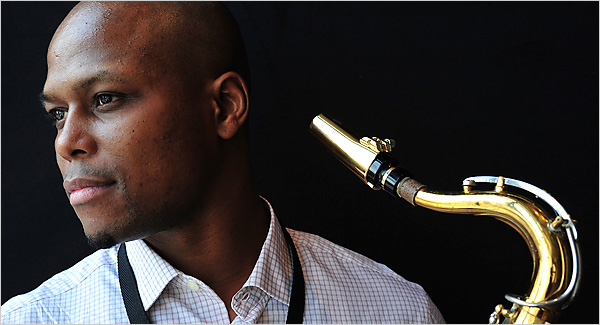
My first exposure to J.D. Allen was at last year’s Charlie Parker Festival, on the uptown Saturday, in the northeast corner of Marcus Garvey Park, where the concert had been relocated while the bandshell was under renovation. Allen’s trio was midway through their set by the time I showed up—which, at the Marcus Garvey half of the CP Festival, is defined by the threshold where the concert becomes louder than the drum circle always happening on its perimeter—and I regretted my lateness before I’d even found a spot to sit down. I love the raw power of a saxophone trio, and I couldn’t remember the last time I’d heard anything quite so raw or so powerful as Allen’s. It wasn’t just the horn, either; the whole band was relentless. They seemed hardly to come up for air.

The trio had third billing that day; still to come was the always-impressive Jason Moran, followed by McCoy Tyner solo. But nothing came close to Allen. It was the thrill of discovery, that moment when a musician or band or composition becomes “ours,” a sort of foundling godchild.

It wasn’t until the beginning of the following April that I happened to be in a record store, picked up a New York City Jazz Record, and found that the trio would be at Smalls mid-month, on a Monday night. Happily, this would be during spring break.

I got to Smalls a bit early, unsure of how much of a crowd to expect—I figured Allen was a rising star, but I didn’t know how much of a name he’d made for himself yet—and anyway, it was a Monday, and it was Smalls. As it turned out, the previous set had not yet ended; there were a few dozen people in the club, a few empty chairs toward the back. I sat down in the last row, signaled the waitress, and commenced eavesdropping on my neighbors. The woman to my left was on stopover from London; the woman to my right was from Los Angeles; she and her husband were visiting their son, who had relocated to New York to work in real estate (surprise), and who had dragged his parents to Smalls for (one presumes) an authentic NYC experience.

I ended up speaking to the madre angelina, and offered the padre, who was standing with the son behind the last row, to take my seat. Graciously declined. The waitress was tied up at the door, so I went to the bar for my drink, looking for the holy ghost in the mirrors, watching the club hop and bustle, and all the men with mysterious black cases, like country doctors. The musicians mulled about in the back. A few minutes after I’d sat down again they were announced, and filed down the alley between the chairs and the bar to scattered applause, ducking the waitress’s drink tray. Then the barmaid turned off the stereo, the dim lights got dimmer, and the trio started to play.

If I had to make a comparison to what I heard this night—and to a lesser extent, what I’d been hearing on Shine!, the trio’s latest effort, for the previous month—it would be to Coltrane’s quartet at the dawn of the ‘60s. On uptempo cuts, Allen tends toward permutations of short phrases, sometimes harking back to Giant Steps; on slower, more searching tracks, toward something like the “Psalm” on A Love Supreme. He seems more at home in the latter, in extended gestures played against abstract, washed-out backgrounds, cut with occasional squirted-out birdcalls. Granted, at the Smalls set the rhythm section had a tendency to set tempos Allen couldn’t quite match, sending him running after the proverbial streetcar. But Shine! avoids those audacious tempos … and yet one still notices that neither speed nor sharp rhythmic phrasing are among his gifts. Where Allen excels is in the sound he gets out of his horn, and in his ability to shape his rather open-ended lines into luminous, deeply-felt musical statements. In his liner notes to Shine!, Ben Waltzer describes that sound as “incantatory” and “hypnotic.” It is sometimes reedy, sometimes sodden in vibrato, always weighty—the paradox of a heavy thing floating in air. I honestly can’t think of another player to whom I’d rather listen sit on one note for a good ten seconds. But if this is so, it isn’t only because of his tone, but the note as well, the choice of where to drop anchor. And the power of those endnotes has to derive in part from the shape and momentum of the melodic line that delivers them.

In terms of his sound, and to a certain degree his approach, Allen is actually closer to fellow Detroiter Kenny Garrett than to Coltrane, this though Garrett is an alto player, Allen a tenor. (One could also draw a line from Coltrane to Garrett, who recorded an entire album of Coltrane’s music, called Pursuance; but then one could draw such a line to almost any post-‘60s horn player.) I’m thinking above all of Garrett’s Songbook, “Sounds of the Flying Pygmies” and the anthemic “Sing a Song of Songs” in particular, from which Allen seems to have gleaned a trove of useful ideas. In this respect, I found it interesting that Waltzer mentions a litany of Detroit players with whom Allen has worked, including Geri Allen and James Carter, but does not mention Garrett. Maybe they put something in the water out there, a sort of jazz fluoride. Call it purity of essence.

The affinity to the early ‘60s Coltrane, though, has as much to do with the function and interaction of the trio as with Allen himself. Waltzer notes that Detroit was ahead of the rest of the country in seeing no real difference between the (once-?)warring camps of mainstream and “free” jazz. Indeed, several times during the Smalls set, the music achieved and sustained a level of centrifugal beauty one is more apt to hear at venues like The Stone or Roulette. Not so much sheets of sound as walls of noise: deafening storms in the rhythm section—torrential rolls and crashes from Rudy Royston at the drum kit; bassist Gregg August strumming away at those fat strings—giving way to almost surreal moments of clarity from the horn. Rather than participating in the fray, Allen attempted to rise above it. The impression is of a powerful but human voice asserting itself against the din (of modernity, of mass culture … of what you like). Except that then you hear Allen’s voice calling out to his bandmates between breaths, and you come to realize that he, that human voice, is also orchestrating the chaos, driving it forward and holding it together, a ship’s captain calling forth and reveling in the storm.

I wondered whether the few people who scurried out mid-set were disappointed, daunted, or deafened, and whether audiences in the early ‘60s had done the same during Coltrane’s sets … particularly with that imp named Dolphy standing at Trane’s shoulder, prodding his squeaky pitchfork into Trane’s ever-bendable ear, trying to convince him that HE was the voice of God! And all this was particularly curious in a reputable little jazz venue like Smalls, where Wynton Marsalis might wander in at any moment, like the Hall Monitor demanding your pass. I felt sort of bad for having told the real estate salesman’s mom that Allen was “a revelation,” as I did in passing before the set began. But they were real stalwarts, stuck it out to the end. Hell, maybe they even liked it.

Compared to the prolixity of most newer jazz, one notices that the tracks on Shine! are brief, not a one over five minutes. But this belies the way the trio works live: rather than stopping and starting to name tunes and highlight band members’ contributions, each song blends into the next. (Shine! does this, at least with a few pairs or sets of songs.) They are similar enough in tone and style to give the impression of a single, hour-long composition—an approach that once again evokes the avant-garde. “Sonhouse”; “Teo (Ted’s Theme)”; “Se’Lah”: these are tunes with a sort of found-object beauty, like arrowheads. No wonder that the likes of Thoreau had an uncanny knack for finding them; they are just such barely-hewn stones, blurring the line between composition and improvisation, arising like forms of crystalline loveliness in tidal pools … only to be drowned again in the torrents of noise. The music only really stops when the trio is done—when they’ve run out of breath, I guess, or have crossed whatever collective mental or emotional finish line they have drawn for themselves.

I could go on with Coltrane-quartet affinities, Royston’s in particular: his demolitionist’s approach to the drum kit; those breakout rhythms, dead ringers for Jones’s. The flying sweat. But the chief affinity is broader than that, and as glaringly obvious. For the ultimate goal of this band, as it was for Coltrane’s, is grace, spirit, ascension. It is gospel enfolded into a jazz idiom. It hardly makes them derivative. On the contrary: a collective working toward spirit seems always renewable.

And yet … where would such spiritual exercises be without just the slightest hint of the charlatan? I couldn’t listen to Coltrane without distrusting him a little. Allen, too: the throwback fedora and number-runner’s suit. Just like I distrust the Bible-thumping preacher as he steps up to the pulpit, in that moment right before I take the first sip of my whiskey sour, close my eyes, and get swept up in the sermon.

Can I get a hallelujah?

I Die (A Little)

I was standing on the corner of St. Nicholas Avenue and 145th Street listening to Sonny Rollins play “Ev’ry Time We Say Goodbye” (The Sound of Sonny, 1957) when a hearse drove by. True story. Cross my heart &c. It was leading a two-car funeral procession, lights on, curtains drawn. On my headphones, Rollins was dying a little.

Or was he? The problem here is that when Rollins plays “Ev’ry Time We Say Goodbye,” it’s just so goddamn upbeat. He swings the hell out of it, stutters the first note of each part of the melody regardless of whether friend or lover is saying hello or goodbye, and then really opens up the horn for the last two bars—so much for that famous “change from major to minor.” I ask you: Is this man really dying a little? Even just a little? I think not. This is the bon voyage of broken champagne bottles and ships’ horns; that stutter is the bit of palpitation anticipating freedom, not return. With Rollins on the bandstand, that hearse was practically bouncing on its rims.

The man turned eighty the other day, you know. You have to wonder if he’d play it the same way—if he’d swing it even harder, say, or be moody about it, or contemplative, or rage against the dying of the light. Or all of the above.

A friend of mine used to have this song on his answering machine, a woman’s voice singing the first two famous lines with a shrill, wavering lugubriousness; then the beep—this back when you used to be able to mix your own answering machine messages on those micro-cassettes, in what I have elsewhere called the endlessly malleable analog world. Then came ring tones; long live magnetic tape. Waiting to cross, I watched that mini-procession wend up St. Nicholas Avenue, Rollins bouncing notes like tennis balls off my eardrums. I almost waved.

A Year in the Pit

Amid the offal and carrion.

I can’t climb out of the pit, but I can climb high enough up the sides to get a pretty good sense of the lay of the land.

Some days I can’t find the sides, so I just jump up as high as I can, like I’m in a crowd watching a parade. Except that I’m alone, and so far as I can remember always have been.

By jumping, I can see for a moment above the perennial mist, around my dim environs. This combination of jumping and climbing allows me to take stock of where I am, what I’ve done; for with darkness, as with light, space is also time, a record, a history of space traversed.

Somewhere in the pit there’s another pit, a deep dark hole to which I find myself irresistibly drawn. There may be several such pits-within-pits; I’m never quite sure what direction I’m going, and so I’m never sure that I haven’t stumbled onto the same one. For all I know, these pits may have their own pits, and so on, mise-en-abyme, as the French say.

All over the pit—I mean my pit, the pit where I live—in every direction, are words, words, words. Piles of them. Warm, rotting heaps of them.

As I happen across them, with my pitchfork I pick up the words, carry them over to a hole, and dump them in.

I spend a lot of time—I spend most of my time—finding and dumping words. Or so it seems. Like space, time is difficult to judge here. But most days it seems like I do pretty much nothing else.

So the words are everywhere, and it seems like no matter how many of them I try to get rid of, there are always more. Sisyphus, you know what I mean, right? And Ixion, you too? (Pablo: thank you for these words; I do not plan on returning them.) Nor does it seem possible to fill the hole, or a hole, any hole, as was my intention when I started this project a year ago, believing (naively, so naively) that if I kept dumping words into them, I would eventually hear them hit bottom, and not long after see a sort of hillock nudging up toward the edge, until in time I could walk over the wordfill where the hole had been, and stamp it down with my feet, and clap my hands, and do a little dance, and clear my throat, and move on.

But the words all disappear without a trace. Sometimes I think I hear a bit of an echo, but probably I’m fooling myself.

And so a sound pines away after an image enamored of itself, the one never able to grasp the other—a myth that captures the essence of the absurdity of this project.

We’re all better off embracing the absurd. So I toil on. Holes must be filled.

*

I think it was some guest on Charlie Rose said, “How do I know what I think until I read what I write?” Writing is a means of coming to know ourselves … and perhaps even more, of creating and re-creating ourselves in the flux of experience. Writing about music is no different in this regard, since by attempting to discover, define, and describe the object, we inevitably loop back to the self. Writing these posts, as I noted at the very beginning of this project, is a means of personal and cultural as well as musical exploration. I’ve tried to keep a balance among the three, and to use each to illuminate the other.

A few themes jump out at me. A big one is music as vehicle for transcendent experience in the secular world. I know, that’s big, cheap, and old, but there it is. I mean, this blog is being written by someone who once asked his parents what the plus signs were on top of all those buildings. Or maybe that was my sister. Same diff. Not much religion going on in my house when I was growing up. Lots of art and music and science and technology. So, music as a way to get in touch with something larger than the self. Nothing supernatural here, just a personal/universal vibe: memory, emotion, community, biology, the intuition of deep structure—you name it.

Second, the idea of excavation, of an archaeology of tastes, is all over these posts. I’m interested in the way the different kinds of music we listen to at different periods of our lives, and then return to, intersect and end up speaking to each other.

If you’ve read more than few posts, you also might have noticed that I tend to write about stuff I really like. I’ve never really enjoyed the nasty broadside. Something about that if-you-don’t-have-something-nice-to-say injunction. Incredible, but even the savage atheist has a rudimentary concept of morality. The internet seems to cultivate the weird sadism behind public stonings. Yes, you’ll find criticism from time to time, always with caveats and qualifications and addenda. But like I said, I’d rather spend time thinking and talking about the music that excites me. If I want to stone something, I’ll bring a bag of rocks down to Trump Tower … or better yet, up to Albany. Now’s the time. Wanna come?

(Sorry about the questions; it occurred to me many months ago that the blog, the internet itself, has murdered rhetorical questions, but foolishly I keep asking them.)

As a relative novice to the blogosphere I am unsure about blog netiquette. I sort of assume it’s the height of rudeness to comment on one’s own post until someone else has done so. Instead, I thought to use this anniversary reflection (a neologism: metablognitive) to post a few addenda and corrections to the year’s work … with more sure to follow next year.

About “Convalescing With Miles” (4.14.10), I think Joshua Redman put something I was trying to say there about Miles better than I ever could: “It’s like you couldn’t have written it better, but you couldn’t have written it” (in The Jazz Ear, p. 131). Only … he said it about Rollins!

About “Bands, Very Large and Very Small” (8.5.10): Here is Whitney Balliett reviewing a big band performance (in New York Notes): “every instrument was essential, the massed sounds proved new melodic and harmonic points, and a majestic aura was achieved” (30). Ouch. That’s a comeuppance if ever there was one. Not the majestic aura so much, but “the massed sounds prov[ing] new melodic and harmonic points.” In case I tried to repress it, the wall of tenors at the recent Brad Meldhau concert really drove the point home.

Regarding “Modern American” (12.2.10): Where to begin with my cringing re-reading of those snotty assertions in the first paragraph of this post? That I went to hear Papo Vasquez a few months back and his decidedly Latin pianist blew me out of the club? That Bebo Valdez plays nothing like his son, and I could listen to him (Bebo) all day? That I put on “Autumn Leaves” on Somethin’ Else the other day for the first time in years, listened to Hank Jones’s patient, mysterious, singing right hand, and thought, “Who needs a left hand?”

I should acknowledge the recognition of the diabolus in musica in “Black Sabbath” (“Deulogy,” 1.4.11) came from a long-ago conversation with the old roommate of a friend of mine, a brilliant, reclusive black-metal fanatic named Ian. For a while I would call up looking for my friend, get Ian on the phone instead, and end up talking to him about All Thing Metal (ATM) for upwards of an hour. (And if you happen to find a stray word of yours worked into the piles around my pit … that means I was listening, note-taking, as Virginia Woolf put it, for some future revision.)

Finally, I am always moved by the spectacle of those deeply appreciating the music they hear, which finds its apotheosis in dance. Conversely, I am probably overly impatient with those who are bored or distracted. (I am probably overly impatient with bored and distracted people in general. I don’t get boredom; I don’t think I’ve ever been bored a moment in my life. I’m sure I’ve feigned it now and again, to fit in.) With regard to “Contrasts” (1.22.11), then, I have been meaning to apologize for some time now—not for the updated version, but for the initial one, which was available for a full week before I thought to edit it. Now, if you knew what the hell I was talking about, you probably wouldn’t be reading this blog at all anymore. Which makes this apology, like all apologies, pointless and self-serving. Ah well. All I can do is try to do better, though my moral learning curve always (or rather never) runs up against the asymptote of my ego, as big as the parabolic mirror on Mount Palomar. (Yeah, I know, an asymptote is a line. Whatever.)

I may be evil (after all, “I am man”), but I’m not a bad person, I don’t think. Not that bad, anyway. Like Twain said: Bigger than a breadbasket. Smaller than an elephant.

Some words apply to literally everything.

*

Much to come. Beethoven and Brahms and Bartok and Domenico Scarlatti, a roundup of the spring’s Town Hall concerts, Ornette and Monk, Irene Schweitzer and Branford Marsalis, Django Reinhardt, Evile and Judas Priest, flamenco and salsa. And all these interspersed with comments and reflections on whatever else musical the city happens to throw my way between now and next March in its constant cultural shock-and-awe campaign, some to get posted immediately, some deferred until I have nothing else immediate on my radar, and some to float in limbo …

And, of course, dozens, hundreds of new posts about Rush … but all of them hoarded until December, like every studio does with their Oscar contenders, when I can stand on the landing at the top of that winding staircase and say, “I’m ready for my close-up, Mr Foote!” … and then come sashaying down those stairs, and into my second major Academic Commons award.

Hotels on Boardwalk! Champagne with Fay Wray! Right to organize, right to strike!

Silent Movie

Over the last intersession I had a chance to read Robert Spadoni’s Uncanny Bodies (U California, 2007). The book examines, as its subtitle says, “the coming of sound film and the origins of the horror genre,” with particular attention to the reception of Dracula and Frankenstein in the context of Hollywood’s transition to sound (1927-31). For Spadoni, the uncanniness of Dracula—and by extension Dracula’s early popularity and prestige, which seem inexplicable today—was partly attributable to the uncanniness of the speaking figure itself in early sound film: “figures now [circa 1930] seemed more vivid and animated, and yet … [they] could seem distinctly less alive than before” (22). Conversely, Whale’s mute Monster was a throwback to silent film, which had already begun to seem alien to audiences habituating themselves to sound. The nascent horror film genre capitalized on this dialectic of spectatorship as its conventions began to solidify, “convert[ing] a fleeting reception phenomenon into the solid basis for an enduring genre practice” (7).

As interesting to me as the overall argument and imaginative close-readings, however, are some of the tidbits Spadoni includes about how the transition to sound was perceived. Here is one: in the early ‘30s, “nondiegetic music was not yet a norm of Hollywood sound cinema. There was disagreement as to how much, if any, nondiegetic music a film should contain. Some believed that music would annoy viewers who were trying to listen to dialogue; others worried that viewers would be wondering where the music was coming from. Still others feared that viewers would find incidental diegetic noises distracting, as well. As a result, dialogue scenes sometimes played out against inordinately quiet backgrounds” (22).

As I noted in an earlier post, I spent much of my last filmgoing year and a half watching silent movies shown in two series at the Museum of Modern Art: “An Auteurist History of Film” and “Daydreams and Nightmares: Weimar Cinema 1919-1932.” (The Weimar series just ended; the “auteur” series is ongoing, but finished the silent period several months back.) After reading the above passage, I found myself reflecting on some of the uncanny convergcnces between my own experiences watching silent films and those of the original audiences of early sound cinema.

MOMA is probably one of the few places in the world where you can sit in the midst of a near-silent public watching a silent film without accompaniment. Whispering spectators are violently shushed; snoring ones are cudgeled awake. When such a hard-fought silence reigns in the cinema theater, the image can indeed take on an uncanny, ghostly, quasi-theatrical power, akin to Spadoni’s Dracula or Monster. The images transfix us, like daguerreotypes of the newly deceased. And yet, in such a thuggishly quiet environment, where the proverbial dropped pin resonates like a church bell, the spell is easily broken by any noise from the theater: the rustling of those ubiquitous plastic bags; the swishing of latecomers’ hands along the railing as they descend the stairs in near-darkness looking for an open seat. (To this one would have had to add the ka-thunk of chairs every time a spectator left the theater, a dozen or so ka-thunks from every seat, like a spinning saucer coming to rest. Thankfully, when the museum was renovated several years ago, they replaced those seats—yet another annoyance become nostalgic memory.) Finally, during an unaccompanied silent film, one can hear the muted whir of the projector … and even, sometimes, the noise of the projectionist, that phantom figure behind the curtain, himself a sort of absent presence, like the images on the screen. My favorite moment here is when a friend and I went to see October without accompaniment, and we could hear something that we eventually identified as a TV program. It turned out that the projectionist was watching Wheel of Fortune in the booth. Was he aware of the irony?

For most silent films, however, MOMA provides piano accompaniment. Early sound film viewers would not have been unaccustomed to sound itself during a film, but rather (as Spadoni notes) to the question of the source of the sound without the living sound-makers present, just as they questioned where the voices were coming from when the technology was so primitive as to make it seem those voices were coming from anywhere but the actors’ mouths.* Today, the scheme is reversed: having a live pianist in the room is potentially as distracting to the modern viewer unaccustomed to seeing silent films in the theater as the presence of nondiegetic music or poor sound quality for dialogue was for early sound cinema viewers. We have become so accustomed to the “speaking effigies” that live presence/performance during a film has a certain uncanniness about it.

Indeed, a live pianist today can not only disrupt dialogue, but the whole cinematic experience … and to a far greater degree than a badly-scored film. During the recent showing of a restored version of the 1918 J’Accuse, I left the theater after the first hour. It wasn’t the film; it was the piano, which was so overbearing that I couldn’t focus my attention on the action. The same thing can happen, though to a lesser degree, when the pianist makes an obvious error, or seems to play out of synch or out of character with the images on the screen. (I would guess that the prevalence of recorded music, together with the growth of music as a profession, has made us less tolerant of mistakes than early silent film audiences were.) Conversely, like a good score, a good silent film pianist will blend into the movie, clarifying and emphasizing character and conflict, and helping to weld the visual elements together into a whole …  which is sort of ironic, given how much of such accompaniment seems to be a Frankenstein’s Monster of stitched-together pieces of popular songs and romantic melodies.

The presence of intertitles adds a whole other interesting wrinkle. A movie pianist has no reason to stop playing during an intertitle; in my experience, they generally play without stopping from the first frame to the last, although they may pause at moments of high tension, often with a staccato burst, to let the action play out unaccompanied. But MOMA also shows a lot of foreign silent films, many of which are without subtitles. Sometimes they will just show the film in its original language without translation. On other occasions, they will have a translator in the cinema with a microphone.**

This creates yet another sonic layer to the “silent” film experience, and a dilemma for the pianist that reminds me once again of those early concerns about sound film: the voice of the interpreter rendering the dialogue or narration of the intertitle competes with the music provided by the live piano. The piano may stop and start, or at least modulate its dynamics, according to whether the translator is reading. This creates an unattractive rhythm, disrupting the ambience of the film, while the wooden, often halting voice of the translator drains the intertitle of the inflections that the viewer’s mind provides upon reading the words. (That said, it is far worse to have an interpreter who tries to read the intertitles dramatically, as I have also experienced.) Once again, the concerns about the “talking” film at the dawn of the sound era are ironically recapitulated in the unsubtitled foreign silent film at the beginning of the twenty-first century: now, it is the dialogue (or narration) that interrupts the music, not the reverse.

* I wonder if this helps account for the seeming abundance of diegetic music in early sound film … and perhaps for the immediate introduction of the musical (apart, that is, from sheer novelty), despite the technological challenges of early sound. A piano accompanying a silent film often plays nondiegetic music and simulates diegetic events: staccato chords for slammed doors and hammer blows, a descending glissando for a collapsing tower, etc. The piano is a whole soundtrack unto itself, confusing and collapsing the diegetic and nondiegetic, “miming” as much as the actors do. Perhaps the diegetic music was there to help fill the void of the suddenly-obvious silence of sound film (e.g., the resident pianist in the Weimar film Farewell (1931), who plays while he converses with the other guests in the boardinghouse where the movie is set), or to provide a clear source for the music. In other words, if there was a fear that early audiences “would not know where the sound was coming from,” but filmmakers wanted to capitalize on “the power of music to make mobile and to vitalize” (Spadoni 23), the presence of the performer on-screen—whether a character who happens to play piano, or a full-fledged musical number—seems a viable way of resolving the problem. As for the early musical: like the piano, the musical seems to be a place where the diegetic and nondiegetic cross over: the music is at one and the same time performed on screen and transcends the narrative moment, enveloping the diegesis in a way that only nondiegetic music can.

** In my understanding, this is not the same as the role of the narrator in the early cinema, who would tell the story of a film without intertitles, whether in English or no. It would be interesting to find out to what degree this practice was used for early foreign silent films, rather than subtitles or replaced intertitles. For an idea of the possible sonic environments of silent cinema, see, for example, Robert Sklar, Movie-Made America (Vintage paperback, 1994), pages 16-19 and 86.

Postmortem I

As I noted in my inaugural post, Fall 2010 was to be my first opportunity to teach Writing About Music, a course I co-developed with a colleague along similar lines to the Writing About Music course I took as an undergraduate. Now that the smoke has cleared (cough, cough), I thought to post some reflections (cough) about the way we approached the course, and a few of the successes and failures (cough!), in the hope that something of what follows might be useful to colleagues around and outside of CUNY. Think of it as a walk-through … maybe inspired by CUNY’s recent PESH violations, and the risk assessment walk-throughs we just finished at my campus. So, get on a pair of comfortable shoes, and give your back a streeeeeeeetch …

Course organization

The Writing About Music course I took as an undergraduate was structured modally, and in developing the Hostos course my colleague (Prof Tere Justicia) and I made an early decision to follow a similar model. The course is thus more writing- (and listening-) than reading-focused; in some ways it feels closer to the “workshop” model of a creative writing class than to the lit surveys usually taught at this level.

As an undergraduate, I wrote a description, narrative, technical analysis, imitation, and performance review, a voice-based revision of the review, a free assignment, and a free response to music criticism (I may be forgetting one). For the original version of our course, we replaced the technical analysis and imitation with a compare-contrast and a research paper, and ripped out the free assignment. When I revised the course for its second run, I replaced the voice-based revision with an argument. The research paper, which asked students to contextualize a historically significant album or piece of music, was submitted in chapters over the course of the semester, to be revised and resubmitted as a final project. Students also engaged in informal writing during class and on a Blackboard-based blog.

Reading

Because the course is focused on music as a text for inquiry and writing as a process for inquiry, the question, “What to read?” loomed large from the beginning. First, Prof Justicia and I never intended to teach a class on music and culture. There is actually an excellent textbook by a Hunter colleague, Anna Tomasino, called Music and Culture, published by Pearson. Although I appreciate the utility of themes such as race, gender, and economics for writing about music, and adopted some of these for my last formal assignment, they were not the focus of the course we envisioned and designed.

Conversely, I was not teaching (nor would I be qualified to teach) a class in music appreciation. As a result, the excellent music appreciation textbook Prof Justicia adopted for the course’s first run, Musical Encounters, by David Nichols, did not seem suited to the course as I wanted to teach it. True, the basic information about music theory and practice would have been helpful (more on this later). The text’s accompanying CD is exemplary, as are the listening guides. But in an English course where writing is the focus, and fifteen weeks is all we have, my feeling was that this text went too far afield into music history, theory and culture … and said almost nothing about how to write about this odd beast called music.

Finally, there are a couple of academic press books on the market specifically for writing about music, which I found either disappointing or ill-suited to the HCC student body. Richard Wingell’s Writing About Music is largely a guide to writing a research paper with a short introduction about music. The other, A Short Guide to Writing About Music, by Jonathan Bellman, was much closer to what I was looking for, and reading it helped me strategize about how to approach my own course. In the end, however, perhaps because it seeks to appeal to students at different levels, the book contained too much that was irrelevant to my course (such as the sections dedicated to critical theory and to technical analysis) and was too research-handbook oriented to be a good fit.

Finding “the right book” can be a porridge-too-hot/too-cold exercise in futility. So, inspired by my own college writing-about-music experience with Dr John Spitzer, whose bibliography I shamelessly raided, and with the help of intrepid writing fellows & musicology students like Mr David Pier (formerly at the GC; commented on an early version of the syllabus) and Ms Angelina Tallaj (currently at the GC; worked with me throughout the semester, Robin to my Batman, or probably the reverse), I decided to play the bricoleur and assemble my own readings. After all, the world of academic publishing presents us with the fantasy that we’re all engineers, and they can fashion our perfect tools. But every teacher knows that we’re really bricoleurs, and proud of it, regardless of whether we adopt a textbook or cobble one together.

Finding words

Writing about music tends to go in one of two directions. Either it is technical and analytical, which presupposes an academic musical background, or it is poetic and imagistic. I think the best writing about music tries to strike a balance between these two tendencies: it uses technical language sparingly, in such a way that the lay reader is both hailed and challenged, and it uses image and metaphor both imaginatively and precisely—that is, focusing on what is happening in the music. Good writing, then, requires good listening. Finally, because of the subject’s abstractness, music writing demands (and I think rewards) familiarity with a range of music, and to an even greater degree, with a store of cultural capital with which to think analogically. That abstractness is why so many music-oriented humanities classes tend to focus on history or biography or culture: they serve as a variety of mirrors, shields that permit us to look into the music’s Medusan face without turning to stone.

So, the challenge. Even after a year of college—imagine!—students come into a class like Writing About Music with limited vocabularies, little to no technical background about music, and little in the way of easily-accessible cultural capital. (I don’t just mean “culture” in the Western, Great-Tradition sense: I mean their own cultures.) As such, they have an excessive tendency to fall back on describing their emotional response to music, and to describe it in the most clichéd, vague terms. It’s not that the emotional response to music isn’t valid. It’s that they can neither describe these emotional states (what Aaron Copland, in one of our first readings, calls “the expressive plane” of listening) with any sort of nuance or depth, nor can they connect those emotional states to what is happening in the music (for Copland, “the sheerly musical plane”). So much of good writing about music is about finding precise words to describe a sound, or an emotional state, or a relation, or a mental image.

So, after an initial reflection about music, which invited students to write about the simple prompt “what does music mean to you?” (as gleaned, on Mr Pier’s recommendation, from the book My Music, together with some representative responses for class discussion) in very much the vague, general, emotion-drenched terms described above, the goal for the first several weeks was to begin to move them beyond this. Again, not entirely. And not only because we took music as our subject: it could be argued that this class is “developmental” in the sense that, unlike reading skills, which I could hazard students had spent a year improving, I could not assume that students came into Writing About Music equally prepared to listen, or knowing anything about how to effectively translate that listening into language.

Our models and advice came from Copland and Jacques Barzun, from Alex Ross and Whitney Balliett; our listenings, Earl Hines and Igor Stravinsky. We examined the vocabulary the writers used, where the language becomes poetic or technical, how elements of genre and biography help contextualize or ground a description. But of everything we did leading up to the first assignment—a 2-3 page description of a piece of recorded music of their choice—the most productive was an in-class group exercise on finding words. It was simple: I put together a mix of short pieces from different cultures and genres (Ms Tallaj suggested an emphasis on vocal music, which I followed); I played each 2 or so minute piece twice, the second time more quietly; all the groups did was try to find words to describe what they were hearing. They were invited to use a dictionary and thesaurus, and even their goddamn f&@!ing phone, to look up synonyms for the bland words that first popped into their minds; they were invited to find not just adjectives, but nouns and verb (parts of speech matter so much, as Virgil Thompson reminded us). My only regret is that I didn’t spend two full class days doing this, instead of just one. For the assignment itself, I privileged specificity above all else. I wanted to know what was happening in the music, and when it was happening, as best they could describe.

We took a couple of detours in this first unit as well: Debussy’s “Sunken Cathedral,” accompanied by three short readings about it, and paintings by Monet, Turner, and Redon; a one-week unit on jazz poetry. My intention was to give students a range of strategies for approaching music in language, as well as some intellectual fodder for thinking about the relationship between image, music, and text. (One of the “Cathedral” descriptions actually resorts to sketching church arches, and compares them to how the score looks from a distance! It was not a great piece of writing, but maybe better than any other dramatized the challenges of the task at hand.) Anyway, the problem here is probably self-evident: way too much in too little time, particularly for the jazz poetry, which should become a unit in its own right.

My intention for the second assignment/unit was for students to build on the skills practiced in the description paper by comparing two pieces of music. I settled on the idea of “cover versions” because I figured these would provide clear similarities and differences between easily-approachable pieces.

We began by listening to a few different versions of “The Lion Sleeps Tonight” (Ladysmith Black Mambazo, The Tokens, etc.) and discussing the similarities and differences between them. This was intended as a platform for the weekend listening on which the formal assignment was based. Although the “Lion” lesson was moderately successful, given the students’ level and time limitations, I think it would have been better to focus the entire unit’s listening around the songs they were assigned to compare in the formal essay. Of the five possible pairs, the most popular was the two versions of “I Will Survive” by Gloria Gaynor and Cake, followed by “Imagine” by John Lennon and A Perfect Circle. (Interestingly, despite the large number of Hispanic students, no one chose to write about The Beatles Cubanos!) Ms Tallaj designed the excellent assignment, which included two creative choices: contrasting assessments of the “original” and cover, and a mock interview with the cover band.

Interestingly, the topic of “covering” songs generated heated discussion. Students were fascinated by the aesthetic, economic, and moral implications of “covering” someone else’s song—which is more than a little ironic, given the ubiquity of sampling and “mash-ups” in today’s pop music, to which our discussion and listening eventually turned; but also given the ever-growing problem of plagiarism, which had led me to believe that these cultural shifts were partly responsible for students’ seeming inability to understand what “giving credit” means anymore. Anyway, the blog went nuts on this question, with a few students sticking to the position that great songs should never be covered!

One other note: I’ve found that nothing works for generating animated discussion like giving the students a list of juicy quotes from the readings (in this case, a pair of articles from Popular Music and Society and Crawdaddy) at the beginning of class and asking them to pick one or two to write about for ten minutes. (If you’re unfamiliar with Crawdaddy, look them up on the web; they have an interesting history.)

Music in Context

I haven’t read much in the way of pedagogical theory, but in organizing my courses, I generally strive to begin with some basic skills, and then integrate these into more complex (although potentially more familiar) tasks over the course of a semester. In expository writing, for example, I start with representing ideas (summary, paraphrase, quotation), and then ask students to integrate these into comparative and argumentative essays. (I’m about to throw this model out the window, but never you mind.) I do this because my experience has been that students coming out of high school or a bout with the ACT know how to structure an essay, but have no idea how to write about texts. (This may change a little now, what with the CATW replacing the ACT.) I tried something similar in Writing About Music by beginning with description and compare-contrast, which asked the students to (try to) focus on the music per se, and then having them integrate these listening/writing skills into reviews, stories, and arguments—that is, into the contexts of performance, literature, and music videos. I suppose it will be objected that without context, there is no listening experience, and hence nothing for a student to write about; perhaps even that there is no such thing as “the music itself.” I see the point, and my students’ reactions to jazz seem to bear this out. But there is also something to be said for getting students to “face the music” in whatever way they can—for trying to force something out from under the comfortable folds of context, context, context. Like the description assignment I often do with my developmental writers, which asks students to really look (and listen, and smell, and …) the place they are describing, ideally the music description forces students to really listen to something that they think they already “know.” (By and large students chose music they were well familiar with, but in hindsight it occurs to me that I could add this stipulation to the assignment instructions.) My intention was to pull away the crutches for the first few weeks, and then hand them back halfway through the semester and say, “Yes, but look at how well you can walk!” True, they might have been limping, and more than a few fell right on their butts; but at least they were trying things they wouldn’t have tried otherwise.

We stepped out of compare-contrast into performance using the first movement of Beethoven’s Fifth. I thought it would make a nice transition for a couple of reasons: because of the extraodinary number of versions that have been recorded over the years, from salsa to disco to all manner of parody; and because it begs questions about ideology, sublimity, and transcendence, raised in the readings by E.T.A. Hoffmann, Lester Bangs, E.M. Forster, and Virgil Thompson. The first of the two assigned Thompson reviews was meant as a linchpin: Thompson hears a martial performance of the Fifth in 1945 and connects the interpretation of the piece with the historical moment. The goal was for students to be able to look backwards (to ideas about “covers” or “interpretations” of a classic piece of music) and forwards (to the role of performance in music-making).

If any assignment failed last semester, it was the performance review. Here it was an issue of the chefs trying to get too creative with what should have been a relatively straightforward assignment, which resulted in a few gems and a lot of nicely-detailed botches. That admitted, let me focus on a couple of things I thought did work. (Don’t worry, I’ll liberally salt a few wounds at the end of the post.) First, I “outlined” a review of an Aventura concert from the New York Times using the “Comment” feature on Word, and then asked students to do the same with a review that they found on their own—this by way of giving them some viable models for how to approach the assignment. The other thing that worked well here was an in-class exercise where students met in groups to answer questions about excerpts of two performances we watched in class: Glenn Gould performing the Goldberg variations, and Tito Puente’s band in Calle 54. The point was to get students noticing different aspects of performance, which would serve as a template for gathering material for the formal assignment.

For the narrative I used a prompt that the fiction writer Ron Carlson once gave to my graduate workshop: “The first time I heard [song title] by [artist], I was with [person] at [place] and we were [doing something].” My original idea had been to give this prompt the first or second day of class as a diagnostic, and then to hand it back with comments later in the semester, to be revised into a formal assignment. It’s a great prompt for two reasons: from a narrative perspective, it forces students into a moment in time, and hence away from the sort of dull abstractions that become a crutch when they try to write a story; from a musical perspective, it automatically connects music, emotional memory, and culture. Anyway, we did draft this one in class; it was traded, extended, turned in, returned, and revised. In the end—and in some cases, from the very beginning—it delivered some of the semester’s best writing: learning to dance salsa with an aunt, getting lost on the way to church, creating hip hop culture and community on the stoops of the Bronx in the ‘80s …

As for reading, I had wanted to give students three stories relating to three different genres or periods of music. “Sonny’s Blues” was a shoe-in, and I confess that we spent every moment of class discussion during the unit on this complex and beautiful story, which (not surprisingly) captivated the students like no other reading this semester. (The other two selections were E.T.A. Hoffmann’s “A Tale of Don Juan” and John Cheever’s “The Music Teacher.” The Cheever story is wonderful, weird and dark, but I doubt I’ll assign it again—I’d rather something contemporary. Suggestions?)

Finally, argument. I thought videos would be a great focus, as it would give students the opportunity to work with visual texts, and think critically about one of the most common modes of delivery for the popular music they listen to. Ms Tallaj was instrumental in getting the material together for this unit, from suggesting vids to coming up with viable readings. We ended up with Juan Luis Guerra’s “A pedir su mano” and Calle 13’s “Pa’l norte,” Matisyahu’s “King Without a Crown,” Madonna’s classic sex vid “Justify My Love,” Lady Gaga’s “Bad Romance,” the old Aerosmith/Run DMC crossover “Walk This Way,” and a Pepsi commercial to “Forever Young,” the last of these suggested by my colleague at NYU’s Gallatin Center and professional trombonist Greg Erickson. (Confession: I became totally obsessed with Lady Gaga videos for a day or two there; unhappily, I am almost fully recovered.)

I thought the readings worked really well in this unit for their variety and depth. First, a paper about the Matisyahu video by Kevin Holm-Hudson … who, in the small world of popular music scholarship, turns out to be the same Holm-Hudson (is there another?) who edited and introduced an anthology on progressive rock which I’d used in my own scholarly work. The talk discusses Matisyahu’s Rasta-Jewish cultural context, and then analyzes the  “King Without a Crown” video, and so served as a great jumping-off point for thinking about the assignment—that is, about what elements of a video are there to be read: color, dress, motion, visual planes, and narrative content, and how these connect to the music.

The other readings were an article from Popular Music and Society about Caribbean women’s attitudes toward gender in Caribbean popular music (by an old colleague of Ms Tallaj’s at John Jay, Peter Manuel), and a short article by Camille Paglia about Madonna (discovered in Prof. Tomasino’s earlier-discussed reader; many thanks). For the assignment I gave students a few choices. In one, they were asked to write a letter to either Madonna or Lady Gaga arguing that their videos reinforced negative gender stereotypes, and then a second letter from the artist to the writer defending the video/music. (This was inspired by Manuel’s ambivalent conclusions about representations of women in Caribbean popular music; students were invited to draw from his article and/or Paglia’s.) In the other two choices—one a formal argument, the other a dialogue—students considered the theme of “crossing” as it appeared in the songs and videos, whether in terms of race and ethnicity, sexual orientation, genre, generations, or national boundaries. Should I be surprised that most students chose to write the letters … or that the best papers addressed one of the other two choices?

Reflections & regrets

A few things occur to me. The first is that I was not assiduous enough in the second half of the semester making sure that students carried over and honed the listening and writing skills they had begun acquiring in the first half of the semester. In the future, I will have to set some specific requirements regarding those skills in the assignment instructions. That may seem like a no-brainer; but a new course tends to pull one in many different directions, and sometimes one finds oneself putting out so many other fires that the one in the boiler room gets neglected.

Second, misgivings about the role of the readings. I’ve always been a stickler about college writing being writing about readings. Every other sophomore-level elective I regularly teach (if once every couple of years counts as regularly), like Latin American Literature and Studies in Fiction, is focused entirely on writing about readings. But in those five formal essays, which amount to half their grade, students did almost no writing where they were asked to engage with readings. Only the research paper provided that opportunity. I salve my conscience with the idea that this is a different class, that it is in some ways closer to teaching a writing workshop than literature, that it is doing all sorts of other important things … and yet, I still can’t rid myself of the idea that I failed my students on a very basic level for a sophomore-level English course because they didn’t really write about readings!

Third is the very sticky subject of student preparation. My students last semester ranged from a few immensely talented and self-motivated writers to those with almost no facility with English who had somehow managed to pass their two first-year writing courses. In terms of musical background, there were students who had played professionally and students who could not name a single instrument in a small-group ensemble. There were also several students who, at the beginning of the semester, had never been to a live musical performance. Prof Justicia raised similar issues after teaching the course for the first time, and some of my revisions were intended to address these disparities. Altogether, it raises the question of whether an introductory music class should be a pre- or co-requisite for the course. The question then becomes whether in a community college like Hostos we could get sufficient enrollment to run it, and if not, whether we need to re-tool the course to accommodate the reality of the institution. There is also the possibility of working with the Humanities department, and particularly our rapidly-growing Digital Music program, on recruitment. More on this as we move forward.

Fourth is the issue of trying to have one’s cake and eat it too. As I’ve alluded to a couple of times, this was an overloaded course—not in terms of the total amount of writing or reading, but in terms of the diversity of tasks built into each unit. I had to make some adjustments for that over the course of the semester, but more remains to be done. I like the idea of students applying skills and ideas to a new text as a means of scaffolding; but for such a difficult (albeit attractive) subject, I think that students could use more focus on the formal assignment itself from the beginning of each two to three week unit. That means no jazz poetry unless I cut an entire other unit and rearrange the course, no “Lion Sleeps Tonight” unless it becomes the subject of the formal assignment, and so on.

Finally, I want to work on putting themes up front. This is a modally-organized class, at least as it is currently conceived, and I think there are advantages to this in terms of clarity of tasks and close attention to writing. At the same time, in the readings and in our listening experiences, a few themes kept cropping up: the romantic and sublime; secular and spiritual music; ideology, appropriation and creativity; culture and memory. Listing some “big questions” on the course syllabus, as is done on the syllabi for the ESL intensive program I’m currently teaching in, and trying to loop back to these questions at every opportunity in discussion, should help to weld the semester together in a way that the disparate tasks and diverse musics students engaged with over the course of the semester didn’t.

*

In a second, shorter installment, maybe a few months hence, I will go over the elements of the class I have not had a chance to discuss yet: the research paper and the listening blog, as well as how listening was integrated into the semester. But this is enough for now. I need to take five. By the way, I’m happy to share syllabus, assignments, etc.

Vinyl Pasts

Billy Joel’s Glass Houses and The J. Geils Band’s Freeze Frame were the first two albums I ever bought, and I bought them on cassette. A few years later, I switched to records. I’m still not sure why. Maybe I heard somewhere that vinyl sounded better, but I doubt it. I hardly listened to my records; I would immediately tape them onto one of those TDK SLII-90 blank cassettes. An LP would fill about one side, together with an EP B-side if the album was a little short. If it was maddeningly long (say 48 minutes … just too long for the extra two or so minutes you always got on a “45 minute” side), it went by itself onto a TDK SLII-60, with EP fillers again, if necessary. The records would then go into a milk crate, my version of a reliquary, where they became proper objects of devotion.

If records were sacred relics, tapes were the opposite: relentlessly personalizable, a place to practice band logos, doodle scenes of medieval violence, crack private jokes, and list all sorts of useless information on those very inviting lines that appeared when you flipped the label inside-out. Man, we worked on those cassette labels like prisoners sculpting in soap.

Like a lot of people, when I hit my mid-twenties my taste in rock music froze. I stopped trying to keep up with the constant flurry of new bands and splintering scenes. Besides, there was this whole other genre of music called jazz that I was eager to explore, and which sated my desire for the “new,” even though the vast majority of it seemed to have been recorded before I was born, and most of the practitioners I was listening to were dead. My taste moved on from there, to modern chamber music, flamenco, free jazz and salsa. If I wanted to listen to rock, I could always put on something I’d listened to in high school, or college, or early grad school.

By my mid-twenties I had also moved into buying music in the relatively new medium of compact discs, and for several years I didn’t bother to buy anything on vinyl, except for the occasional dirt-cheap classical record at a garage or library or radio station sale. Then two things happened. First, I started listening to new(er) rock music again—metal bands that had popped up in the mid-to-late nineties, as well as non-metal acts that attracted my attention (Calexico, Radiohead). Second, for whatever reason, I decided to reinvestigate the roots and branches of “my” music from the seventies and eighties. And this meant, somewhat inscrutably, going back to vinyl.

My collection of rock records from the seventies and eighties had always been supplemented by my friends’ collections, and theirs by mine, so that if, say, Andrew had X album by band A, I would buy Y album, and then we would tape them off of each other. As a result, my record collection was maddeningly incomplete, although I probably never felt it as such until I had lost touch with those friends with whom I had shared this music. I had a lot of Rush and Voivod and Testament and Metallica and Maiden, but little Zeppelin or Priest or Slayer or Megadeth or Floyd, which I had mostly taped. There were also certain bands and artists that I hadn’t gotten into until late college or post-college, like (believe it or not) Black Sabbath, when I was already buying everything on CD. Looking at my record collection was like looking in a mirror and seeing only half of my face.

Now, there is no logical reason why, when I started to pick up the old albums I didn’t have on vinyl, I couldn’t just buy them on CD. Most of my friends happily re-bought all their vinyl on CD in the ‘90s. But somehow, when I went to buy the ‘80s metal, ‘70s prog rock, and ‘60s classic rock I never had, or never wanted—again, inscrutably—I had to buy it on vinyl.

Hang in there, now—I know this all seems a bit too navel-gazing, and you’re wondering at this point whether you should actually give a shit. But have you ever stared at your navel so long that it starts to look … well, a little funky? Like maybe it’s not even your navel? (You can mentally italicize either “your” or “navel” in that last fragment-question.) Have you ever fallen into your navel, like Alice into her rabbit-hole?

Until about five or six years ago, my record collection represented a period of vinyl-buying that lasted from about 1984 to 1991. Over the last several years, however, I’ve started adding to it again—buying those missing records I only had on home-mixed cassettes, yes; or that I had only bits and pieces of from friends’ mixed tapes, and never, for whatever reason, got around to getting in their entirety—Exodus’s Bonded By Blood is a good example; or albums that I didn’t like in their entirety, and so, according to the endlessly-malleable analog world we used to inhabit, I had recorded edited versions onto mixed tapes myself. But then I’ve also started buying records by bands I didn’t listen to at the time or the moment, but feel like I should have. Example: given my prog rock-classical music background, it took me a while to break down and start listening to the more noisy, minimal thrash bands. I resisted Metallica until after Master of Puppets, Slayer more fiercely, arguing with myself about the un-musicality of it all, arguments that continued even after I had begun listening to them regularly. This is one reason I only ever had 1988’s South of Heaven on vinyl. But how can any self-respecting middle-aged metalhead have a record collection without Reign in Blood, the most pummeling, aggressive, hate-cathartic album ever recorded? That TDK SLII-90 I used to tape Arjun’s record back in 1986, black-pen blood droplets and a pentagram on the spine, just didn’t cut it. I was like a cardinal with a styrofoam crucifix.

These are dangerous things to say publicly. I risk losing a rather hard-fought identity. Because I was always identified as a metalhead, and so got used to calling myself one. In those days, once you listened to one metal album you were sort of lumped in with the crowd; the idea that you actually discerned among music in a genre that the bulk of the population regarded as “noise,” as “just screaming,” or that you listened to other things, too … well, that was preposterous. And so a sort of chute is formed for you, and you embrace whatever is at the end. I imagine most people’s identities are forged in just this way, via these complex negotiations between resistance and acquiescence.

By buying up all those records I didn’t have—not just the Judas Priest and Nuclear Assault and Death Angel albums I had taped in part or in whole off of friends, but also the Black Sabbath and AC/DC and Dio and Slayer albums I resisted, or didn’t much care for, or even outright disparaged—I am correcting my past. I am flexing my consumer muscle in order to create a version of who I might have been, perhaps should have been, according to who I have become. That I am doing this materially, via a consumer artifact, is crucial; for this way I can mold my memory, and hence my identity, to fit the evidence before me. Because if I became a metalhead partly by dint of being identified as one, then the external evidence is that much more persuasive. To others, yes; but first and foremost to myself.

And what a perfect choice of commodities: records! Grooves in pressed vinyl! It partakes of both the permanence of the engraving and the malleability of the material upon which the grooves are made. It is arguably a better metaphor for memory in the age of mass consumption than Freud’s mystic writing pad. It can even be played at varying speeds, and spun backwards …

As I said, in truth—in truth—I came to some of this music reluctantly, even kicking and screaming, arguing with myself about the aesthetic paradox and poring over Zen and the Art of Motorcycle Maintenance in my very early twenties for guidance and solace, before abandoning the paradox and embracing the aesthetic, so to speak. But it doesn’t matter now, because the vinyl is right there, and it speaks more clearly than memory ever could. It admits no paradoxes; it is uncontradictory, self-identical. And it says otherwise. I have become the image of what people always believed I was—a musical scoundrel—and perhaps what I most wanted to be for them, in whose eyes I needed to complete my identity, rather than what I truly was—what I truly was—which was surely more slippery, much much more slippery—what never exists in such a clear consistent outline as that persona we adopt in others’ eyes, the impressed circle of a record on a paper sleeve—and which is what, for all the emendations and distortions inherent to writing, or rather because of them, these words are here to correct, or perhaps more accurately, to counterbalance, to undermine, to goad …

I’m being a little facetious, of course, a little unfair; I’m having fun with myself at my own expense; the writing begs it of me. And then there is that part of me that imagines I am trying to assemble a collection that is “representative” of the genre, that is in some way “canonical,” that reflects a more “mature” vision … but representative of what, precisely?

All this is why I can never buy new vinyl—those beautifully-packaged, carefully weighed-and-measured re-pressings (mind the pun) of old records, weighing twice as much, “mint,” perfect-sounding (as if there were such a thing as perfect vinyl). I still have the hundred-dollar Pioneer turntable I bought on Route 22 in the mid-eighties. I’ve replaced the needle a few times, sure. But if my records sound a little old, all the better. After all, I’m constructing an illusion of my taste at a particular time; how would new vinyl help? Better to have a bit of scuff and dogeared corners … but not too much! Remember, I taped my records and then put them away, so the ones I bought new are in very good condition. I listen to them more now than I ever did then. And with each spin they become that much more persuasive.

*

Ding-dong! “They’re here? Quick! Hide the Norah Jones! Hide the Macy Gray! Hey, hey! What? Elton John? Elton John! Oh Jesus, for the love of God—hide the fucking Elton John!”