Author Archives: helldriver

Paying the Rent, Now and Then

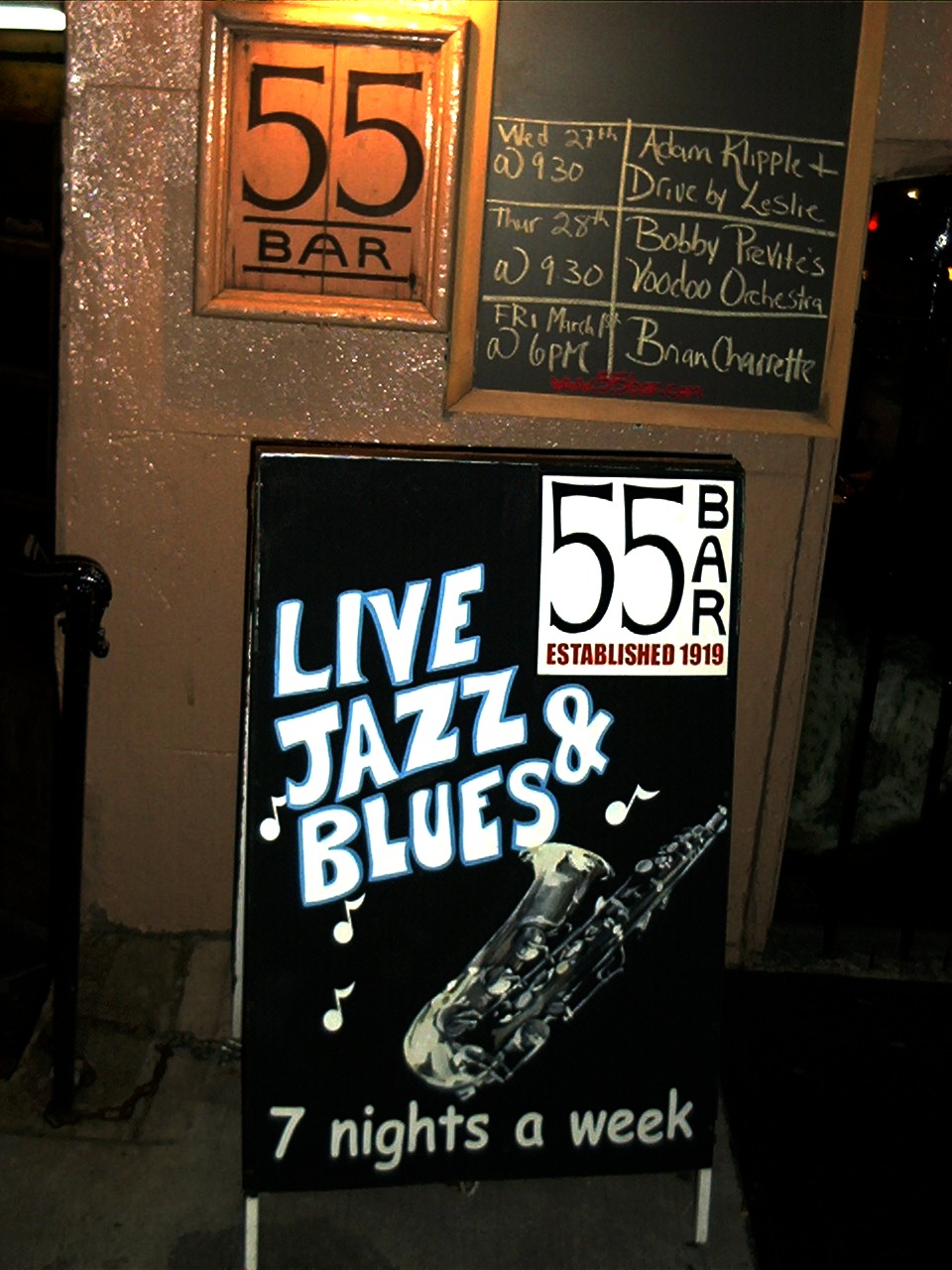
The first time I went to the 55 Bar (on Christopher Street just off Seventh Avenue) was probably late 1992 or early 1993. A friend of mine living in Weehawken and working in the City took me to see Mike Stern, whose trio played at the 55 every Monday and Wednesday. It was eight dollars a set, and although it seems ludicrous today, I’m pretty sure that included two drinks.

Stern was my initiation into the New York jazz scene, and I could hardly have asked for a better one. A one-time Miles Davis sideman, Stern plays a sophisticated fusion, a cross between the Al DiMeola “more notes!” school, which my guitar teacher, trying to get me to sublimate my heavy-metal urges, had guided me toward as a teen, and the bebop and post-bebop jazz that I had only begun listening to the previous year, while living in Madrid. I had bought my first jazz discs only months before, to supplement the Art Blakey and Thelonious Monk I had taped off an Australian friend in Spain. It was a fittingly cosmopolitan introduction to the music. Now I was back in the States, and for the moment in the New York area, and I was eager to start digging into jazz at its source and mecca.

Stern generally opened his sets at the 55 with a long, driving standard that built slowly from shuffling, chorus-infused lines to a blues-rock-funk climax. At some point along the way the drummer would trade his brushes for sticks, the bass would stop walking and start stomping, and Stern’s pick, which he’d been using like the drummer had his brushes, would begin to bite. During this rising action you could pick out the guitar-heads on their 55 pilgrimmage from the drool on their chins. They were all sitting on their hands, waiting for Stern to hit the overdrive and start wailing.

The slow movement of the set Stern would begin and end solo, fingerpicking, accenting the rounder tones he could get from his Telecaster, a guitar more often associated with country music. The “Tele” probably helped him to split the difference between the overdriven twang of his rock soloing (a Telecaster, after all, is just a one-horned Stratocaster) and his quicksilver bop … as well as to avoid the bulbous sound that players using similar effects often get from their big hollowbody Gibsons.

As for the last movement, it would return to something like the original allegro, though a bit louder, a bit funkier, and featuring an extended cadenza for the drums.

Of all the many tricks Stern smuggled in his deep pockets and up his ample sleeves, my favorite was when he would pick a single note on the high “E” string in swung triplets and interpolate chords on the upbeats. It’s an effective technique for crescendo: the chords zigzag up the neck; after a few bars, the repeated note will move up a third, say—higher ground on which to build another set of relentlessly-climbing triads. The effect is almost pianistic, with the contrast between the insistent high note and the shifting chords generating tension. When the passage was over, Stern would be someplace other than where he began—further up the neck, certainly, but on a new emotional plateau as well, although maybe not quite ready to hit that overdrive pedal. It’s a technique that fellow New York guitarist Ron Affif would take to its logical conclusion, quadrupling the speed of the high note to a mandolin-like tremolo, while reducing the accompaniment from a chord progression to a melodic line. In both cases, technique acts as a signature: it announces the musician’s identity as surely as a composer’s name coded into a score.

I remember how Stern used to look when he came in: hair unkempt, face unshaven, wearing a nondescript grey shirt and jeans and holding a diner coffee. He looked like he’d just gotten out of bed, which he might have; and truth be told on some nights he played like he was still asleep, or had woken up on the far wrong side. The waitress would rip our tickets in half (I say “our” because I’ve tried to repay the favor done me and take as many friends as possible to see Stern), and while we drank our first drink we would watch the musicians filter in, greet the people they knew, and chat while they set up their gear. I appreciated the lack of pretension, and the lack of distance between the audience and musicians. In itself this was nothing new: I’d been catching rock acts at small to mid-size clubs for a good five years, and more than once I’d stuck around to chat with bandmembers, whom I generally found to be down-to-earth and eager to discuss their music. But this was something more: a fantasy of being in the musician’s workshop, like one of those all-night jam sessions at the old Minton’s, although for what I knew at the time the comparison is anachronistic.

I always figured the 55 barflies hated those Monday and Wednesday nights, when the tourists and so-called bridge-and-tunnel crowd would pack that little bar to the gills, the acolytes crowding a foot away from the head of Stern’s Tele and jamming up the doorway to the bathroom behind him. The waitresses had to do pirouettes to get drinks to the tables. In this respect Stern’s appearance was apropos: the 55 was a dive, and proud of it. I’m sure they welcomed Stern for the same reason The Tower art theater in Salt Lake City held over the hit sports documentary Hoop Dreams for months on end: even at eight dollars a head, he paid the rent.

It’s the early-nineties décor I remember best of all. One painting in pastels showed a woman doubled over the back of an armchair. At the top was the injunction to “practice safe sex”; at the bottom, much larger: “FUCK A CHAIR.” Next to it was a mural-sized painting of a group of American presidents at a sort of Last Supper, with Reagan in the place of Jesus, a miniature mushroom cloud rising from his plate.

*

Besides the price, the pictures are about the only thing that’s changed at the 55. I miss them. Today, the walls are covered with the clichéd jazz-and-blues memorabilia you can find in any club: smoky, heavy-chiaroscuro portraits, iconic photos of Miles and Robert Johnson, “A Great Day in Harlem,” Blue Note album cover reproductions. It’s a small but significant difference: the 55 has gone from being a bar where jazz was played to a jazz bar. Maybe noplace can withstand a regular gig by an internationally-known musician for long without changing in some fundamental ways. But in a broader sense, what’s happened to the 55 is indicative of what’s happened to New York City as a whole, which for the last couple of decades has been busy draining itself of all its wonderfully garish “local” color, and repackaging itself as one more franchise in a global urban chain store, drawing liberally on its own myths to manufacture a brand identity.

I still go to the 55 a few times a year, though it’s been a while since I saw Stern, who still plays there Mondays and Wednesdays, just less regularly than he used to. Wayne Krantz was my surrogate Stern for a time, but his invigorating Thursday-night sets have (sadly) come to an end. Of all the other great music I’ve caught there recently, I wanted to single out the last time I saw Chris Potter, in part (but only in part) because it makes for an interesting counterpoint with the 55 of yore (at least my yore).

Like Stern, Potter is a rent-payer, and the crowd was the typical mix of music students, locals and tourists. By the time I arrived, there wasn’t a seat in the house, although several people were being instructed to sit in places where there seemed to be no available chairs. The waitresses were engaged in their usual calisthenics, and drinks were being passed like buckets in a fire brigade. The bar itself—I mean the wooden thing you lean against and set drinks on—was packed two deep all the way down, with the biggest crowd, as always, next to the band, making it well-nigh impossible to get to the bathroom before the set’s end.

I took a spot against the back wall, right by the door, standing with my feet slightly parted and my backpack clamped between my shins—there wasn’t even room for it on the floor next to me. It was actually the first of several elements that conspired to make the night’s set one of those quasi-religious experiences that recorded music simply can’t reproduce. There’s nothing like a little pain to get you in the mood for spiritual uplift: ten minutes of standing with my backpack between my knees, and I was ready to sink down on them and beg the God of Music for a speedy deliverance.

Add to this that it was one of those school nights when I shouldn’t have been out at all, had snuck down to the Village in spite of my conscience and better judgment, reading papers on the train in both directions. In this sense, Music was not only my god, but my mistress as well, and I was at once martyr and sinner. Who knew what my partner would find on my collar when I got home?

As for Potter, he stood facing me at the other end of the pub, as if he were my mirror image, or I his. He seemed to stare at a spot directly over my head while he played. And I couldn’t rid myself of the idea that he was playing for me, and only for me—this despite the acolyte who stood almost directly behind him, also facing me, whose face I watched from time to time, and whose changing expressions I began to mirror, as if I could make his emotions (surprise, wonder, pleasure) my own.

And as for the music Potter played … well, this was almost a year ago; I couldn’t name you a single tune. I couldn’t even tell you who his band was. But that tone … that tone! For Potter was channeling Rollins that night, his big sound poured, and poured, and poured, until the bar ran over with it. It pinned me to the wall more than any crowd could. And it swallowed me, as sure as Jonah was by the whale. Except that unlike Jonah, I wasn’t fleeing the Lord; I’d boarded that boat hunting Leviathan as much as any Ahab, had stayed on deck through the gale, waiting for Him to find me. And when He did, and opened His mouth, I held my nose and jumped in.

*

A closing observation on the Potter set: Depending on the tune, the bartender would turn the AC on or off. A ballad, and the AC would go off; a burner, and the AC would come back on. I just can’t imagine this being the case twenty years ago, before the music was put on an altar. In fact, I can’t imagine the 55 had AC at all, though I’m sure it did.

Then again, clicking the AC off for a ballad is really only a stone’s throw from FUCK A CHAIR, isn’t it? This little pub-that-could has worked hard to brand itself as a cross between Dizzy’s and dive bar, a place to slum with the anointed. The altar is made of plastic.

And then again, who cares? Altar or no altar, plastic or solid gold, old New York or new, the music has stuck it out, even thrived. The wood paneling may smell like cigarettes, but there’s music there, too. Put your ear to the wall and you’ll hear it, like the sea in a shell.
No Tie-Picker He


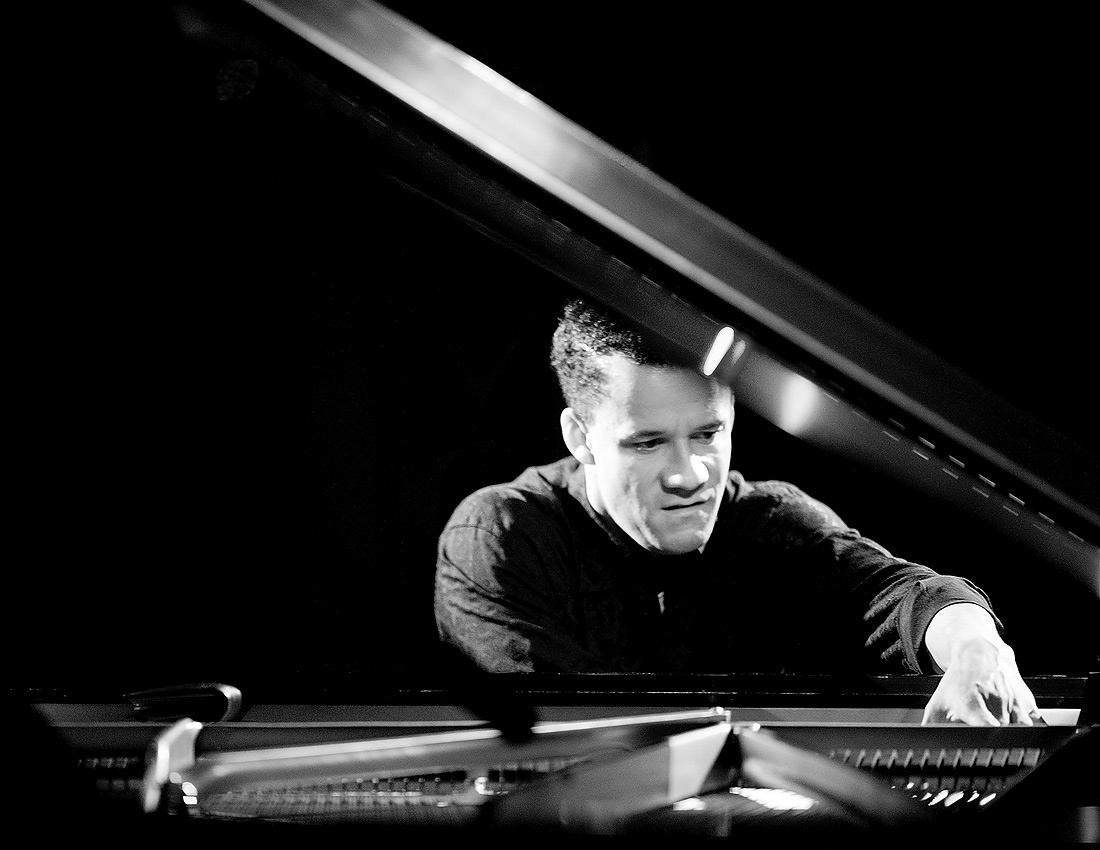
Photo/ Daniel Sheehan/ EyeShotJazz

I took a chance on Jacky Terrasson’s trio at the Jazz Standard the other night and I haven’t stopped smiling since. I don’t always take such chances at the City’s higher-end jazz clubs, forty-plus dollars (between the music charge, “tax,” drinks and tip) being a lot to pay for potential disappointment. But something told me to take a chance on Jacky. Maybe it was the fact that I’d be leaving New York a few days later to visit family for a month; that always puts me in the mood for one last live-music fix. Terrasson’s was the name that loomed largest in the assortment of guides and internet bookmarks I use to keep tabs on the local music scene, this though I knew him only from a single recording with Cassandra Wilson, called Rendezvous.

So I listened to the available samples from his most recent album, Push. What I heard (and granted, it wasn’t much) made me nervous. Push has that contemporary mainstream jazz feel that rubs me all the wrong ways: melodious to a fault, hyperconscious about making nifty harmonic turns, glossy and flat and just a little dull. It’s sort of a thinking man’s smooth jazz, a jazz without corners. I suppose I could blame Pat Metheny for this, but that would be rude, particularly after Question and Answer had so recently reminded me of what a great player Metheny is when he lets his hair down.

I thumbed my nose at Push and went anyway.

If there’s a watchword for the Terrasson set I saw, it would have to be communication. There was a freshness and openness about the playing that really moved me, and that only happens when the players are really speaking with one another. Sometimes the success of a jazz shows rests on how much one or another soloist is able to impress you, and if he misses the mark, well, there’s always the next solo, or the guy with the other horn. In most bands, too, there’s either an implicit or explicit hierarchy, and even if we imagine that hierarchy rotates according to which soloist is in the spotlight, some version of the hierarchy remains from one moment to the next. But Terrasson’s trio was very much engaged in a dialogue from the moment the players took up their instruments, and it was so open and obvious a dialogue that the listener, the audience, couldn’t help but feel invited to participate. This constant contact between band members was underscored by shouts and calls and a lot of eye contact. Again, in many jazz bands (and for that matter, chamber ensembles) the musicians furtively eye each other for the next cue from whomever is equivalent of first fiddle. But the cues in this band seemed to emanate from all points. It was a participatory aesthetic, and I think the great sense of joy in the music and performance arose from this.

For example: often when musicians are trading eights or fours they end up playing “over” each other. The sense is that the soloist hasn’t quite finished his or her musical thought, and so treads into the second soloist’s space (usually the drummer’s) with a guilty air. The phrase will conclude at diminished volume, or simply trail off. This is participatory, I suppose, but in the sort of private-ownership way where everyone owns their appropriate share. With Terrasson’s trio, however, there were several instances of Jacky and drummer Jamire Williams “trading,” but each continuing to play with the other in a way that supported or promoted the current musical idea. I didn’t get the sense, that is, that these players were competing with each other, so often regarded as the motive force of the music. Instead, I got a sense of musicians working collectively toward some greater goal … and enjoying themselves immensely in doing so.

I don’t mean this to sound like a paean to authenticity. Terrasson is quite the showman; he does the sorts of flashy things with his hands I associate with early videos of Duke Ellington, and which Ellington himself (if I remember correctly) adapted from the great stride pianists. Terrasson has been compared with Monk, and one can hear and see why in performance—hear it in the fractured and complex rhythms, see it in the swaying and dancing and standing at the keyboard. He’s at home in both a pop and more experimental milieu, and alternates swiftly and randomly between them, or collapses one into the other. Nor is he afraid to play dirty with the keyboard, throwing in an elbow here and there, or reaching out to take hold of the instrument’s guts. He’ll collapse genres just as easily, making a choir piece out of Michael Jackson’s “Beat It,” then swing the melody in octaves to give it a Latin feel, bring it to a pitch and ease it back to near-silence, all without losing the groove. (Apparently, Terrasson’s version also incorporates “Body and Soul,” at least on the record, but I didn’t recognize it.) In fact, all the tunes that evening had this quirky, blended feel, maybe best exemplified by the last number, which superimposed the bass line from Herbie Hancock’s “Chameleon” with the melody from a standard I couldn’t place. All told, it wasn’t so much daring (the word most often associated with showmen) as play. Daring is the wire-walker who takes a risk the audience marvels at. Play is much less outwardly directed, and even though it demands a similarly great assertion of ego, it is more careless. There are no risks properly understood, because there is nothing at stake. That he can do this and yet remain utterly conscious of his audience is Terrasson’s great gift. And it is his great gift as a “leader” that he enables, even encourages, his bandmates to do the same.

The blending of cultures so much in evidence in Jacky’s music is evident in his features as well. He looks younger than his forty-four years, too. Terrasson’s lantern-jawed face radiates a boyish charm. Retains a boyish charm? Yeesh, forget it. Only in moments of intense concentration do lines appear around his eyes, and the flesh around his mouth sags, and one is reminded that he is not so young as he looks … or sounds. But then maybe it’s his band that keeps young: the sum of their ages might be less than Jacky’s. I was shocked when they first appeared, bassist Ben Williams with his dreads tied up in a bandanna, his surnamesake sporting a quasi-mohawk and hipster glasses. I dug their ties, too. Jacky’s was skinny lavender against a dressy blue shirt. (Toward the beginning of the set he had to keep rolling his shirt sleeves up over his elbows—all that dancing—while drummer Jamire had to keep pushing his glasses up the bridge of his nose.) Ben wore a huge tie hung loosely around his neck and down the front of a baggy, un-tucked-in shirt. I liked Jamire’s best: it was tucked into his breast pocket; you could just see it sneaking out over the top.

Several years ago I went to see Ron Carter’s quartet at one of those free sets they used to have on Friday nights at the Rose Space Center (of the American Museum of Natural History). During a break, Carter commented in his urbane, nasal drawl on the responsibilities of a bandleader. There were three, but I only clearly remember one: to pick the band’s ties. That’s maybe the easiest way for me to make my point about Terrasson’s trio: I can’t imagine he picked those ties. Everyone seems to wear whatever the hell they want, but somehow they all match.

Not An Apology

First, a disclaimer: I’m not going to address Rand Paul’s quoting lyrics from “The Spirit of Radio” in his recent primary victory speech.

Five years ago, I don’t think I’d have stood in line for more than an hour to get into a midnight showing of Rush: Beyond the Lighted Stage, the band bio-doc that premiered (and won the audience award) at this year’s Tribeca Film Festival. But there I was, fingers crossed, at one with the marginally functional talking over the noise of their earphones, the jerseyed moms with their teenaged sons lamenting having missed Iron Maiden’s last tour, and the shmooish Gargantua showing off his homemade “Rutsey lives!” T-shirt. (If you don’t know who John Rutsey was, you might want to stop, toggle and Google before reading on.) I have to admit, I felt a little silly. Looking at “them,” I couldn’t quite recognize myself. I guess I’d forgotten what it feels like to be a fan.

I ended up getting an extra ticket off a guy wearing a Signals tour shirt. Of all things, my very first concert. The Garden, 1982. Can’t Fate be just a little subtle? I still have the same shirt, somewhere, faded to the same grey. The sleeves have climbed up my shoulders; the whole shirt throttles me now. As, of course, our past infatuations sometimes may.

A couple of hours later I left the theater walking on air, wondering why I’d ever questioned coming out in the first place. I had happily regressed, submitted myself to fandom; and as I crossed the Village, I carried the words and images and music wrapped about me like a blanket and a dare. I was acting like a recent convert; I wanted to stop at the nearest bar, order a beer, and share The Good News with the nearest drunk. But in reality I’d only been reminded of something: the undeniable truth that Rush is—I blush as I write the next few words—my favorite band.

I’ve always disliked the idea that one “grows out” of certain bands or kinds of music. You grow out of clothes, shoes, maybe allergies and political ideologies. But music? I don’t think so. At least, not in the same way you do shoes, etc. There are certainly some exceptions that prove the rule. (Styx, maybe.) But overall, this sort of willed obsolescence strikes me as immature as the opposite extreme: to wallow in nostalgia, to become the subject and victim of one’s youthful infatuations. Even today, when diversity and inclusiveness are supposed to define what it means to be a “cultured” person, there’s a regrettable tendency to equate taste with the sheer quantity of music one finds unpalatable. In this regard, “growing out of” something becomes the chief indicator of cultural maturity; for what more powerful way to demonstrate a ruthlessly narrow taste than to disparage what you once loved?

Most music grows with you, if you’ll let it. It’s much more rewarding, I think, to hear the old music in the contexts and perspectives of an ever-widening listening palette. That doesn’t mean you keep listening to the old stuff with the intensity or abandon you once did; you may hardly listen to it at all. But why not let your old favorites grate on your ears, and let that song you always found dull or troubling suddenly shine with a new light? In the end, all listening is an act of excavation (even if the archaelogical metaphor is complicated by the fluidity of the medium).

I suppose that after a certain time we should put away childish things, but where music is concerned I refuse to do so. Maybe music is itself a childish thing?

I digress this way with Rush in mind because, ever since I was in college, if I mentioned to someone that Rush was my favorite band, I always got a variation of the same response: I used to like them. I went through that phase, too. Which meant: You’ll get over it. Someday you’ll grow up. Or just: I’m sorry. It’s the sort of thing religious people used to say to me when I mentioned that I hadn’t found Jesus and wasn’t really looking, either. In the late ‘80s, growing out of Rush amounted almost to a rite of passage: not to do so was the cultural equivalent of ending up delivering Domino’s Pizza. In fact, the whole idea of having a “favorite band” smacks of a deranged naivete. They really go hand in hand: Rush (ugh!) is my favorite band (hurl!). Anyway, if this was the response I got when I was in my twenties, I can only imagine what most people my age would say to me today. I may as well just crawl into a hole with my “Rutsey Lives!” T-shirt, conduct mock interviews at home with life-size cut-outs of the band, like Rupert Pupkin in King of Comedy. Maybe I should have nailed a FANS ONLY sign to the head of this post.

Much of this perception has to do with Rush’s longstanding lack of acceptance by the rock critical establishment. In fact, if Beyond the Lighted Stage has a theme, it’s vindication: the sense that we, the fans, were “right all along”; at last, Rush have claimed their rightful place in rock history as one of “the greats.” Rush, it seems, was always condemned to be the band the hip don’t like, but that influenced all the bands the hip do. For the fan—that is, for me—one of the best parts of the movie was listening to testimonies by all these musicians from bands I never cared for, many of which were critically acclaimed, about how important and lasting an influence Rush’s music was for them. I left the theater on a self-righteous high.

It cuts both ways, though: Rush was listening to all those bands that were critically embraced through the late ‘70s and ‘80s, bands like The Police and The Talking Heads, and reshaping their sound according to what they heard. Once upon a time I could not understand how critics’ ears could be so tin (“oído de lata”) as to not hear that. I have a better idea today. Here is a band that in no way fit the image of rock-n-roll bad boys, and whose drummer-lyricist was (deep breath) a libertarian. In terms of the former offense, there’s none of the expected angry young Liebstod, none of the hope-I-die-before-I-get-old bullshit to milk over five or six reunion tours. Honestly, I always found this refreshing. Growing up, I was a bit too straight-and-narrow for rock-n-roll, and Rush told me that was okay. God forbid they sing about things besides smoking pot (which they do with great verve in “A Passage to Bangkok”), like honesty (ugh!) or integrity (hurl!).

From the filmmakers’ perspective, this may have proved a hard pill to swallow. How do you make a rock documentary without the de rigeur trashed hotel rooms, drug overdoses and messy breakups? How do you make a compelling story out of an uneventfully happy marriage? With the exception of Neil Peart’s tragic losses of his wife and daughter in the late ‘90s, there’s not much of a human interest angle to work with. As Lee and Lifeson say tipsily over the closing credits, the problem with the movie is that people will find out they’re actually boring. But then they’re so endearingly boring, so goofy and un-coiffed, that we tend to forget this. It may be the fan in me talking, but I can’t imagine that others wouldn’t find this refreshing, too—among other things, that being a rock musician, like any other musician, is a profession and not (necessarily) a lifestyle.

It’s the second issue, however—Peart’s libertarianism, and the way his politics are reflected in the band’s lyrics—that maybe best explains the critical cold shoulder. That I understand this today is in no way thanks to Beyond the Lighted Stage. The movie never asks why Rush was disparaged; it simply takes critical non-acceptance at face value, as an obstacle to be overcome in rock-Bildungsroman fashion. Given that this is the only real engine for the narrative, I’m surprised it wasn’t milked more heavily. I’m not saying the movie had to be “political.” I can’t think of a worse angle than, say, the “Reaganite ‘80s” explain the ascendency of Rush, or some other such reductive crap. But some measure of context—interviews with dissenting critics, say, rather than just a few blurbed reviews—would have helped to tease out the knotty relationships between music, commerce and ideology that are certainly part of the Rush story, if by no means all of it, and to balance the intimate portraits that are the movie’s strength. It’s as if the filmmakers felt they had to adopt the band’s ideology in order to portray them. (If one wants to understand why Rush can be so easily adopted by the likes of a Rand Paul, one should begin here: not with Peart’s libertarianism per se, but with the trope of the lone underdog struggling against some collective social evil (Big Government, Beltway Insiders, The Liberal Media, what have you), displaced onto aesthetics, emptied of all context, so that it takes on the crystalline purity of a myth.) According to this reading, critical dislike for Rush was always about something other than the music, and bashing the music was an excuse for bashing the politics. Then again, most of said critics would probably argue that the music and the politics are inseparable: Rush are a sort of Canadian Leni Riefenstahl, belting out anthems to the triumph of the will; if one admired them, one was ipso facto a creeping fascist as well. (For an insightful analysis of the band’s critical reception and of the fan culture of progressive rock, see Durrell Bowman’s “Let Them All Make Their Own Music” in Progressive Rock Reconsidered.) Then again, I would argue that if we have to look to popular music to validate our political philosophies, we’re in a whole heap of trouble, regardless of whether one ends up a Joplin-inspired flower child or an Objectivist convert via the gospel of Neil Peart.

I want to suggest something unorthodox for the orthdox rock critic and the orthodox Rush fan alike: do Rush without the words. I’m sure I was prejudiced by growing up listening to classical music, and it’s one reason I landed so hard on jazz in my twenties; but I’ve always preferred rock that doesn’t depend much on lyrics. True, I did know a lot of the words, particularly where Rush was concerned, and they certainly articulated and flattered the more romantic-individualist strains of my nascent political personality. But I also seemed to have had a penchant for making up my own versions of songs without bothering to check them against the record sleeves. (Apparently this is the case for rock fans all over the non-English-speaking world: they will phonetically know every “word” of a band’s songs, but have no idea what they’re singing.) And even when I did know the words, I confess I didn’t think about them all that hard. The sound of Lee’s voice, the sounds of the words themselves, the way the words were sung—all these things were more important than any meaning they were supposed to convey.

This means I didn’t run out and buy The Fountainhead after discovering 2112. At that point I was reading Stephen King and Fangoria and finding Billy Budd and Portrait of the Artist painfully dull (it probably shows). A friend of mine, the bass player in my high school band and another rabid Rush fan, read Anthem. I can’t remember what he thought of it, and I didn’t borrow it. My single exposure to Ayn Rand’s writing wouldn’t come until ten years later. I was on a packed bus in Buenos Aires, reading over someone’s shoulder. (Come to think of it, that’s how I learned about Beyond the Lighted Stage, too.) The book was in English. I read a page or two, and thought it was some of the clunkiest, most godawful prose I’d ever read. It was a big book, too, and I thought, If this is an English language learner, I should do them a favor and advise them to find a less painful primer.

That book was The Fountainhead, or Atlas Shrugged, I can’t remember which. Rand, anyway. I know it’s churlish of me to judge a writer based on a page of flabby prose. Dreiser (say) worked on a broader canvas, and it only takes a few chapters of cringing before the story sweeps me off my feet. The same is likely true of Rand. Or maybe not. I also know I’m supposed to dislike her ideas, not her prose. Regardless, that was my only direct contact with Rand; otherwise, I have only the hilarious sketch in Tobias Wolff’s Old School and a review in Harper’s of two recent bios to go on. If I had to guess, I’d say that when Peart’s lyrics are good, they’re good in spite of Rand, not because of her. Certainly I don’t need Rand to appreciate or acknowledge the power of those lyrics which still speak to me (a very partial list would include “The Fountain of Lamneth,” “Hemispheres,” “Natural Science,” and “Witch Hunt”). Anyway, who’s to say that Peart, who once described himself as a “left-wing libertarian,” hasn’t “grown out” of Rand, just as I’ve grown into Melville and Joyce? Or that she isn’t as yet a star in his universe, albeit a small, dim one? (In case you’re interested, the only scene in the movie where you can make out what the band is reading shows Lee with The Sound and the Fury, Lifeson with God Is Not Great.)

So … to post or not to post? This will throw a ghastly light over all my previous posts, I’m sure. All trust will be lost (trust is such a fragile thing, and so dearly earned!), all previous thoughts discredited, all endorsements made suspect. It’s a skeleton key for understanding my whole listening past, some vulgar Freudian plot worthy of ‘40s Hollywood, my musical primal scene disseminated throughout the web. I was supposed to get over this. Really. But I keep listening. That’s bad, isn’t it. Is it? I like dinosaurs, too. Sometimes, I watch Shark Week on the Discovery Channel. Jesus, Shark Week. That is bad. Should I have said that? Get out your little notepads, all of you. Scribble scribble scribble. Ah, see, I told you, didn’t I? I’m afraid that’s very bad. Ve-ry bad …

I promise my next rock post will not be a confession. But maybe the movie should have been called Out of the Closet instead of Beyond the Lighted Stage.

And since I promised I wouldn’t talk about it, here are the lines Rand Paul quoted: “Glittering prizes and endless compromises/ Shatter the illusion of integrity.” Ah yes, Mr Paul, but those lines are about music, not Washington. It says “music” twice before in the same verse, and the word “radio” is in the title, and words like “studio” and “concert hall” pepper the lyrics, too. In fact, the theme of the struggle between art and commerce wraps around the album; from “Natural Science”: “Art as expression, not as market campaigns/ Will still capture our imaginations.” Not that you can’t take it all metaphorically, of course; but to be honest, I can’t help but hear the “market campaigns” and “the sound of salesmen” in your rhetoric, as much as in the rhetoric of your colleagues across the aisle; and conversely, I can’t help but hear, in “The Spirit of Radio,” in tone, form and content, a partial self-indictment, a tempering of the anger of 2112 into a deliberation on what it means to be professional popular musicians, to be entertainers as much as politicians are … and yet to hold onto the possibility of retaining one’s honesty (ugh!) and integrity (hurl!) in the process—to finding a balance. It’s an idea that returns over and over in the words and music: Hemispheres, Counterparts; art-rock complexity and pop/hard-rock simplicity; their ongoing shuffle on that step between the sublime and the ridiculous.

But I’m as happy to hear you quote it as anybody. It’s a song so fine not even you can diminish it.

*

If I should apologize for anything, it’s probably the length of this post. Rest dismayed, where Rush is concerned I’m only ever just warming up. And as long as I’m being metacognitive, one other note: this blog as a whole is set up so that I have to approve comments before they appear. This may be wise, since it is open to the internet as a whole, not just CUNY; but I’m going to try to figure out how to set it so that comments appear when they are posted. In case, that is, you ever tried to leave a note and figured the site was busted. By the way, I just read that Paul got the cease & desist letter from the band’s lawyer. Copyright infringement, ya know.

Underground Man

One dusk not so long ago I was walking around the tract housing development (or “semi-custom,” as some of the locals call it, except that there are no locals there, and no such thing, when you come right down to it, as semi-custom) north of Houston where my parents live, listening to Out to Lunch. I should begin by saying that this is the sort of neighborhood that makes marijuana pointless. The combination of curving streets, dead ends, and nearly identical houses make me want to leave a trail of breadcrumbs. Everywhere I look are the haunted traces of suburban bliss: overturned bicycles on lawns, abandoned playgrounds with empty swings slightly rocking, single-car garages awaiting their occupants. Some days it all reminds me of a façade built on a testing range in the Nevada desert.

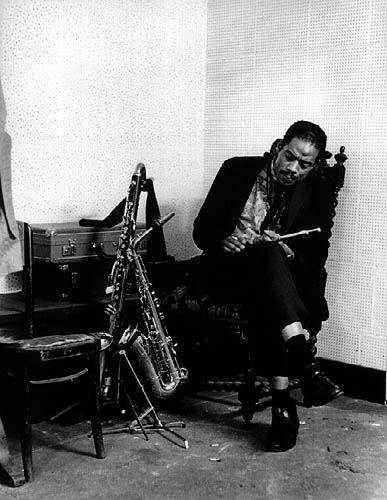
That evening, passing house after house in the near-dark, I was struck by a counterintuitive aesthetic kinship. For my typical feelings of disorientation were heightened almost to dizziness by the wonderfully disorienting compositions and improvisations that make up Out to Lunch … so much so that, after walking for a while, I was forced to retrace my steps in order to get back to my parents’ house, even though, as I realized later, I had made almost a complete circle. I could only blame Eric Dolphy for this: for pretzling the insipid curves of the suburban beautiful; for making me believe a man in a bowler hat stood poised with a net behind every door.

I think what Dolphy’s music did was expose the neighborhood’s essential weirdness, dis-integrating it, disassociating every element—every lonely pine tree, every shutter, every glass door—from every other, and making all of them seem like the products of an alien culture. In “Aminadab,” Sartre defines the fantastic this way: you order a coffee; the waiter brings you an inkwell; you say, “But I ordered a coffee”; the waiter says, “That’s right.” In fact, Sartre’s conception of the fantastic as “the revolt of means against ends” is a not a bad formula for describing Dolphy’s music.

Unlike in the suburbs, though, there is no retracing your steps with Dolphy, no equivalent of a trail of breadcrumbs. There is only a staggering forward motion, as of a man riddled with bullets, leading only to the most unexpected places, or to nowhere.

Out to Lunch is probably the pinnacle of Dolphy’s ensemble work. As has been noted, this is because it is the only Dolphy album where the walking rhythm section gives way to free-form improvisation by all the bandmembers. And what a band it is. Bobby Hutcherson’s vibes seem to fit most perfectly into Dolphy’s idiom, forcing us to ask where the vibes were before. (Mal Waldron’s piano occasionally has that vibelike timbre on the Five Spot sets and other albums; but it makes me wish Dolphy had recorded with Earl Griffith, whom I know only from the Cecil Taylor recording Looking Ahead!) The Richard Davis-Tony Williams rhythm section acts in perfect questioning counterpoint to the rest of the band, Williams’ resounding toms and bass drum in particular. In fact, the snare is almost vestigial. Only Freddie Hubbard seems a little out of his element here, as if he occasionally realizes he’s lost his way, and by doing so makes the listener aware of it, too (rather than simply being pleasantly lost with the rest of them, and us).

One thing that needs to be stressed about Dolphy is his gift for melody. It is a paradoxical gift. His melodies are at once catchy and unsingable, groovy and jagged. The heads of “Out to Lunch,” “Gazzelloni,” and other tunes will stay stuck in my head for days after I listen to them; and yet I’m sure my memory of them is corrupted, both in terms of time (for “Out to Lunch,” for example, it’s notoriously difficult to remember where each symmetrical part of the melody ends, as well as how long are the breaks between each part) and pitch (I hear a travestied version in my head, and woe is me if I try to hum them accurately, or figure them out on my guitar). There is something magical about this combination of the seemingly-accessible but perennially-out-of-reach. They’re a long tease; the alto sax, the flute, and the bass clarinet are all laughing at me, each in its appropriate register (whoop, giggle and guffaw, respectively).

Part of what makes the tunes so catchy is their infectious rhythm, which Dolphy carries over into his soloing. I remember listening to him on the Live at the Village Vanguard recordings with Coltrane’s quartet (this while driving a rental car into San Francisco via the Bay Bridge) and realizing that he swung like crazy, yet every note—every note!—was “wrong.” The rhythmic grammar of bebop was being co-opted to speak a new language. If Scott Deveaux is correct (in his awesome Birth of Bebop) that it was the rhythmic more than the harmonic advances that made bebop bebop, then perhaps it was with Dolphy (and the other musicians forging the avant-garde at that time) that bebop rhythm began to find an appropriately crooked harmonic language.

There are other fascinating elements to his soloing, on Out to Lunch and other albums. Dolphy can play a slow, whining blues like nobody else, with a plaintiveness that borders on self-mockery. And then those trills, always too high or too low. The huge leaps across the range of the instruments. The moment on “Out to Lunch” when, after all that empty space (the whole album absolutely revels in space), the alto irrupts back into the song in a long cascade of misplaced notes. On the other hand, I also like the way Dolphy has a standard line that he plays over and over and over again, that he must have played a million times over his short life. He plays it seemingly unthinkingly as he gears up for each next musical idea, returning to it obsessively, though with slight variations. It is the musical equivalent of “ummm …” As such it is the purest expession of his musical thinking, the background radiation of his personality. I imagine it was what he was thinking from the moment he forsook the nipple for the reed.

Dostoevsky’s Underground Man raged against the tyranny of 2 + 2 = 4. Why, oh why couldn’t 2 + 2 = 5? Well, Dolphy is that happy psychotic for whom 2 + 2 is 5. He was utterly, unshakeably convinced of this. It was his great leap of faith to believe so, the law of his particular universe, to which, of course, he was perfectly well-adjusted. It’s probably why he was (reputedly) such a sweet person. And it’s no wonder so many other musicians wanted to come along.

Circus Masada

Just this: You’re riding the Bx 19 bus up 149th Street to the Grand Concourse. On your headphones, the mad Jewish carnival that is Masada, the song is “Karaim,” on the album Gimel, these words mean nothing to you, but the music still conjures images of acrobats somersaulting between trapezes and elephants stampeding around tents. And what should you see when you look out the window but a black man furiously pedaling a unicycle up the hill beside you, keeping pace with the heaving motor of the bus? This latter-day John Henry, a circus runaway, surely, first to, then from. He’s balanced high above the pavement, his coat is slung over one arm. Such serendipities can happen anywhere. But why do they seem to happen with such greater frequency in New York?

Encore

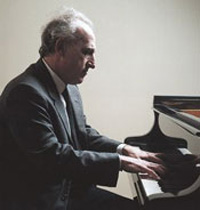
If I had to hazard a guess as to what was the musician, ensemble, or band I’d seen live more than any other, it would probably be Maurizio Pollini. The first time I saw him I was in my early teens, and I’ve repeated the experience maybe thirty times since. I know this is a number more commonly associated with rock bands, like The Dead and The Who, but it does make some sense: reunion tours notwithstanding, most rock bands don’t have this sort of longevity; classical and jazz musicians are more likely to age with you (plus the jazz musicians, when they’re local, are playing around town all the time). I saw Pollini play the complete Beethoven cycle in the late ‘80s, and got stage seats in the late ‘90s when the regular auditorium was sold out. There are some pieces by Beethoven, Chopin and Debussy I’ve probably seen him play a dozen times. If for whatever reason a year goes by without his coming to Carnegie Hall, I feel like I’ve skipped a season.

This year promised to be a treat: a series of three recitals, all of them all-Chopin. I bought tickets for all three, and then promptly missed the first during a blizzard of grading. It made me that much more eager for the second, which was last weekend, and the third, which, as I post this, is later today.

Among Pollini’s many gifts, perhaps the chief one—particularly for a pianist who specializes in that instrument’s romantic literature—is his ability to play commandingly at both ends of the dynamic range, from quiet passages of great expressive subtlety to tempestuous, often technically brilliant outbursts. It may just be my aesthetic, but the second seems the rarer gift. Playing the climactic moments of the great Beethoven sonatas (for example) convincingly, in such a way that the listener (at least this one, at least occasionally) is transported by the sublimity of the music, seems to me the true test of romantic pianism. It is in just such moments that many of even the greatest pianists fall short. Maybe it’s the dread of sentiment, or ridicule. (Emmanuel Ax to a student in a master’s class, regarding Brahms: “I want you to play faster and louder.” Chuckles from the audience, but hell, that’s the way I want my Brahms, too; and if you don’t give it to me that way, you might as well go play Haydn.) In fact, one of the things that has most impressed me about Leif Ove Andsnes (of the younger generation of top-notch pianists) is just this confidence at the all-guns-blazing end of the dynamic range.

One other thing about Pollini: he is as close to technically flawless as seems humanly possible. One can’t help but get used to such perfection … and to come to expect it.

Last weekend’s was a lovely program: two nocturnes, two polonaises, four mazurkas, the second ballad, the second sonata, and the opus 49 fantasy. But with the exception of the ballad and parts of the sonata, the execution fell well short of my expectations. Had it been only the fantasy (a piece I’ve always had trouble with, and hence am perfectly willing to blame Chopin for …!) and the occasional missed note, I might not have been bothered enough to write. But my disappointment was general, and seemed to arise from every facet of his playing. A nocturne, for example, should be easy to fall in love with. Just last year he played one as an encore, after a program of breathlessly-executed Beethoven, and my partner and I agreed that it was the finest thing he played that whole evening. So delicate. But on this night the nocturnes did not seduce me; the high notes in particular sounded strident. As for the sonata, the bells of the funeral march were muted—hardly bells at all—while the last movement, which on Pollini’s recording is barely audible, eerily affectless, and blisteringly fast, an undertow of notes, notes, notes, like some dark thought tormenting you, was muddled by dynamics that diminished the overall effect. The encore—the second scherzo—only sedimented my feelings about the whole recital. That technically daunting passage bridging back into the piece’s “A” section was almost painful to listen to.

Pollini, off? Surely it was a sign the end is nigh. I remembered the recent spate of earthquakes, the volcanic eruption in Iceland, the oil spill in the Gulf. Faiths would crumble, relationships end, distraught listeners leap from the balconies …

Or perhaps not. Nobody seemed to notice; the applause was general, thunderous; apparently the heavens don’t fall for such a trifle, as Conrad so aptly put it.

To be honest, by the end I wanted the audience to stop applauding. They’d never seemed so sadistic, or the pianist so much a gladiator, helpless but to engage in combat, now not with the music, but with his own body. I’d seen him play that scherzo before as an encore, obviously exhausted. But this seemed like more than mere exhaustion. And to think he could have come out and played a nocturne. I’ve seen him shrug before sitting down to play an encore, too, as if to say, What the hell. But there was no shrugging last weekend. It was as though he realized that he had no choice, that he was chained to that piano, slave to whipping-post.

*

During the concert, as my disappointment grew, my mind wandered from the music, and I started thinking about the piano’s role in our culture, and about what the public expects of its classical pianists generally, and Pollini specifically. Robert Walser traces the piano’s role as “music’s central vehicle for heroic individualism” back to Franz Lizst’s “invention” of the solo recital in 1839. Little seems to have changed since then, at least in terms of what we desire from our pianists: the incarnation of that heroic ideal, a musical athleticism that we don’t expect even from other classical performers. Not for nothing Chopin was portrayed by a barrel-chested Cornel Wilde in 1945’s A Song to Remember: the thirtysomething dandy already dying of tuberculosis must be dashing and exuberant, and built like Michael Phelps, at least for Hollywood. Today, the classical music industry seems to churn out hot young pianists as fast as supermodels, all bemedaled from this or that international competition. What happens to them as they grow old, or obese, or infirm—that is, as the body interposes itself between the music and the heroic spirit? Do they really age with us, as I said earlier, or are they turned out to pasture?

The above is not true of all pianists. Alfred Brendel, for example, crafted a very different persona for himself, a sort of living New Yorker caricature: bashful, introspective, erudite. (None of this is meant as a criticism of his playing, which I admire.) But Pollini has always seemed to be the poster-boy for romantic pianism. And he has retained this persona as his hair has grown whiter with each passing year.

I’m wondering, then, if what I witnessed last weekend was the passing on of the younger pianist, and if it is a transition that Pollini has not yet fully embraced, or does not quite yet know how to make, or, perhaps, is as yet unwilling to. I’m wondering, that is, if Pollini still wants to be the great athlete of the piano, even as his overwhelming technical facility begins to fail him. Because only an athlete could play the second scherzo for an encore. And last weekend, the athlete stumbled. Thinking back, I’m wondering if the desperate speed at which he played the Beethoven sonatas last year, his near-Puritanical distaste for rests, was a harbinger of this year’s recitals. And I can’t help but remember tubercular Tristram’s desperate, sentimental journey through France in Book VII of Tristram Shandy, fleeing Death and dancing mad circles with peasant girls; and the aging protagonist of John Cheever’s story “O Youth and Beauty!” assembling the furniture around the living room to run the hurdles one last time, about to be shot dead by his long-suffering wife.

All this is not to say that Pollini is a virtuouso without the depth of spirit to interpret these works. Nothing could be further from the truth. Pollini is a brilliant, even generous, interpreter. Today, we tend to be suspicious of virtuosity, as if any such display were necessarily emotionally bankrupt. It’s a combined product, I would guess, of the cult of authenticity and the culture of distrust. But like anything, great technique is as full or empty as the uses the artist puts it to. Virtuosity and affect aren’t so easily extricable from one another as seems to be imagined. Anyway, what was remarkable about this Pollini recital was the way in which a slight shift in the pianist’s ability to phrase and articulate and ornament pulled the curtain aside on the wizard, and all the gorgeous effects on which our emotional engagement with the music depends, and which themselves depend so much on coloring and sustain and a jumbling of musical phrases into a warm, distorted whole, suddenly vanish before our ears.

Finally, an irony to ponder. What does it mean for the music of a terminally ill thirty-five-year-old to be routinely performed by robust men and women of twice that age? Do the inverted ratios of health and age lead performers to perennially miss something in Chopin’s music?

Addendum. While I was in line for the bathroom at today’s third and final recital, I overheard an older gentleman commenting on the previous recital. He was disappointed, too, and when he saw me nodding vigorously, we fell to talking. It turns out that Pollini had been ill, though I’m not sure how he found this out. He thought they should have canceled or postponed that concert, and I agreed. Anyway, I’m just pleased that the infirmity was only temporary. The berceuse today was a gem—how can anyone’s right hand can get those sounds out of a piano? It was also great to hear him back in form for the Bm sonata, a piece which, like Pollini, grows with me. May he continue to run those hurdles for many years to come, Death nipping at his heels the whole way.

And still the nagging question: Why the second scherzo for an encore, if he was indeed sick? And so all the musings about sadism and aging romantic bodies and musical athleticism continue …

Spring, Washington Square

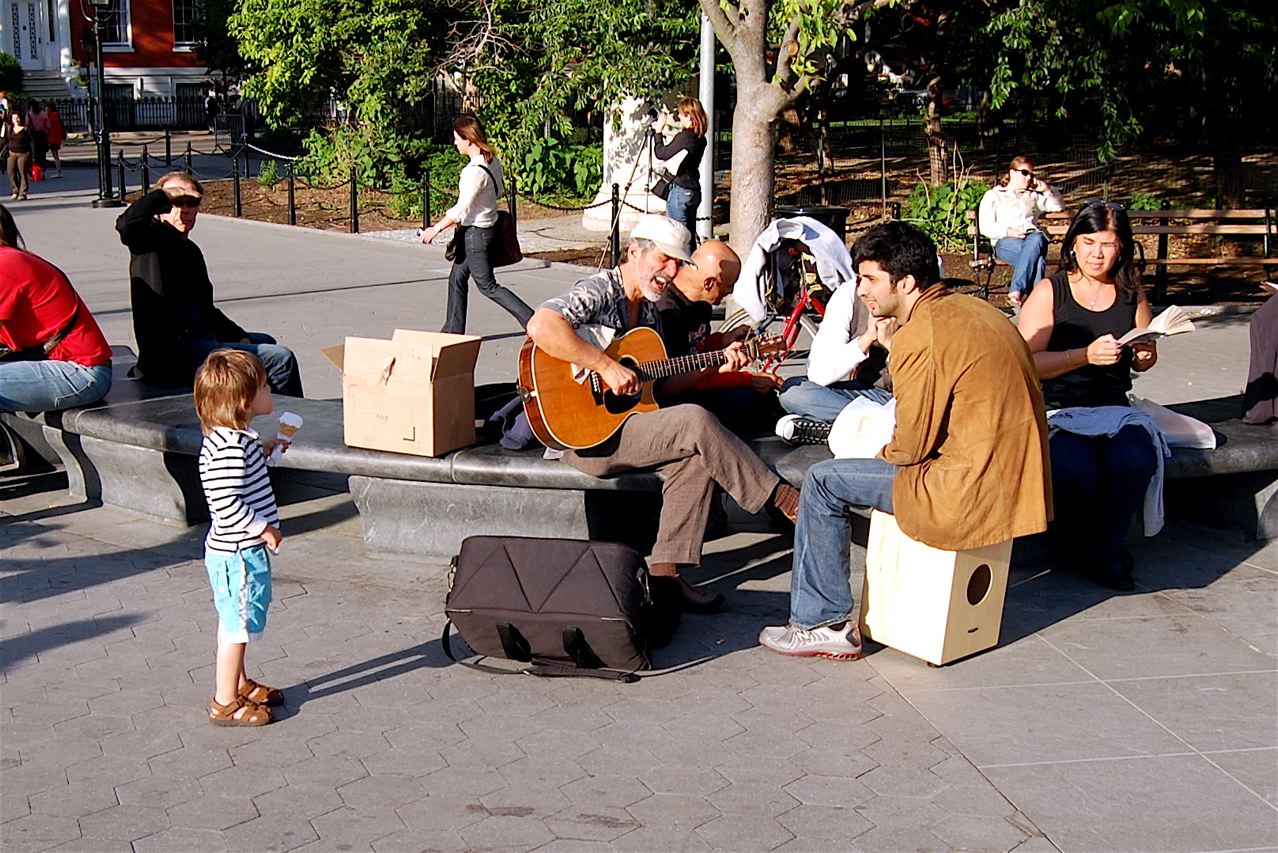
I love spring in Washington Square, when the musicians come out with the crocuses and daffodils. You’ll be walking through the Square on one of the first warm days of the year and hear the strains of a trumpet or a saxophone you hadn’t heard since the previous fall, and you’ll recognize it immediately, though the notes, and by and large the musicians, are as anonymous as cathedrals.

The other day I took a train to Park Slope hungover and got my taxes done and had lunch and sat down in Ozzie’s café and finished Sweet Hearts by Melanie Rae Thon (what a writer) and then sat drooling and half-dozing watching the shops across the street re-open while the sun emerged from behind clouds and beat through the window. Then I took a train back to the City. I listened to “Perugia,” maybe the most mournful piece on Brad Meldhau’s album Places, while the B train crossed over the East River, listening to the clatter of the train over the music and watching the water and the city behind and before me for the duration of the crossing. The sun wasn’t going anywhere now, and between the satiety of the receding hangover and the slight caffeine buzz and the nostalgia of the music and the view of the city from the bridge high above, all of these things colluded to bring about one of those lingering moments when you think about old lovers and other possible lives, and you feel a secret sad joyful resignation. I felt pleasantly scummy, too, as if I’d never made it home the night before, as if I were still in my itinerant twenties, all full of wanderlust and the spirit of vagrancy.

So I wasn’t ready to go home yet. I got out at Canal and footed it up to Washington Square, on this first real spring day after half a week of torrential rain. How could the Square not look radiant? And who should be playing on this day but Lawrence Clark. Lawrence is a young tenor player I’ve spoken to a couple of times. He seems to have had a champion in the late, great Rashied Ali, whom he played with at the uptown Charlie Parker Festival in 2008. Another time I tried to go see him at The Kitano, but he didn’t show. (An image from that set sticks in my mind: a drop of spit clinging to the edge of the bell of the trumpet, falling, forming again there.) He played brilliantly at the Festival—better, I thought, than the young altoist whom the crowd obviously preferred, and who won the day’s perhaps unintended (but always implicit?) cutting contest. Her sound was more firmly grounded in R&B; Clark, following Ali, has a tendency to play farther out. The crowd that comes out for the Charlie Parker Festival is not the same crowd that goes to, say, The Stone, or Roulette—not even the crowd for the downtown sets on Sunday, so far as I can tell.

Clark’s blowing has a buttery tone reminiscent of Rollins’s. At least, that was what struck me when I sat down to listen to him play, closed my eyes in the sun like I had in Ozzie’s. Jazz sounds almost preternaturally good after a hangover. You surrender yourself to the music, you let it wash over you. And then all the pores in your body open, and the music saturates you. Of course, there’s a time and a place for intellect and processing, for standing back and comparing musical phrases, for thinking the music even as you listen. But this was not such a time or place. Not in Washington Square, at the beginning of the spring, after drinking too much. These are moments for surrender.

It was a trio, sax and bass and drums. The bass player had thick dirty fingers—Brahms had fingers like that—and a red star on his baseball cap. There was a plastic wheelbarrow set in front of them, for donations. A wheelbarrow. It seemed a bit ambitious.

Look at them: they have no right to play music like this, this well. They might have wandered here off the street. They might have just met. History has not anointed them geniuses. They have no right to play music like this, this well. Which, I guess, is one reason they do.

It was like running into an old friend—even though these musicians wouldn’t know me from Adam—because the sound, the sound was back, very much the sound of the Square. (And this remains true, mind you, even as much of the old vibe seems to have migrated north, to Union Square.) I’ve always loved this quote from Eric Dolphy: “Once the music’s over, it’s gone, in the air, you can’t get it back.” But in the Square you can get it back; the circle is inscribed in the square, the music is as cyclical as the seasons, and as transient as the passers-by. That’s the beauty of it: you leave one day in the middle of a song, which fades slowly out of hearing as you walk away; but you’ll pick it up again the next day, or the next week, or the following year. Each band may be staked in a different corner of the park, but the listener lives on the frontiers, the melodies mesh one with another. And in the meantime the other business of the Square goes on around, a Whitmanesque time immemorial of walking-meeting-parting-listening-playing. And so you’re never sad to just be passing through, because you’re never just passing through, because you know you’ll return to this very spot, and the sound will be here, an old friend, waiting, in that one long jam without beginning or end.

Immortal, Beloved

Immortal_photoThat I am not a true fan of Immortal, the seminal Norwegian black metal band (black as in Satanic, not African-American), but went to their recent show at the Brooklyn Masonic Temple anyway, is a sin for which I am still repenting. What follows is the text of my confession.
I was lost in Clinton Hill looking for the place—I had forgotten to bring the address; all I could remember was the first letter of the street name; the subway station was without an area map—when out of the blue my guardian demon appeared. She was pale, gangly, maybe nineteen years old, with stringy blond hair, and dressed in black from boots to hoodie. I asked her if she knew where the Brooklyn Masonic Temple was; excited, she asked if I was going to the Immortal show; I confessed that I was, and so we started walking to the venue together.

About a block later I could sense that she was becoming suspicious. After all, I didn’t look like an Immortal fan. I was dressed in a blue windbreaker over a quilted chamois shirt that everyone says makes me look like a lumberjack. I had on new jeans, North Face shoes, and a New York City Parks & Recreation baseball cap. I should have been on my way to play tennis, not to a black metal show. In fact, I don’t think she believed I was going to the Immortal show at all. I was really some middle-aged creep in a blue windbreaker preying on nubile young black metal chicks in the middle of Brooklyn.

True, underneath the windbreaker and chamois I was wearing a Mastodon T-shirt: the open-mawed white shark with the legend “Megalodon” in electric red letters. But a prog-metal shirt would hardly convince her that I was anything but a poseur. (Probably better I didn’t engage in any unzipping or unbuttoning in an attempt to show her my shirt. God knows how that might have been interpreted.)

She said, “So, what’s your favorite Immortal album?”

The ultimate fan question! It was like she had peered into my soul. Everything came out then: how I didn’t really know Immortal; how a friend of mine had bought me a ticket; how, had I known the show was forty-five dollars, I probably wouldn’t have come at all; how I had listened to one of the songs from the new album on YouTube and “liked it”; how I had actually seen Immortal once before, a couple of years back, opening for Halford and Testament at B.B. King’s, and had “enjoyed them” (in reality, I hardly remembered them at all, except for their creepy corpse-paint and synchronized thrashing).

Why was I suddenly so defensive? I could justifiably have said that I’d been listening to metal since before she was born. And yet, what would I have been trying to justify? Would there be some sort of litmus test at the door? Would I have to drink the blood of a ritually-butchered goat and recite the Lord’s prayer backwards? Would they at least give me part of my forty-five dollars back if I didn’t make the cut?

She said, “Wow. I never met anybody who was indifferent about Immortal before.”

And with those words it was clear that she was done with me. I had been consigned to the dustbin of metal history, together with my heroes, who were yet older than me.

*

At the show my friend and I bought tickets for beers like we were at an amusement park and commented on the number of hipsters who were crashing the party. I was safely with someone nearer to my own age now, so I could claim old-guard status, and hence a certain degree of authority. After all, whether I loved Immortal or no, I was here because I loved metal; I wasn’t one of “those hipsters” who had come to stand in the back and sneer. I thought, “Thank God for hipsters,” and drank until I almost put that nineteen-year-old Immortal freak out of my mind.

I did end up enjoying the show, as I knew I would—the endless blast beats, the suffocating double bass, the sheer squandered volume of theatrical smoke, the generally eeeeeevil atmosphere they managed to create between the music, effects, and corpse-paint.

But there was something I enjoyed much more than Immortal, and that my non-love for Immortal allowed me to appreciate. It was watching those who did love Immortal. There were fans there as young as eighteen (and maybe younger, despite the age cutoff) and as old as fifty. They were there with their girlfriends or boyfriends or in same-sex groups. They absolutely exploded when the lights went down, and the shadow of the drummer appeared behind the kit, and then the other two members of the trio sprang from the wings in a miasma of noise and smoke. They banged their heads and made devil-horns. They knew all the words, and “sang” them, too, as surely as if the lead singer had said, “Now, boys and girls, aspirate along with me …”

There’s a gesture I’ve been thinking about a lot since that concert. Not the fist, and not the malocchio. The hand is open, palm turned three-quarters up. The fingers are slightly curled—the index finger should be the most extended, the pinky most curled—and taut, so that the hand looks like a claw (see photo). The arm is also rigid, bent slightly at the elbow, and raised over the head. Now, diaphragm tensed, spit the lyrics back at the singer-guitarist, word for word, mirroring his delivery. That was what I saw when I looked around the crowd: dozens of passionate individual performances, souls strung up and together by music, fans demonstrating their intensity to themselves and the rest of the crowd and the band. The arm really has to go up for the words to be broadcast with their full measure of vehemence (unless, that is, you’re also playing the guitar) … the metal version of that much-parodied gesture of singers worldwide, be it opera or flamenco or Irish ballad.

Ah, love for Immortal. What could possibly be Satanic about that?

Convalescing With Miles

milesA few Fridays ago I was listening to Out to Lunch, WKCR’s weekday afternoon jazz program, as I try to do whenever I have the opportunity. Because Friday is the day I’m least likely to be listening, and because the DJs rotate from one day to the next, and some only work every other week, the voice on this Friday was unfamiliar to me. It was a female voice, a British voice; apparently, it was the voice that DJ’s every other Friday. I was at home, convalescing, or hoping I was convalescing, the process can be so slow, the body so unreliable. And this voice, it seemed better suited to a classical music program than to jazz … but of course it’s ridiculous to associate British accents with classical music, just as it would be to associate New York ones with jazz. The whole ethos of KCR would crucify me for such a prejudice—if, that is, one could be crucified by an ethos, and if it weren’t too ironic to be crucified for a prejudice.
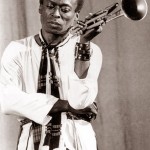
Anyway: I want to thank this DJ, whatever her name is, for playing Miles Davis, and nothing but Miles Davis, on this day, day of hoped-for convalescence. For playing songs from Walkin’, and Seven Steps to Heaven, and Miles in the Sky. New Miles, old Miles, Miles known and un-: I could think of nothing I’d rather have listened to. In the best possible way, and as he has in the past, Miles settled on me. I remember many years ago listening to Kind of Blue and sensing that there was an effortless perfection about Miles’s playing, and a sense of inevitability about his choices. Each note spoke the next one, which looked back upon the last, and which, somehow, could have been no other. And I was convinced of this, even as I understood that, at each moment, he could have chosen any other. And so I walked along with Miles, carried by him, expecting and not expecting each next note, each next note making so much sense that I couldn’t imagine it otherwise; listening, I couldn’t help but say yes, of course, that’s right, as if Miles had just proved to me that this note necessarily follows that one, and the next the next, with all the beauty and certainty of the simplest proofs of geometry. Miles told me there was noplace else to go. And that, in its small way, was comforting.

Miles settles and rolls, never strains or trembles, hoeing that straight, simple line (for a hoe in the hands of an experienced farmer is as expressive a tool as a jazzman’s horn). Wherever he moves—and he never really stops moving—he’s always at home. Such grace and poise and confidence, even in those growled motherfuckers. The result doesn’t sound like improvisation; it has more the feeling of sculpture; even as it unfolds in time, it has a spatial, plastic quality, as if, after he were done, you could hold the entire solo in your hands, turning it; or as if, while listening, you were walking not with but around it. You appreciate it as a whole, even though you can never hear it all at once. Sonny Rollins has been credited with introducing this sort of structural unity to the jazz solo. But I can’t imagine Rollins without Miles; there is the same seeming inevitability of choice about both men’s playing.

I’ve listened to a lot of Miles since that moment many years ago when I realized the above, listening to Kind of Blue, realized but never tried to say it; but I hadn’t really felt it again until this day—felt it and remembered that feeling, remembered what Miles is (as opposed to who he was). And that made me want to go on, and go back, and keep listening. So again, Ms. DJ, with your fine British accent and good taste, and with those vast archives at your disposal, whose name, in this age of the internet, I have chosen to let remain a mystery: thank you. A lot of music is a salve when you’re ill, but some is more salve than others. And then there’s some you just can’t be healed without. Miles fits the last category.

J.S. Bach: The English Suites

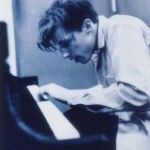
glenn-gould-canadian-pianistWhat struck me listening to the English Suites this time around (the Glenn Gould recording from 1977) is how different they are from each other. Each has its own personality. The second, for example, is expansive and refined, the first with such a long, imposing prelude, culminating in at once the most soaring and static (cathedral-like?) of gigues.* The third is the polar opposite of the second: it is hardly adorned, building patiently on its musical phrases, giving the performer time to settle them at his leisure. The fourth is expansive like the second, but of a romantic mood. The fifth sounds almost impossibly modern. I don’t know why it strikes me this way; Bach was hardly a stranger to chromaticism. As for the sixth, where to begin? At the end, maybe. The gigue is haunting. But here, I particularly appreciate the playful gavotte that directly precedes it: it sounds like children marching.

I first heard these suites, together with the French ones, on tapes a friend of my father’s made for him. I was probably 14 at the time and, an inveterate mixed-tape-maker of rock songs, I quickly copied my favorite sections from a variety of suites together on one side of a cassette; the other side had the first, fifth and sixth piano sonatas by Beethoven (performed by Wilhelm Backhaus), I think, which I had taped from my father’s records; and they, together with a couple of other cassettes of Chopin and Beethoven, and the pieces my father practiced nightly, constituted the core of my identification with classical music when I was a teenager. I made several other tapes, all from my parents’ records, but these first few pieces remain mine in a way nothing has since. The suites were thus all jumbled together and incomplete. So when I listen to them now, it is the suites themselves that seem all mixed up; and whenever I run into an old friend—the bourees of Suite #2, the gavottes of Suite #3—I ask, “What on earth is this doing here?” They still seem more natural where they appear on my old mixed tape than in their “proper” place in the middle of a suite. I like the rhythm and the tension this creates in listening to a suite as a whole, each section more or less familiar, more or less loved.

I should say something about Gould’s playing, for he is no doubt partly responsible for making each suite so distinct (and yet all of them together so distinctively Gould). I have another recording of the suites by Andras Schiff, another pianist I greatly admire, from about 10 years later. I have actually listened to the Schiff recording more, simply because I have so much Bach by Gould that I haven’t bothered to load Gould’s English suites onto my computer yet.** I was struck by the difference. Perhaps Schiff is a bit too high, a bit too serious, for Bach. (He certainly came across that way in the one master’s class I had a chance to see him teach.) Gould is so much more playful, intimate, even irreverent. He seems to dare to do with Bach what the composer might have done himself. I hope that doesn’t sound too theologically author-enamored. But no one else could play the children’s crusade of the sixth suite with those careless near-glissandos and pauses. Nor does he need to overemphasize the low trills and descending arpeggios of the gigue to make it truly haunting. I don’t think this is simply a matter of emotional memory or musical imprinting, either—that is, of the link between my discovery of classical music as a teenager (in the sense of finding a canon of pieces that spoke to me) and my association, surely a common one, of Bach with Gould.

* I can remember the first time I “heard” this gigue, really heard it, driving down old Route 24 through Chatham, New Jersey, onto an exit ramp by the Short Hills mall. Not the most propitious setting for a musical moment of being. But then I’m always unprepared for them; in fact, surprise seems to be an important factor, as a friend of mine, a fiction writer, noticed about similar moments in stories. My musical life is punctuated by listenings which, for whatever reason, transcend all previous and color all subsequent ones. I don’t imagine I’m alone in this.

** As a New Yorker, I do a lot of my listening while walking, and given the limited amount of space on my iPod, I rarely have more than a suite on there at a time, which means I rarely listen to them as a set … yet another example of the way the technology of reproduction affects how we appreciate and understand music.